
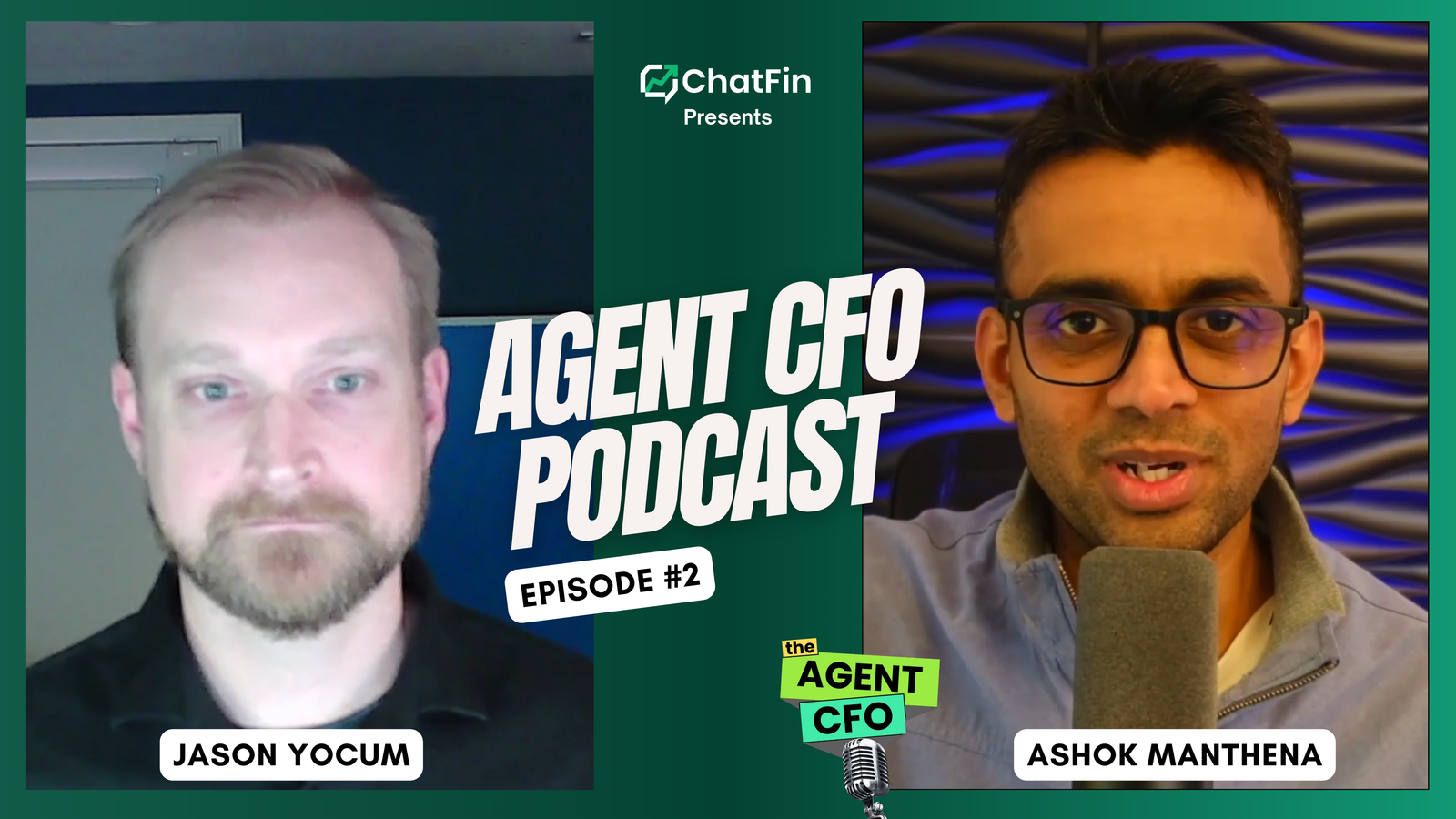
Why CFOs Like AI That Learns Over Time | Jason | Ashok | AgentCFO
Jason Yocum on Rolling Forecasts, Cross-Functional Finance &
Why Modern CFOs Focus on Cash Over Budgets
Episode Summary
In this episode of the Agent CFO podcast, host Ashok Manthena sits down with Jason Yocum, a seasoned finance executive with 20 years of experience spanning Big Four auditing, retail finance at Gap Inc., wine industry operations, and now fractional CFO work at SaaS companies like Foxit Software.
The conversation dives deep into what it really means to be a VP of Finance today—beyond just accounting and FP&A. Jason shares candid insights on retail finance operations, the controversial death of budgeting, why AI hasn't transformed finance yet (but will), and perhaps most importantly, why understanding people matters more than perfecting spreadsheets. This is a masterclass in finance leadership from someone who's lived it across multiple industries.
Follow on Linkedin
Full Conversation
By the way, this podcast is called Agent CFO. And I think the idea is I want people to get confused whether it's Agent 007 or the AI agent. So we're going to talk about all the things under finance, accounting, and everything falls under a CFO, right? These days even operations, some of the operations are now under CFO including AP, tax, treasury, accounting, FP&A.
Welcome Jason, welcome to Agent CFO podcast. It's great to be here. We had a lot of chats with coffee today. We don't have coffee, but we can still chat about finance.
Jason has 20 years of experience in finance. He worked in retail. He worked in wine industry. Now he's working at various other companies. And I'm very glad to have him here today. Welcome Jason.
Great, happy to be here, thank you so much.
So what are you doing these days?
Yeah, so I'm doing a lot of fractional CFO work. My primary is working for a company called Foxit Software. They're a SaaS company, kind of competing with Adobe. But yeah, my previous company was with Vovino, which is the largest wine app in the world, connecting buyers and sellers. And before that, I was with Gap Inc. for about 10 years. And really coming out of the public accounting space, right? Deloitte and Touche, Grand Thornton, when I started my career.
I mean, I know you from GAP. We both worked at GAP for a really long time. Jason, how does retail finance differs from other industries? Is it totally different or are there similarities?
I mean, there's similarities across all industries when it comes to finance. When you're looking at your P&L, your balance sheet, and your cash flow statement. But I would say that when you're talking about retail, you're talking about physical inventory and movement of that physical inventory and capitalizing certain costs and so on and so forth. At the end of the day, you're creating a financial statement that is accurate and under US general accepted accounting principles. So they're both similar, but each industry has its specific accounting guidance that goes with it.
That's right. I think that the understanding of industry is very important. If you're talking about a clothing company, it's not about design or the brand or the manufacturing part of it. It is about supply chain.
How do you manufacture, and you're not even doing it, you're outsourcing it to a different company, how do you design somewhere, send it to this outsourced firm, they actually make it, then how do you ship them very efficiently to the country where you're going to sell and then distribute to each store? And you have these different stores, different brands, how do you distribute all this stuff based on design costs, where they are located. And I think that's where the competitive advantage is for a retail company, even though from outside we only see a brand, right? Did you get that understanding very easily while you were at Gap?
Yeah, no, it's really fascinating when you're talking about finance too. It's kind of min-maxing every little part of the supply chain in order to minimize costs but increase efficiency, right? So you have to do a lot of thought process with the business to understand where can we create efficiencies, not only in cost, but sometimes it's actually more important to increase the cost in order to speed up some part of the supply chain because later on that creates more revenue in for the company at Gap.
Right. You worked as a VP of Finance. What do they usually get wrong when people hear about this job?
Yeah, so I think there's a lot of different types of VPs of finance. Are you focused on just the accounting side or are you focused more on the FP&A side? Sometimes VPs of finance can be acting CFOs. They're reporting right into the CEO and doing presentations to the board of directors. Sometimes they're not.
And I think you said it best earlier when you were talking about how finance has really kind of taken on more and more these days, not just accounting, FP&A, treasury, right? But it's also business intelligence, human resources, right? And what I'd like to think is that we've kind of taken over the back office, so to speak, right? And I think that's where when someone says they're a VP of Finance, you really want to dig in, maybe scratch the surface a little bit more to find out.
Yeah, you can, I mean, it's so general that you can be a controller, you can be an FP&A, or you're even taking care of tax or treasury part of it, right? But it became a very general leadership role as a VP of Finance. And, or even you could be taking care of all the financial systems as well.
Yeah, that's a huge part of it, right? Making sure your ERP system is in place, but also implementing technology, you know, speeding up these days with AI that is allowing us to be more efficient, but you do kind of need to keep your ear to the ground to see what new tools are out there and apply those new tools.
There is, that's the other thing too, right? You talk about VP of Finance, you're also doing system work. Like operational flows and backend office and you get involved with the order management team and the cash applications team and like all these in the sales team. It's like we're connected throughout the entire organization and you're just trying to make that as efficient as possible, right?
And in terms of influence, how influential is your VP of Finance role?
I think they need to be hyper influential, right? They need to be able to communicate with everybody in the organization, right? From top to bottom. They need to be able to present to the all hands and get people who maybe are not financially savvy to understand the importance of their role and how they play into the PNL, right? How they play into the financial performance of the company. So I actually think a VP of finance is the glue that kind of holds the company together in a lot of ways.
We should know every kind of challenge that the business has happened, that's happening to the business and be able to connect those dots. So a good VP of Finance is communicating with all those departmental leaders, but also bringing that up to the board and even other senior leadership like the CEO or the C-level.
And I think a good VP of Finance has that empathy towards the business to help them succeed and not to just focus on compliance rules or not just to focus on the nitpicky details about finance. You know people, they say no to everything, right? They're always trying to cut costs, they're always trying to control stuff, right? And it's like, no, we need to be supportive of our business partners so that they can generate more money and focus on the business. And if you can flip that narrative, you're gonna find that you're gonna be a much more effective VP.
That's right. I think this is a role where, correct me if I'm wrong, you're influential. It's also a leadership role, but at the same time, it has to be hands on. You can't be far away from the process being at that leadership level, because now, since as you said, you're a glue. That means you are expected to perform a few things by yourself.
You have to back up your numbers. You have to have your own reasoning. But at the same time, also be able to be strategic and analytical about the data that you see.
You're absolutely right.
But if you weren't in finance, what do you think you would be doing?
I have a psychology or something. I find people absolutely fascinating, right? And I think that that's the funnest part of the finance for me is getting away from the numbers and getting closer to the people that operate the business, right?
Right. And now with AI, and we all thought 2025 would be a transformational year for finance. It didn't turn out to be. I mean, to be honest, right, we have seen tools, we have seen functionalities, we have seen agents doing operations. But I think in 2024, we expected a big bang, even though even I walk in AI day in and day out.
I expected a big bang kind of impact on our processes. And particularly in finance, I don't think that happened. I think we are just naive to think everything will change in a day or two. But now coming into 2026, I think we'll see this incremental change happening. The pace might pick up, but I think it will still be a slow, more cautious and careful approach that we'll all take an approach towards AI. What do you think?
I think you're right. I think you're right. I think there's a lot of exciting things that AI can do for us and we're excited to see it do for us. I don't know if we've really seen it in a package yet that has been, I mean, for lack of a better word, sexy for the finance folks, right? It's like we know what it can do, but we just haven't seen anybody implement it in the right way. And what's funny is that when you look at industry leaders like Oracle who owns NetSuite,
You look at their NetSuite tool and it's rather lacking in a lot of these areas that you would expect would almost be implemented by now, right? When it comes to AI and supporting, you know, automatic reconciliations, P2P processes, I think it's ironic that these big ERPs, there's a lot of tools that we buy externally from Oracle to kind of sit on top of NetSuite to do the things that NetSuite can't do. And maybe AI will just be one more layer that sits on top of our ERP system.
I'm really excited for the day where we can, I can almost chat with my ERP system. I can chat with my PNL. I can chat with my balance sheet and understand what is causing this flux? What is causing this change year over year or month over month? Where are my problems at, right? Understanding my cashflow, understanding my revenue and my customers, right? To be able to communicate with it and communicate with the data using, you know, language, you know, English language and like an LLM. I think that that's going to be a game changer.
Have you seen Chatfin yet? I'm just kidding. Right. You know, we have been building Chatfin for a while. There is always this AGI goal of having this 100% automated systems that talks to you, but also that can manage everything internally without our human intervention.
As we work on this, actually realized it's pretty difficult to build it, not because of the models. Models are already really smart, but because of the context it needs to make that decision. When you are a VP of finance, you have 20 years of experience that you brought in. Worked in a lot of companies, you work hard, you failed, all that expertise that you bring it in, giving that expertise to AI almost feels impossible at this point of time. And I'm talking about in December, 2025, right? Things could, can change.
So managing that context in a way that can be easily changed. For example, we're talking about a retail industry, totally different context to a manufacturing different context. And then also taking layers that are similar and managing that. That has been a very difficult task and that's probably the answer why if you expect a large companies already in the market to have solved it because still no one knows how to manage this context at that big scale.
When we build Chatfin, this is what we realized, you can't really approach this problem as one big bang rather than you can actually take up multiple pain points and take each pain point and solve them and then you can unify them as you move forward. That seems to be a much more manageable approach, taking AI and finance. And have you seen any other tools in the market right now that you think are very interesting?
Yeah, there's so many tools right now that it's almost overwhelming. So for instance, you're looking at like a procure to pay process, right? And you're trying to streamline that. There's tools like chatfin that are using AI to automate end-to-end procurement, right? So new vendor approval process, purchase orders, approvals, invoices coming in, AI scanning the invoice, booking it into your ERP system, then ultimately even helping you pay that vendor all with a very streamlined processes with the AI kind of in the background and they say that the AI is learning, right? So every new invoice it gets in and how you code it, it continues to learn so that you can touch it less and less as time goes on, right? So that's just one example of one tool, but even drafting accounting memos,
Utilizing the internet, what's already out there, I mean, I was playing around with Gemini even and you know, ChatGPT and others where they can look at the codification, the US GAAP codification to help you draft an accounting memo. Say like, hey, I got this issue, how do I account for it? What guidance is gonna help me get there, right? And you you still have to, it helps you, you still have to read the guidance and make sure it's right, but it guides you there much faster than a simple Google search ever would, right?
That's right. And you remember, you and me, we had this conversation probably a year ago thinking about where AI can be applied and FP&A process. If you take budgeting, long-term planning, how do we do it? For today, let's take an example of budgeting, Such a manual process. You take small company to mid-size company to large company, still very manual process.
I think the only automation probably we have done is having a planning tool and then submitting all the data at a line item level to that and then consolidating it. That's the only automation I think we have done in budgeting. What do you think? I mean, even if we leave AI, can you envision how an automated budgeting process should look like?
The tricky thing is that people are involved. People are involved. Why are people involved? Because they have ideas of what the future is going to be. They have to create the initiatives. So you've got an R&D team who's maybe developing a new product, they got a new initiative. They're gonna roll that out in a certain period of time. And then you've got the sales team that have to go out and sell it. And so you've got kind of this roadmap roughly and you've got all these people involved.
You can collect data from them. You can say, fill out this, you know, Excel file, right? Fill out these numbers. When do you think this is gonna go live? How much revenue do you think that's gonna bring in? The challenge is that they're not finance people. So there needs to be some kind of finance lens, right? That goes through. It's like, well, what's amortized revenue?
It's capturing that human element and capturing that human data, running it through kind of a financial lens and then putting that into a budget and a monthly budget that other people will believe. The board of directors looks at it and goes like, okay, that seems achievable. The CEO says that's achievable, right? Based on what we want to accomplish. And AI I think can get there. But it's taking, it's those meetings, it's those budget meetings. The reason it takes so long is you're having these budget meetings and planning meetings and the finance people are trying to take what everything is said and again, put it into financial terms. So that's gonna be very tricky.
Now where budgeting and AI can meet, I think is baseline run rates, right? Show me the historical data. What do you think is gonna project out the future based on 10 years of data or five years of data and give me some kind of baseline, right, that I can work off of. And I think that can speed up the process quite a bit because finance doesn't have to do as much work to kind of build those out. But that layer, that human layer on top is really tricky to kind of support with AI.
That's right. I think it's the modeling part as well. If we take a line item level, the kind of model or the kind of equation you use to generate numbers for that line item. I'm talking about budgeting or forecasting. That's going to vary from line item to line item. That's going to vary from industry to industry. That's going to vary from department to department.
Because at a company whole, we don't think about how many Excel files we have, right? At some point, we don't even care how people come up with modeling. We just say, what is your output? Just upload it into this consolidated system. But if the system can understand all the modeling, right? All the Excel sheets you have in the company, I think that would become very valuable because now it can generalize and it can also remember all the modeling that needs to be done that goes into a line item. And it can also bring in data from various other industries, how that is done for the specific line item.
And again, now this goes back to the question of how do you manage all this context to get there. If AI can do modeling really well, modeling is not just as come up with an equation with. It remembers, it can generalize it. You actually don't need a planning tool. You can just manage everything in Excel because now you are not doing it. You are not checking every formula. You're just talking about high level assumptions, but the rest of the modeling can be done in Excel by AI.
Yeah, that would be, I think that would be very helpful.
So tell me in terms of your career, you came from big four audits and then you came into these big companies and you worked there, you went into leadership position. What do you think what's one habit you had early in your career that you wish you unlearned very early?
Yeah, you know, if I had to pick one, I think it would be over indexing on perfection over speed. Right? So, you know, in accounting, and that's kind of where I'm bread and butter auditing and accounting, the detail, you need to be exact, right? Like the number of units come in, number of dollars, all exact, right? But the problem is as you get into finance and leadership and FP&A and stuff, the focus on exact models and historical trends and inputs is you gotta be careful. You can go way too deep, way too quickly and create this massive model that is so complex that is based on definitely some good inputs and some realities and get that in the hands of leaders and business partners faster to review that so that you can then tweak it, right?
So you get a lot of junior people, and even myself included, who are kind of like, okay, well, this is gonna be the thing. We're gonna hit this by the end of December, right? And the probability of that occurring, the further out you go, the worse chance you are to hit that thing. So spending too much time trying to perfectionalize your model is not a really good use of your time, necessarily, right?
But isn't accuracy expected from you? It's like a, it's an expected quality.
Right, so we need to know that that stigma exists and tell people that we're not oracles, right? We're only as good as the inputs we're given and that's why ranges come into play a lot. And actually the best thing that I've ever learned in my career is not only to build the model, and instead of telling, asking for leadership's input on that model, so you build the model so that you can tweak it, right? As you're presenting it to leadership and say, well, what do you think? If we change this number, this percentage point by like 10 basis points, it does this. And they go, okay, well, yeah, we'll crank that up to 20 basis points. What happens then? And you get them involved in that forecasting, right? And now whatever does occur is not just on the FP&A team, now it's on the leadership team and the FP&A team. So you make it a us forecast and not just a FP&A forecast.
Yeah, that's also spreading out our risk to more people.
Yeah, right. But also getting more input. You know, again, we are seen as somehow magical oracles, right? And like, I have seen and worked at companies where it's, FP&A is, you know, performance is dependent upon the variance from which actuals occur. Now, FPNA, it's very important to help plan, predict, strategize, but I can guarantee you in 12 months, something in that model that you didn't predict is gonna happen, right? Something is gonna happen—a merger, new competitive person, a contract falls through, a new surprise good contract comes in. Life happens, right? And that's why I actually prefer monthly forecasting cycles than big, expansive budget models and things like that. I just don't think that those are as useful.
Just correct me if I'm wrong, but I feel like as the company grows big and the corp FP&A, particularly corp FP&As, they are far from operational finance. Because if you think about it really big, let's say we're talking about manufacturing company, right? If you're in a corp FP&A, how much do you think a corp FP&A person is aware of what happens in a factory and what is really impacting the operational part of it.
So the way GAP actually did this was we had FP&A people down throughout the chain. So you had like little regional FP&A people who would be closer to the business who would then feed that up to the next level of FP&A people who would then feed that up to the next level. And what's interesting is that as you move up, the materiality of your forecast changes quite a bit, right? So, you know, if you're down at the regional level, you're like, man, $1,000 is kind of a big deal to us. But you go to the corporate level and it's like, maybe it's 5 million is the threshold before they even start to care, right? And so I think they did a really good job. And I think Gap Inc is probably one of the best when it comes to forecasting and planning and budgeting at that corporate level. They really, really had a good system. And that feeding of information upwards, I think, allowed leadership to trust those numbers with more certainty than I think other companies who are just like, we've got one FP&A team, and that's it.
That makes sense. When we're talking about the processes, you have seen it in really large companies to mid companies, right? What do you think that we are doing right now, which is an outdated process, which will go away in, let's say, next two, three years? What is one finance process?
Wow, there's probably a lot. There's one I hope goes away, which is just the whole procure to pay cycle, man. It is, you know, I'm surprised by the amount of companies that I talk to or work with or other CFOs where they still have like an AP team. They still have a team where they're literally getting invoices emailed to them. And then they're going to the internal business partner, hey, is this the right amount? Can you stamp this PDF with your approval? Right? And then they manually put it into the ERP system, and then there's another approval, and then there's a payment later on, and it's just like this wildly clunky process, and in this day and age, it just shouldn't exist.
You should have an accounting team that maybe spends a couple of hours a week on pushing out payments versus two or three AP, dedicated accounts payable accountants, which is wild. We don't need that anymore. That's antiquated, that's gone. But I'm surprised by how it still exists. And maybe that's for your point, when you talk about AI in the future, it's like, wow, if we're not even adopting enhanced procure to pay tools, as in a finance kind of group, it's like, man, AI, adopting AI feels far away for some. The first process that I think will disappear is just the whole accounts payable process. There is such a better way to run all of this.
That's right. One of the interesting things is you know ChatFin can query, can reconcile, can process documents and it can forecast. But one of the very surprising feature that our users really love is document processing. I never imagined it. I always worked in large companies so I was never very close to that document processing part of it. But what users really love is, I have these contracts that are all in different structures. I've seen contracts where there is an Excel table that is copy pasted in there with merge cells. So it's just a nightmare to even standardize contracts. How do you even get extract things from there, right? We said, yeah, Chatfin can do it. Chatfin has much better way rather than just we'll see how it'll do multiple things and we'll do it. And people love it. They're like, it can read the contract? Yeah, we say yes. Can it read a remittance advice? Yes. Invoice, yes. So that's once, which used to be a very manual process to actually not just reading a contract or reading an invoice, but what do you do after that? Right? If you can combine all this, that becomes very powerful. So hopefully in the next two, three years, no one has to read documents manually. There will be systems that can do it pretty good, unless it's kind of like a doctor's handwriting.
Yeah, I know. I love that. Take the small problems that we have and fix it with AI. And then you're fixing those small problems and that'll layer up finally to get to the bigger kind of problems. But if AI can just solve those small things that just take so much time and just speed that up, then everybody's gonna see the value of AI and start adopting it more and more rather than expecting it's going to do everything that the ERP system can do. It's going to do everything that the budget can do.
And coming back to the outdated finance process, what is that outdated finance process you think needs to be taken away?
Okay, controversial maybe a little bit. I'm gonna go out here. I'm gonna say budgeting. Budgeting should go away. Just look setting targets is great, right? We all need targets. But the truth with budgets is that it becomes outdated come February, right? You spend all this time in December setting up these budgets and everybody and their mother is inputting into this thing and you build it out by month and blah, blah, and then come February, it's already messed up.
So instead of hyper focusing on these budgets, I would rather the business focus on forecasting, like kind of keeping that forecast alive, but also spending more time on the unit economics, the margins, the ROI from your marketing expense, your R&D investment and what you're getting out of that, right? And really focus the energy towards even cashflow, it depends on the level of the company or where it's at and what the size is, but understanding your cashflow and your runway and trying to forecast and manage that better. There's got to be a better way, right? I think there is. I think there is.
I'm going to make you very popular. I'm going to make the world like Jason thinks budgeting should die. People will love you or people will hate you.
That's it, yeah.
And now, just talking about your career, right? If you're starting your finance career today, what do you think you would do differently? A little differently.
You know, I think I wished that I understood the importance of people earlier on, right? And I know that's kind of been a theme throughout everything we've talked about here today, but you know, like early in my career as an auditor, I actually found some rather large errors in a financial statement of a company, right? And boy was I excited, right? I found problems, right? And I went straight away to the controller of this company and I was like, look, I found this problem, like it's $10 million and blah, blah. And I expected, you know, an applause. I expected just, oh, a big thank you, you found this thing, let's fix it, right? But the exact opposite happened, he got angry, right? He was not happy with this finding, because, you know, I think because of, you know, from an ego standpoint, it was kind of on him. It was kind of his fault and I didn't stop to think about how he would receive this information.
Nor did I take the time to think about how to present that information in a way that maybe he could either save face or you know come along with that journey with me. Right? And so I actually tend to be very lucky that I learned this very early on. Right? That people may not always want to hear what you have to say from a finance perspective. And a lot of the times they don't. A lot of the times you actually bring bad news, right, as a finance individual. And shooting the messenger is a very common problem. So how do you flip that? How do you make sure that you approach this individual that you're talking to appropriately based on what you know about that person based on where they're at what their goals are all of that and having that empathy towards them has really shaped my career, my leadership style.
Because you can deliver those tough messages in a way that they do receive it well and then maybe you know applaud or even you give away the reward of it or the feeling of gratification of you found something instead I would have been like, hey, controller, you found this, right? And switch the narrative, right? And make sure that he felt like he was the one finding the error and telling his leadership team and not the auditors, right? And that would have built much better client satisfaction, right? So I think overall that's the one career kind of mistake I made, but learned early on. And that's changed everything since.
It's in the ideal world, it shouldn't even matter, right? The good news or the bad news, that's the only thing that matters. It's not about how it is delivered. But we don't live in ideal world. And there are a lot of people might think, right? I can be straightforward and I will get things done. And that's it. I don't want to participate in it. But since we live in this maze of humans and emotions and this works at various levels, it works at a boardroom level, it works at a C-suite level and it works at an analyst level and someone who knows how to manage this and again you can just keep it aside, think as politics, right? But that's a very over simplistic way of looking at the human dynamics.
Thank you, Jason. Thank you so much for spending time with us. Thank you for sharing all your insights on retail finance, AI, budgeting, and leadership. It's been a very enlightening conversation and I really hope people will find it useful. Thank you for spending time with us.
Thank you so much, Ashok. I really appreciate it.
More Episodes

The Modern CFO: Navigating AI, Data, and the Future of Finance
Join Ashok Manthena and Caitlin Haberberger as they explore the evolving CFO role, AI adoption in finance, and strategic leadership in the modern enterprise.
Stay Updated
Subscribe to our channels for the latest episodes and insights on AI in finance.
Your AI Journey Starts Here
Transform your finance operations with intelligent AI agents. Book a personalized demo and discover how ChatFin can automate your workflows.
Book Your Demo
Fill out the form and we'll be in touch within 24 hours