
AI for Tax Operations: How Finance Teams Are Automating Tax Provision and Compliance in 2026
Tax provision takes days. Compliance monitoring is perpetually behind. AI agents are changing both — pulling trial balance data automatically, calculating deferred tax positions, and flagging compliance gaps in real time. Here is the 2026 guide.
- Cycle Time Reduction: AI-assisted tax provision processes run 30 to 50% faster than manual processes, compressing a 5 to 7 day quarterly provision cycle to 2 to 4 days.
- Audit Risk Reduction: Finance teams using AI for tax data collection and reconciliation report 60% fewer audit adjustments related to provision errors, driven by cleaner data pulls and automated reconciliation to the GL.
- Compliance Coverage: AI agents monitor 1099 vendor classification, sales tax rates by jurisdiction, VAT reconciliation, and transfer pricing documentation simultaneously — coverage that manual processes rarely achieve comprehensively.
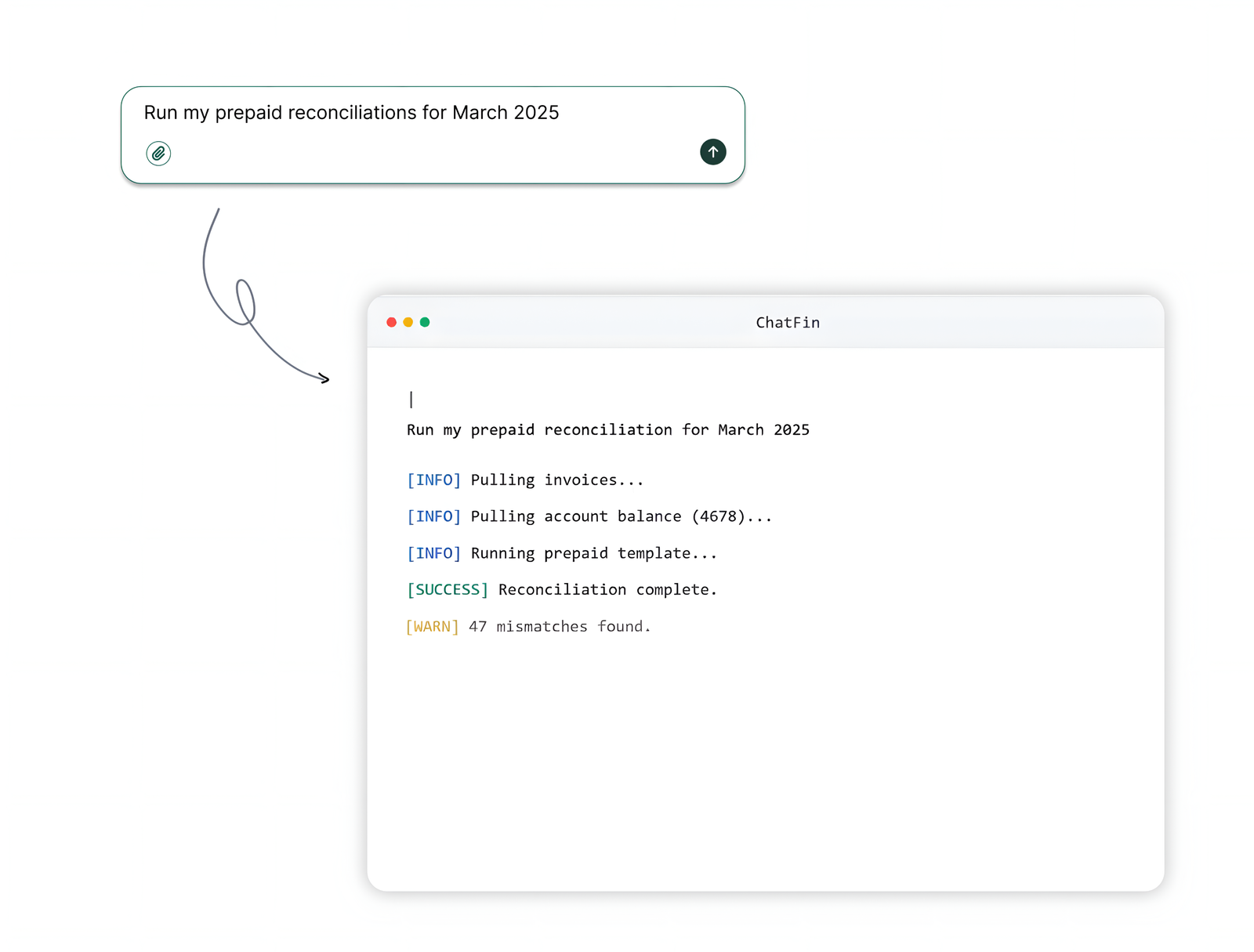
- ERP Integration: ChatFin pulls trial balance and transaction data directly from NetSuite, SAP B1, SAP, Oracle, and Dynamics 365 to feed tax provision calculations and compliance workflows via native API.
- Tools Ecosystem: ChatFin handles the ERP data layer; Thomson Reuters ONESOURCE, Vertex, and Avalara handle the tax calculation and filing layers. The combination covers the full tax automation stack for mid-market companies.
- Tax Director Role: AI automates the data collection and calculation steps. Tax judgment — uncertain tax positions, valuation allowances, strategic transfer pricing decisions — remains with qualified professionals.
Tax operations is one of the most data-intensive functions in the CFO office and one of the least automated. The quarterly tax provision under ASC 740 requires pulling a trial balance, identifying every temporary and permanent book-to-tax difference, calculating current and deferred tax components at the correct rates, generating journal entries, and reconciling the provision balance to the general ledger. This process involves multiple people, multiple systems, and significant judgment — and it runs under time pressure every quarter.
AI for tax operations does not replace the judgment. It eliminates the manual data collection, calculation scaffolding, and reconciliation steps that consume most of the time. A tax provision process that previously took a team of two 5 to 7 business days can run in 2 to 4 days when the data pull and calculation steps are automated. The tax professional reviews the AI-generated output, validates the positions, and approves.
This guide covers how AI tax provision automation works, which compliance tasks AI handles best, and how tools like ChatFin, Thomson Reuters ONESOURCE, Vertex, and Avalara fit together to cover the full tax automation stack for mid-market finance teams in 2026.
Why Is Tax Provision (ASC 740) Still So Manual and What Does AI Automate?
The ASC 740 provision process is manual for a structural reason: it requires combining book income from the ERP with tax-basis adjustments that live in separate workpapers, applying jurisdiction-specific rates, tracking deferred tax asset and liability balances across periods, and reconciling everything back to the GL. No single system contains all the inputs.
AI tax provision automation addresses each step of the process systematically:
| Provision Step | Manual Process | AI-Automated Process | Time Saving |
|---|---|---|---|
| Trial Balance Pull | Manual export from ERP, reformatting for tax model | ChatFin API pull directly to provision model, no export needed | 4 – 8 hrs |
| Temporary Difference Identification | Manual comparison of book and tax schedules line by line | AI compares book and tax bases systematically, flags differences above threshold | 3 – 6 hrs |
| Deferred Tax Calculation | Manual spreadsheet applying rates to each temporary difference | Automated calculation using configurable rate table; AI applies enacted rates by jurisdiction | 2 – 4 hrs |
| GL Reconciliation | Manual tie-out of provision balance to deferred tax accounts in GL | Automated reconciliation with variance flagging | 2 – 4 hrs |
| Journal Entry Generation | Manual entry or template-based workpaper | AI generates draft JE for tax provision, subject to approval workflow | 1 – 2 hrs |
The steps that remain manual — and should remain manual — are the tax judgment steps: assessing uncertain tax positions (ASC 740-10), determining the need for valuation allowances on deferred tax assets, and making strategic decisions about deferred tax positions. These require qualified tax professional judgment that AI does not replicate.
"AI provision automation does not make tax simpler. It makes the data collection and calculation phases automatic, so the tax team can focus time on the judgment calls that actually require expertise."
Which Tax Compliance Tasks Can AI Agents Automate in 2026?
Beyond provision, AI tax agents address a range of compliance tasks that traditionally required significant manual effort:
How Does the AI Tax Operations Tool Stack Fit Together for Mid-Market Companies?
No single tool covers the entire tax operations workflow. The mid-market tax automation stack in 2026 is built from three layers:
Layer 1 — ERP Data (ChatFin): ChatFin connects to NetSuite, SAP B1, SAP, Oracle, Dynamics 365, Sage, JD Edwards, and Acumatica via native API. It extracts trial balance data, transaction details by vendor and customer, intercompany transaction records, and GL account balances in real time. This is the data feed that provision calculations and compliance reconciliations run on. Clean, live ERP data is the foundation of accurate tax automation.
Layer 2 — Tax Calculation (Thomson Reuters ONESOURCE / Vertex / Avalara): ONESOURCE handles income tax provision calculations (ASC 740 and IFRS) with full return-to-provision capability and deep multi-jurisdiction support. Vertex handles sales and use tax rate calculation and filing for companies with multi-state nexus. Avalara offers a cloud-native alternative to Vertex with stronger SaaS and e-commerce coverage. The calculation layer consumes the ERP data that ChatFin provides.
Layer 3 — Compliance Monitoring (AI Agents): ChatFin's compliance agent handles real-time monitoring: flagging 1099 classification gaps, reconciling sales tax collected vs due, alerting on rate changes, and compiling VAT return data. This is the layer that keeps compliance current between filing deadlines, rather than discovering gaps when the filing is due.
What Quantified Impact Does AI Tax Automation Produce?
| Metric | Before AI | After AI | Source |
|---|---|---|---|
| Quarterly provision cycle time | 5 – 7 business days | 2 – 4 business days | Deloitte Tax Technology Survey, 2025 |
| Provision audit adjustments per year | 3 – 6 per year (average) | 1 – 2 per year | Thomson Reuters Tax Benchmark, 2025 |
| 1099 misclassification rate | 8 – 12% of vendor population | 2 – 4% | KPMG Tax Operations Report, 2025 |
| Sales tax reconciliation time | 2 – 3 days per filing period | 4 – 8 hours | Vertex Tax Automation Report, 2025 |
| Tax team hours on data collection | 40 – 60% of provision hours | 5 – 10% | Internal ChatFin deployment data, 2025 |
The most significant impact for CFOs is not the time saving — it is the audit risk reduction. Provision errors caught by auditors result in restatements, adjustments to deferred tax balances, and in some cases penalty exposure. AI-assisted data collection and reconciliation eliminates the category of errors caused by manual data pull mistakes, stale trial balance data, and miscalculated temporary differences. What remains are the judgment errors, which require better tax analysis — not better automation.
Frequently Asked Questions
How is AI used for tax provision (ASC 740) automation?
What compliance tasks can AI tax agents automate?
Which AI tools are used for tax provision and compliance?
How much does AI reduce tax provision cycle time?
How does AI handle tax compliance monitoring in real time?
Tax Operations with AI Is a Strategic Advantage, Not Just a Compliance Upgrade
The CFOs who approach tax automation as a compliance cost reduction will capture the efficiency benefits. The ones who approach it as a strategic capability will capture something more valuable: a tax function that is always current, always reconciled, and capable of providing forward-looking tax analysis rather than backward-looking reconciliation.
When the provision process runs in 2 days instead of 7, and when compliance monitoring is continuous rather than periodic, the tax team has time to analyze effective tax rate optimization, evaluate tax planning opportunities, and contribute to M&A diligence and capital structure decisions. That is the strategic return on tax AI investment.
By 2027, the mid-market companies with the best tax outcomes will not be the ones with the largest tax teams. They will be the ones with the most automated data pipelines feeding their tax calculations and the most capable professionals applying judgment to the output.