
AI Data Query: Ask Your Financial Data Anything

The information already exists in your systems, getting it out is the problem. AI Data Query lets anyone in finance ask a question in plain English and get a sourced, explained answer in seconds, without SQL, tickets or waiting on the data team.
- AI Data Query turns plain-English questions into sourced answers from your ERP and warehouse, no SQL required.
- Finance teams spend 35 to 40 percent of their time on data extraction; this collapses that to seconds.
- It maps questions to a governed semantic layer so metric definitions stay consistent and auditable.
- It investigates, not just retrieves explaining why margin fell, not only that it fell.
- ChatFin understands finance context (periods, GL, entities), so answers are finance-grade, not generic BI output.
In most finance teams, the information already exists in the systems. The problem is getting it out. A simple question what's our cash position next quarter, why did gross margin fall, which customers drive our concentration risk turns into a ticket to FP&A, a hand-written SQL query, an export, an Excel model, and an answer that lands three days after the decision was made.
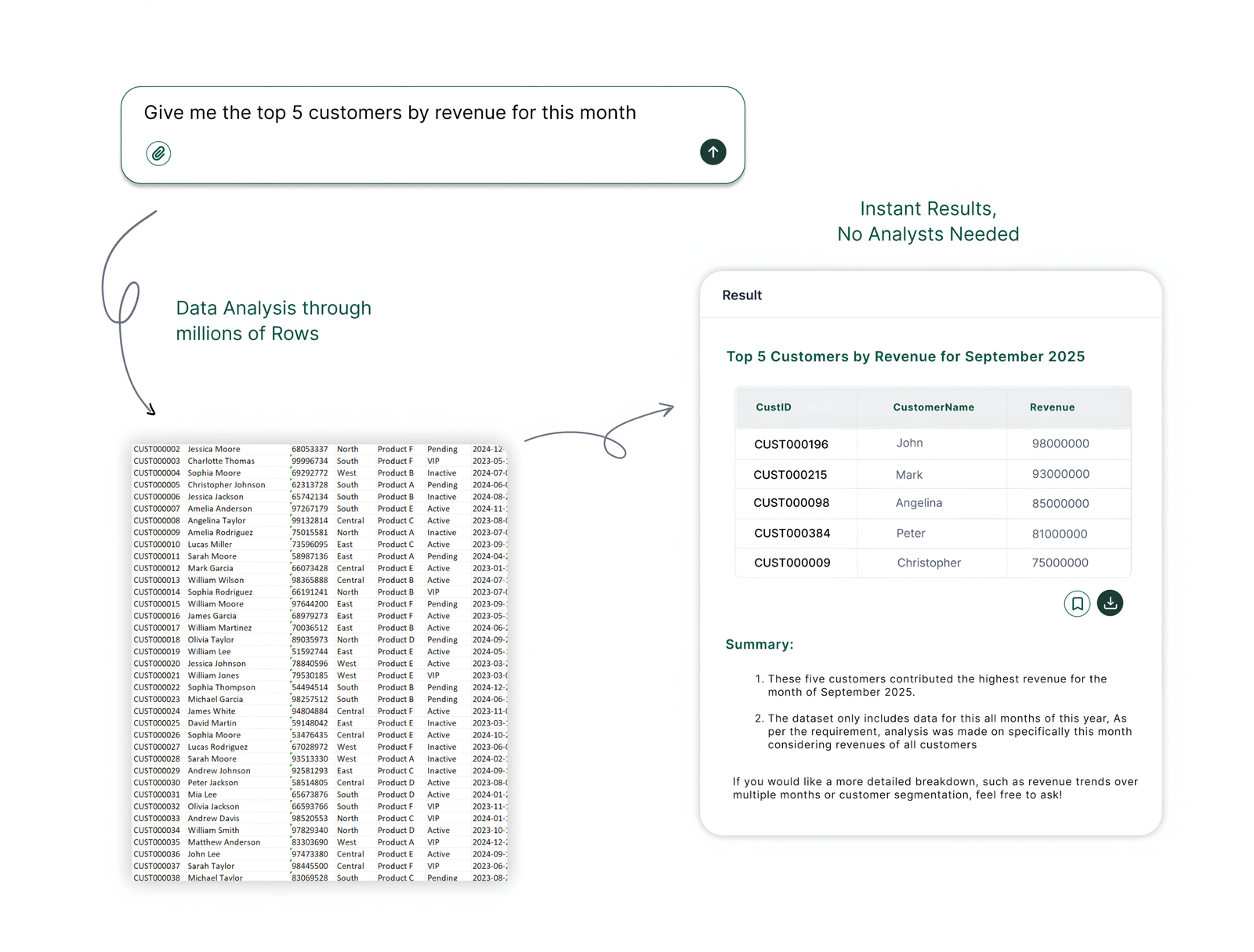
AI Data Query removes that gap. Instead of learning SQL or waiting on the data team, anyone in finance asks a question in plain English and gets a sourced, explained answer in seconds. ChatFin's AI Data Query connects directly to your ERP and data warehouse, understands finance context, and turns questions into answers without the ticket, the export or the wait.
Gartner research finds finance teams spend 35 to 40 percent of their time on data extraction and preparation before analysis even begins, and fewer than 30 percent of business users could ever run their own analyses in traditional BI tools. Gartner now expects more than half of enterprise analytics queries to be generated by natural language rather than built by analysts by the end of 2026.

What Is AI Data Query?
AI Data Query is the ability to ask questions about your financial data in everyday language and get answers directly no SQL, no dashboard-building, no analyst in the loop. Under the hood, natural-language processing interprets the intent of your question, maps it to the right datasets and metric definitions, generates the underlying query, runs it against your live data, and returns a clear answer as a number, table, chart or narrative. The best systems are agentic: they hold context across a conversation, ask clarifying questions, and explain how they arrived at the answer.
The Data Access Problem in Finance
Traditional analytics forces a choice between two bad options. Dashboards answer only the questions someone anticipated in advance, so any new angle means a ticket and a wait. SQL and BI tools answer anything but require technical skill most of the business doesn't have. The result is a bottleneck: the person with the question can't get the answer, and the person who can get the answer is backlogged. By the time the report arrives, the decision has already been made on gut feel.
Questions that should take seconds take days. The information exists in the systems extracting, analyzing and communicating it is what costs the time.
How AI Data Query Works
A production-grade finance query system moves through four steps every time you ask a question:
Because the system learns from usage, its understanding of your business terminology and its answer quality improve continuously the more the team asks, the sharper it gets.

What Finance Teams Ask AI Data Query
Beyond Answers: Investigation, Not Just Retrieval
The real leap is from retrieval to reasoning. Ask a dashboard why margin fell and it can't answer it only shows that it fell. Ask an AI Data Query agent and it investigates: it decomposes the change into volume, price, mix and cost effects, checks related transactions, and returns an explanation rather than a chart. That shift from what happened to why it happened, and what to do next is what turns data access into decision support.
Benefits of AI Data Query
Implementation Roadmap
Why ChatFin for AI Data Query
General-purpose text-to-SQL tools can write a query, but finance needs more than syntax. ChatFin is built for finance context: it understands accounting periods, GL structure and entity hierarchy, so answers are finance-grade rather than generic BI output. It integrates directly with your ERP and data warehouse, keeps a governed semantic layer so definitions stay consistent, shows its reasoning so numbers are auditable, and connects the query layer to the rest of the finance function so an answer can flow straight into a report, a forecast or a workflow.
Frequently Asked Questions
Do I need to know SQL to use AI Data Query?
No. That's the point. You ask in plain English and the system generates and runs the query for you, then explains the result. It's designed for non-technical finance and business users.
How is this different from a dashboard?
Dashboards are great for monitoring predefined KPIs but can't answer new, ad-hoc questions without rebuilding. AI Data Query handles the on-demand, exploratory questions dashboards can't, and it explains the answer rather than just displaying a number.
Can I trust the answers?
A governed semantic layer keeps metric definitions consistent, and ChatFin shows the reasoning and data behind each answer so finance can verify it. Accuracy also improves over time as the system learns your terminology and from user corrections.
What can it connect to?
ChatFin connects directly to ERP systems and data warehouses, and can pull in secondary sources like CRM and billing to answer cross-system questions from a single conversation.
Turn Every Question Into an Instant Answer
AI Data Query ends the ticket-and-wait cycle that defines finance data access today. Instead of extracting, preparing and modeling data before analysis can even start, your whole team simply asks and gets sourced, explained answers in seconds while analysts are freed for the strategic work only they can do.
ChatFin's AI Data Query connects to your ERP and warehouse, understands finance context, and turns plain-English questions into trusted answers, so the answer arrives before the decision, not after it.