
AI Agent (Finance): Definition & Implementation Guide

An AI agent in finance is an autonomous system that perceives financial data, decides on actions within defined boundaries, executes across systems, and learns from outcomes — going well beyond scripted automation. This guide covers the definition, architecture, agent types, benefits, and governance.
- AI agents in finance operate autonomously — perceiving data, deciding, executing, and learning without step-by-step human scripting.
- They differ from RPA: agents adapt to changing conditions and handle exceptions rather than following fixed rules.
- Core architecture: perception systems, a decision engine, an action executor, and a learning module.
- Agents specialize by domain — accounting, FP&A, treasury — while collaborating as a multi-agent system.
- Successful deployment needs clear decision boundaries, audit trails, security protocols, and performance metrics.
AI agents in finance represent autonomous artificial-intelligence systems designed for financial operations, capable of independent decision-making within governed boundaries. Unlike simple automation that follows predefined scripts, agents perceive their environment, reason about options, act across financial systems, and improve from experience.
This shift — from rules to reasoning — is what separates an agent from a macro or a bot.
Core Capabilities
Understanding AI Agents in Finance
AI agents are a step beyond traditional automation. Where an RPA bot follows a fixed script and breaks when the input changes, an agent adapts to changing conditions, learns from experience, and reasons about the best action given context. That makes agents suited to the messy, exception-heavy reality of finance operations.
Agent Architecture Components
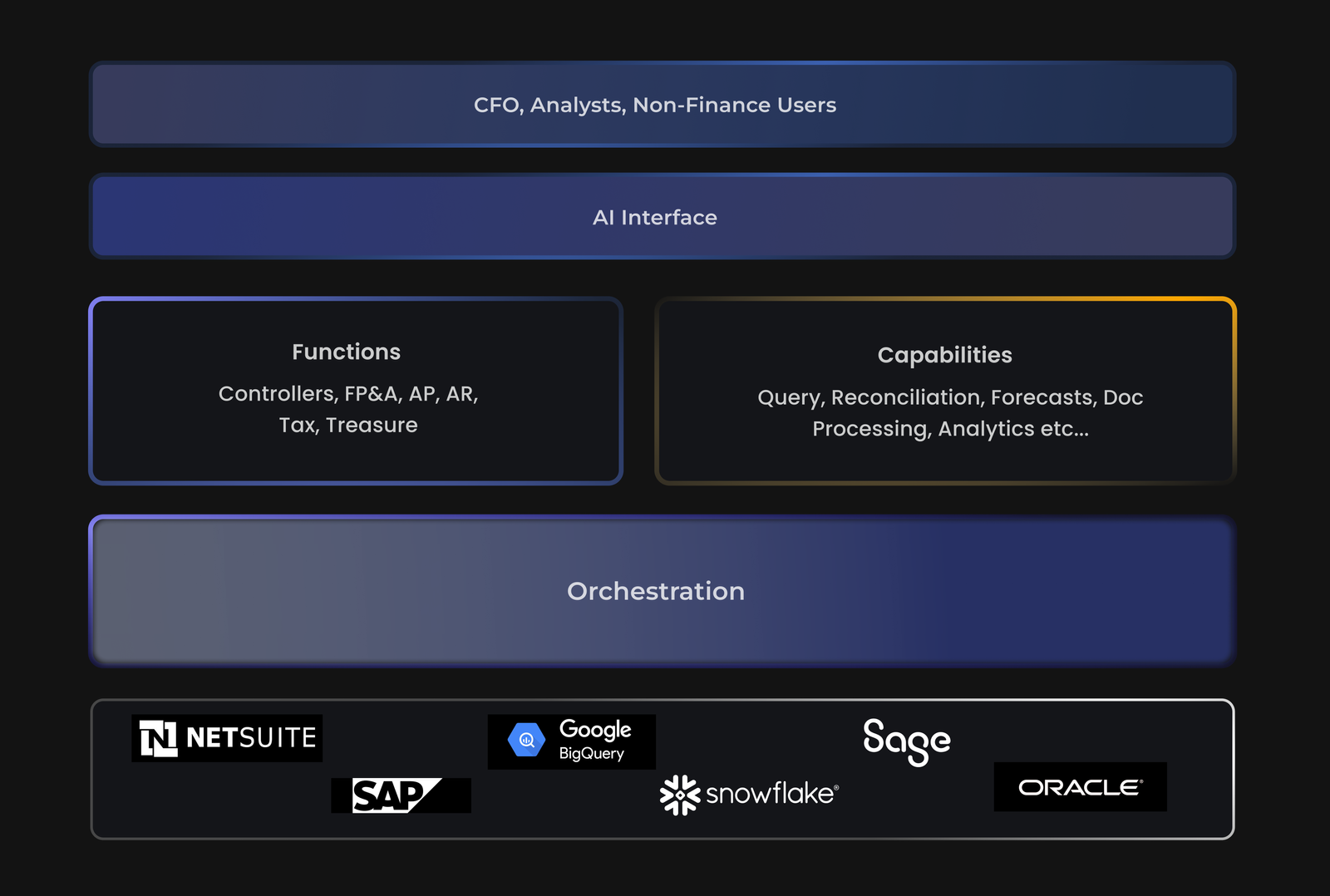
ChatFin's Advanced AI Agent Platform
ChatFin's platform delivers autonomous finance agents that combine cutting-edge AI with deep finance domain knowledge. The agents handle complex scenarios — from multi-entity consolidation to sophisticated variance analysis — while learning and adapting to each organization's chart of accounts and policies.
ChatFin's AI agents handle the majority of routine finance tasks autonomously while flagging the genuinely complex cases for human review — machines do the moving, humans do the meaning.
Types of Finance AI Agents
Agents can be specialized for functional areas, each bringing domain-specific expertise while collaborating with the others.
Accounting AI Agents
FP&A AI Agents
Treasury AI Agents
Benefits and Transformational Impact
Operational excellence
Strategic advantages
Implementation and Governance
Successful deployment requires careful planning, a robust governance framework, and clear guidelines for human-AI collaboration.
Implementation strategy
Governance framework
Governance starts with what people already use
Before a company deploys its first sanctioned finance agent, staff are usually using personal AI tools on finance data already.
The AgentCFO podcast conversations flagged that unsanctioned AI use is already happening inside companies, and that involving IT and governance early is how it becomes safe.
Start governance with an inventory of the AI tools already in use, then set rules for data access, approvals and logging for the agents you add.
Ready to Deploy AI Agents in Finance?
AI agents are the next frontier in finance automation — moving beyond task automation to intelligent, autonomous systems that make complex decisions and improve over time. Organizations that deploy them gain faster processing, higher accuracy, and the ability to focus human talent on strategy.
ChatFin provides production-ready finance agents with the governance, audit trails, and security enterprises require — deployed on your existing ERP.