
Why Traditional Spreadsheet Forecasting Is Becoming Obsolete in 2026
McKinsey data shows 44% of CFOs now use generative AI for 5 or more use cases, up from just 7% a year ago. Most finance teams are struggling to keep pace.
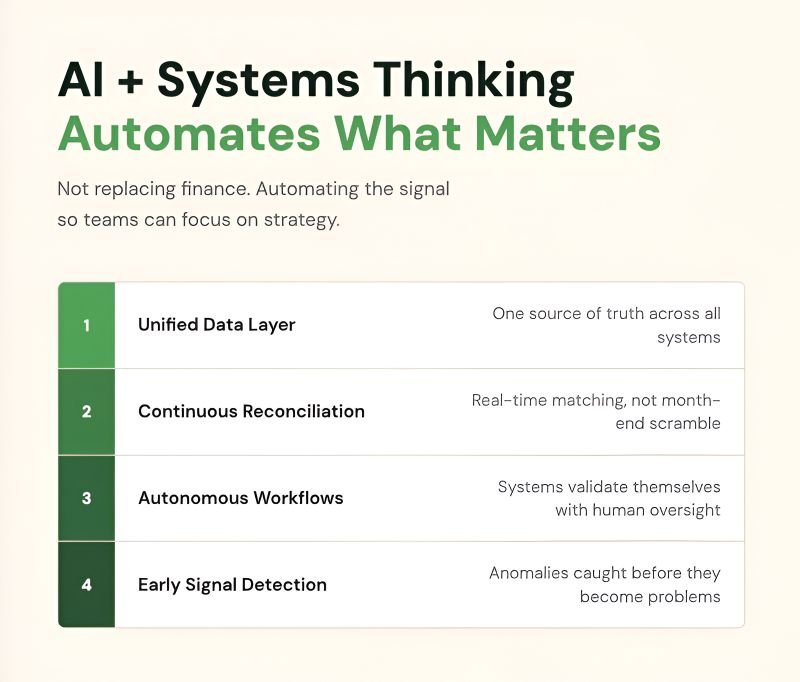
- Business Impact Organizations deploying these solutions are seeing measurable improvements in speed, accuracy, and cost efficiency.
- Data Foundation Success requires clean data and disciplined governance as the foundation for automation and AI.
- Change Management Technology is only half the equation. Process redesign and organizational alignment determine success.
- Competitive Advantage Finance teams that move now are building capabilities that competitors will spend years trying to replicate.
- Speed of Execution The organizations winning are not using better tools. They are executing faster and learning quicker.
The speed of adoption is outpacing capability in most organizations. What CFOs and finance teams are learning is that AI in FP&A is not a tool you layer on top of existing processes. It forces redesign of how forecasting actually happens.
44% of CFOs Are Already Past Pilot
McKinsey's 2025 State of AI in Finance found that 44% of CFOs are using generative AI for five or more use cases, up from just 7% in 2024. The adoption is happening. The challenge is execution. Most organizations deploying AI in FP&A are discovering that the software is not the constraint. Forecast accuracy and organizational alignment are.
Leading finance teams are treating this as a capability rebuild, not a software deployment. They are retraining planners on how to set assumptions differently, using AI to test scenarios rather than to replace judgment. The teams that are winning are treating AI as a forecast acceleration tool, not a replacement for strategic thinking.
From Annual Plans to Rolling Forecasts
Traditional FP&A locked finance into annual cycles. New AI-powered systems are enabling rolling forecasts that update monthly, weekly, or even daily depending on business cadence. The benefit is not just speed. It is accuracy. When you forecast more frequently and feed actual results back into assumptions, variance shrinks.

The Real Bottleneck: Change Management
Finance teams that have moved fastest on FP&A AI are not moving fastest because they have better tools. They are moving fastest because they redesigned the role. Planners are no longer spreadsheet custodians. They are scenario architects and assumption owners. That is a fundamental career reorientation for people who have spent a decade in detailed line-by-line planning.
The organizations struggling are the ones trying to bolt AI onto existing 12-month cycles and spreadsheet-driven processes. That approach does not work. AI in FP&A requires you to answer a hard question first: what is forecasting for? Once you answer that, the AI deployment becomes clear. Until you do, you are just spinning up another system that will sit next to your spreadsheets.
"The organizations winning at FP&A AI are the ones that stopped trying to automate 1990s processes and redesigned the entire function." - McKinsey AI in Finance, 2025
What Winning FP&A Teams Do Differently
Organizations that have successfully deployed AI in FP&A share three patterns: they created a single source of truth for assumptions, they reduced the number of moving parts in the planning system, and they invested heavily in change management before touching the software.
The finance teams that will set the benchmarks in 2026 are already making bets on how FP&A will work two years from now. They are not waiting for the perfect tool. They are experimenting with small teams, learning what works, and scaling the winners. The speed of that learning cycle is now the competitive advantage.
FP&A Is Being Rewritten
AI in FP&A is moving from a discussion about tools to a discussion about fundamentals: what are we forecasting, why, and for whom? Organizations that answer those questions first will redefine what FP&A does in their companies. Everyone else will be updating spreadsheets.
The finance leaders making moves now are not racing against adoption curves. They are racing against the teams next to them. By the time AI in FP&A becomes table stakes, the gap between leaders and followers will be irreversible.
The ChatFin Advantage: Enterprise Finance Automation Platform
ChatFin is a finance AI super-agent platform that runs directly inside your ERP - NetSuite, SAP, Oracle, or Acumatica. Unlike disconnected point solutions that create more integration work, ChatFin connects AP, AR, reconciliation, forecasting, and compliance in a single autonomous system. With 100+ pre-built finance agents, ChatFin teams deploy agentic automation in weeks, not months. The platform learns your workflows, handles exceptions intelligently, and surfaces only true anomalies for human review.
Organizations deploying ChatFin report measurable results: 40-60% reduction in close cycle time, 80%+ automation rates on exception handling, and finance teams freed from tactical work to focus on strategic priorities. ChatFin does not replace finance judgment. It eliminates the mechanical work that masks it.
Read more: The Finance AI Stack 2026: Every Tool CFOs Are Using Across Close, AP, AR, FP&A and Reporting
Additional resource: Treasury AI: How CFOs Are Using AI Agents for Cash Flow Forecasting in 2026