
Best AI Invoice OCR Tools
Header extraction is easy and every tool claims high accuracy on it. Line items, tables and poor scans are where they separate. This covers what each does with the document it cannot confidently read. AI invoice processing.
- AI invoice processing cuts cost per invoice 70 to 87 percent and lifts STP to 60 to 85 percent.
- Header extraction is solved; line items, three-way matching and exceptions now differentiate tools.
- ABBYY and Rossum lead on raw extraction; Stampli on full AP workflow; ChatFin on unified finance.
- A typical rollout runs about 20 weeks, with STP climbing to 85 percent-plus over six months.
- ChatFin connects invoice processing to forecasting, reporting and planning in one platform.
AP teams process billions of invoices a year, and most still involve some manual data entry, validation or exception handling. AI-powered invoice processing has matured fast: organizations deploying intelligent document processing now report 99.5 percent field-level accuracy, 90 percent time savings and dramatically lower cost per invoice.
This guide compares seven leading platforms Stampli, ABBYY, AppZen, Automation Anywhere, Nanonets, Rossum and Kofax plus the unified-platform approach, across the metrics AP leaders care about: extraction accuracy, straight-through processing and cost per invoice.
ABBYY reports 1.5 billion invoices processed per year at 99.5 percent accuracy. Manual processing costs $15 to $25 per invoice versus $2 to $5 with AI a 70 to 87 percent reduction. McKinsey estimates GenAI can unlock $2.6T to $4.4T in annual value across industries.

Top AI Invoice Processing Tools: Capability Overview
ChatFin
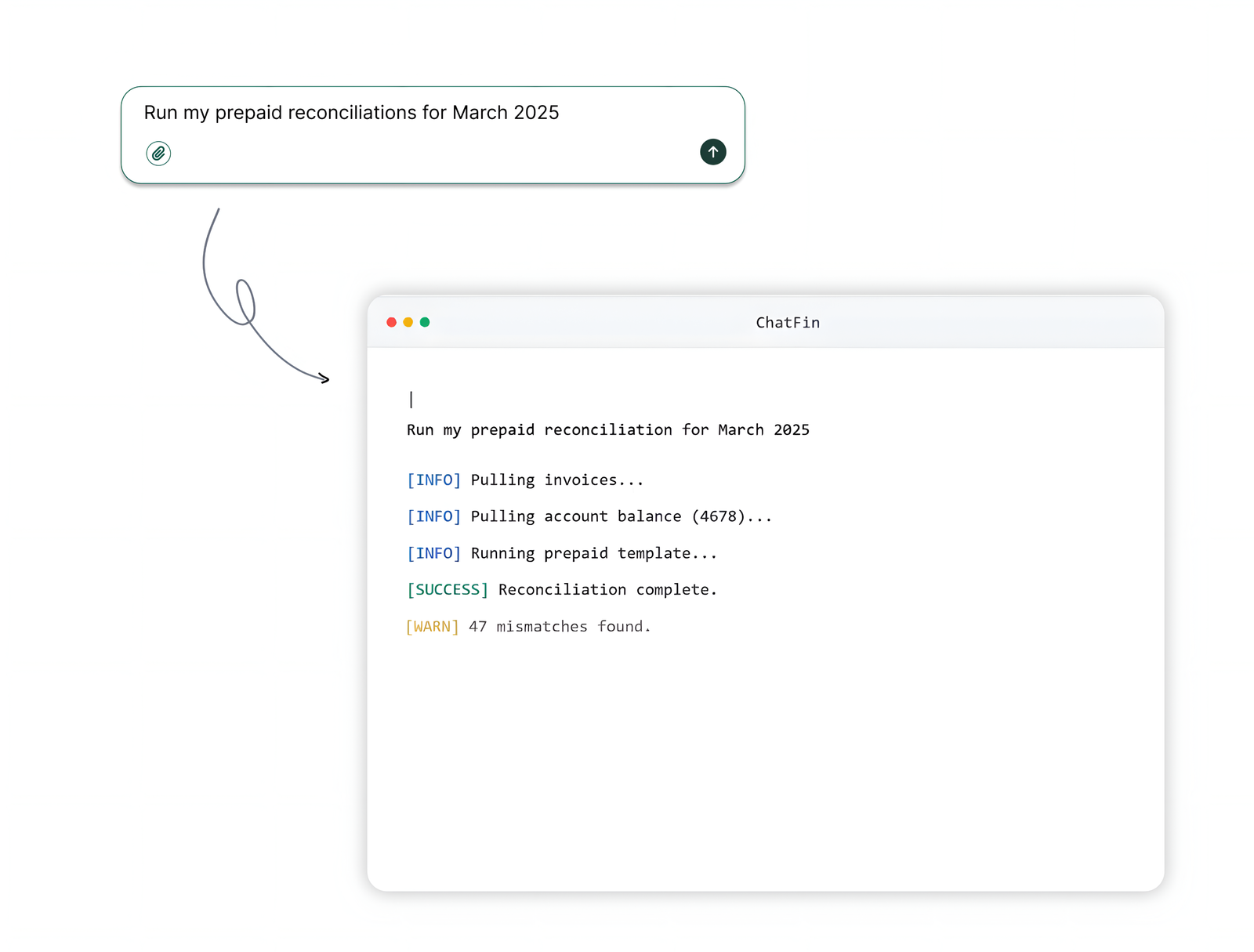
ChatFin treats invoice processing as one component of a broader finance automation platform. Rather than a standalone AP tool, it provides AI agents that handle capture, coding, matching and approval and connect the same data to cash-flow forecasting, reporting and variance analysis, so AP is not an island.
Stampli
Stampli covers the full AP lifecycle with AI-assisted coding, approval routing and vendor communication. Its Billy the Bot learns from historical patterns to auto-code GL entries and flag anomalies, with strong straight-through processing.
ABBYY
ABBYY documents the highest field-extraction accuracy at 99.5 percent on structured invoices and 97 percent-plus on semi-structured formats, with 200-plus language support across its FlexiCapture and Vantage platforms.
AppZen
AppZen builds real-time audit into invoice processing, scanning every invoice for fraud indicators, policy violations, duplicates and inflated pricing as it processes.
Automation Anywhere
Combines robotic process automation with Document AI for extraction ideal for organizations already running its RPA platform that want to extend existing bots with intelligent document parsing.
Nanonets
An API-first machine-learning platform for custom extraction models, appealing to technical teams building bespoke AP workflows, with out-of-box accuracy in the 93 to 96 percent range that improves with training.
Rossum
Rossum uses deep learning rather than templates, reading invoices the way a human would understanding context and layout without pre-configured templates.
Kofax (Tungsten)
Kofax targets large enterprises with complex document workflows beyond invoices POs, receipts and contracts within one platform, suited to heavily regulated, high-volume environments.
“Even if you are pulling all the values by scanning an invoice, how do you know if that number is correct? Sometimes a four can be read as a six. There should be a checkpoint where AI can say, I am not sure about this number, can you check?”
Trust, then spot-check
Invoice OCR is accurate enough now that reviewing every document wastes the time it was bought to save. Reviewing none is how a misread total slips through.
I'm not saying sitting there and audit what comes out, although you do have to kind of eyeball it to make sure that it's not hallucinating.
Ilana Esterrich, on the AgentCFO podcast
Pick a tool in this guide that flags low-confidence fields. Checking those, plus a small random sample, is the review load that actually works.
Before and After AI Invoice Processing
| Metric | Manual / Legacy OCR | AI-Driven Processing |
|---|---|---|
| Cost per invoice | $15 to $25 average | $2 to $5 (70 to 87% reduction) |
| Processing time | 12 to 25 minutes | 30 seconds to 3 minutes |
| Field extraction accuracy | 70 to 85% (template OCR) | 95 to 99.5% (ML-based) |
| Straight-through processing | 10 to 20% of invoices | 60 to 85% of invoices |
| Invoices per FTE / month | 500 | 2,000 to 4,000 (400% increase) |
| Duplicate payment rate | 0.5 to 2% | Under 0.1% with AI detection |
| Exception resolution | 2 to 5 business days | 4 to 8 hours with AI routing |
What Separates Good AI Invoice Tools From Great Ones
By 2026 most tools extract header fields (vendor, invoice number, date, total) at 97 percent-plus, so accuracy alone no longer differentiates. The real gaps show up deeper in the workflow:
The question for AP leaders is no longer whether to automate with AI, but which platform fits your workflow and how far beyond AP you want the automation to reach.
Implementation Roadmap
Why CFOs Are Choosing ChatFin
With AI, finance teams no longer need a separate specialized tool for every workflow. ChatFin provides pre-built AI agents for specific use cases that still work together as one unified platform, so each agent handles a focused job while the system supports the whole finance function. That is why many CFOs prefer one platform over managing 10 tools reducing complexity, cost and coordination while gaining broader automation and insight.
The Bottom Line on AI Invoice Processing in 2026
The data is unambiguous: AI invoice processing delivers 70 to 87 percent cost reduction, 400 percent productivity gains and 99 percent-plus accuracy when properly deployed. If you need raw extraction power on a mature AP workflow, ABBYY and Rossum lead; for a complete AP workflow, Stampli is strong.
But if you're a CFO automating finance holistically connecting invoices to forecasting, reporting and planning ChatFin offers the unified platform that AP-only tools can't.