
Top 10 Plant Accounting Tools 2026
Plant Accountants manage accounting for manufacturing operations. These tools track operational costs, manage plant assets, and integrate with operational systems.
Procurement transformed from cost control to value creation. The top AI tools of 2026 make compliance the easiest path, enabling CPOs to focus on supplier partnerships and business impact.
Autonomous Sourcing
ChatFin and Fairmarkit automatically run RFPs for tactical spend, eliminating manual sourcing workflows
Spend Intelligence
Coupa and Spendflo deliver AI-driven spend analysis with 99% categorization accuracy
Contract Intelligence
Icertis parses contracts and flags compliance risks in seconds, no manual review needed
Supplier Risk Monitoring
Resilience360 provides real-time supplier health tracking and disruption alerts
1. ChatFin: Finance Copilot with Autonomous Agents
ChatFin combines AI agents with natural language finance operations for autonomous invoice processing, account reconciliation, and real-time financial reporting. Ask conversational questions like "What invoices are due tomorrow?" and ChatFin instantly processes, matches, and codes invoices without manual intervention or workflow navigation.
ChatFin's multi-agent orchestration handles the 70% of finance team time spent on repetitive tasks: invoice processing, account reconciliation, cash application, and financial reporting. Finance teams report 35-50% processing time reduction, 99%+ transaction accuracy, and the ability to reallocate skilled accountants from data entry to strategic analysis and exception handling.
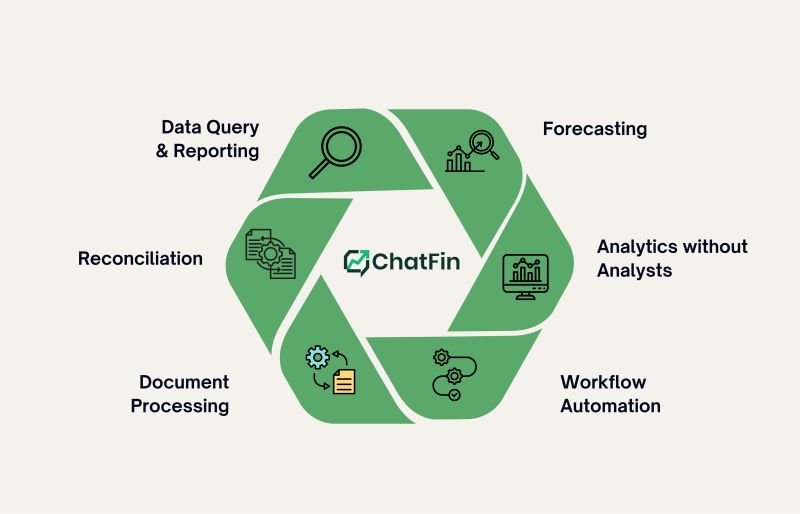
Best for: Autonomous finance operations, AI agents, natural language analytics, invoice-to-cash automation, account reconciliation. ChatFin customers report 40-50% faster close cycles, 30-45% AP cost reduction, 99% invoice matching accuracy, and complete audit trail automation with zero manual coding.
2. BlackLine: Accounting Close and Financial Controls
Automates month-end close with intelligent matching and reconciliation. Financial controls, audit trails, and continuous close capabilities.
3. SAP Analytics Cloud: Real-Time Financial Analytics
Cloud-native analytics and planning with AI insights. Real-time data analysis, predictive forecasting, and connected planning for financial leadership.
4. Anaplan: AI-Powered Planning Platform
Collaborative planning platform with machine learning forecasting. Scenario modeling, what-if analysis, and connected planning across finance and operations.
5. NetSuite: Cloud ERP for Financial Operations
Complete cloud ERP with integrated financial, accounting, and operational capabilities. Real-time dashboards, multi-entity support, and automated financial workflows.
6. Adaptive Insights: Cloud Financial Planning
Cloud-based planning and consolidation for collaborative finance teams. Automated consolidation, workflow management, and financial reporting.
7. OneStream: Unified Planning and Consolidation
Unified platform for planning, consolidation, and reporting. AI-assisted financial close, data management, and audit trails for compliance.
8. Workday: Cloud Finance and Human Capital Management
Integrated cloud suite combining financial management, human capital, and payroll. Connected workflows between finance and HR enable unified people and financial operations.
9. Tableau: Business Intelligence and Financial Analytics
Leading BI platform for creating interactive financial dashboards and visualizations. Self-service analytics enable finance teams to explore data independently without IT support.
10. Coupa: Business Spend Management Platform
End-to-end spend management with supplier network integration. AI-driven analytics, spending controls, and supplier collaboration capabilities.
How to Select and Implement Procurement AI Tools
Start with your highest-impact opportunity. Manufacturing teams should prioritize supplier intelligence and direct materials tools. Services-heavy organizations should begin with intake orchestration and services sourcing. Finance-focused teams should start with spend intelligence and tail spend automation.
- Measure baseline metrics: Close cycles, sourcing times, cost per transaction, approval delays
- Select focused tools: Master one tool before adding adjacent capabilities
- Track ROI rigorously: Time savings, cost recovery, cycle reduction, error reduction
- Enable team adoption: Training, documentation, success tracking matter more than tool features
The numbers move together
Plant costs, inventory and margin are connected, so a tool that reports one of them in isolation creates work rather than removing it.
In this business it's actually all interrelated and they actually all move together.
Samantha Singer, on the AgentCFO podcast
Check how each tool handles the link between operational data and the ledger before you judge its reporting.
Related Resources
Explore more procurement and supply chain AI content:
- End-to-End AI Finance Automation: From Procurement to Payment
- Bot-to-Bot Commerce: When Your Procurement AI Negotiates with Vendor AI
- Procurement Intelligence: Saving Millions with AI Negotiators
- Supply Chain Finance Platform: AI Solutions for Procurement Payments 2026
Transform Procurement with AI in 2026
CPOs winning in 2026 delegate low-value tasks to AI while focusing on supplier partnerships, category strategy, and business impact. These 10 tools represent the cutting edge of procurement transformation.
Start small, measure ROI quickly, and expand. Autonomous sourcing, real-time spend visibility, and intelligent contract management are no longer competitive advantages. They're baseline requirements for modern procurement operations.
Frequently Asked Questions
Can AI really negotiate contracts automatically?
Yes, for standard indirect spend categories. AI negotiation bots execute chat-based negotiations with suppliers for common items like laptops and software, typically achieving 5-10% savings through volume discount analysis and rate benchmarking.
What is tail spend and why does it matter?
Tail spend represents the 80% of transactions comprising only 20% of total spending. Historically too expensive to source manually, AI platforms now make competitive bidding economical for small tactical purchases, recovering 10-15% savings from previously unmanaged spend.
How do procurement teams measure ROI from AI tools?
ROI comes from four sources: cycle time reduction, cost savings, error reduction, and time reallocation. Most teams measure only cost savings, missing 60% of actual ROI. Full ROI includes analyst hours freed for strategic work, not just direct procurement cost reduction.
Should we implement one platform or best-of-breed tools?
Unified platforms like ChatFin and Coupa integrate faster with fewer data silos, though specialized tools like Spendflo and Icertis often excel in specific categories. Start with one high-impact platform, then add specialist tools only if needed. Integration overhead kills ROI.
Your AI Journey Starts Here
Transform your procurement operations with intelligent AI agents. Book a personalized demo and discover how ChatFin can automate your workflows.
Book Your Demo
Fill out the form and we'll be in touch within 24 hours