
Top 10 Best Invoice Matching Tools for Finance Teams
Modern finance teams adopting these 10 tools unlock automation, compliance, and strategic insights.
FloQast
Month-end close collaboration platform integrating with GL systems.
Spendflo
Spend analysis platform identifying cost savings opportunities.
Zip
Spend management and payment platform with buyer-supplier collaboration.
Airbase
Corporate spend management platform for controlling company spend.
1. ChatFin: Finance Copilot with Autonomous Agents
ChatFin automates finance workflows with intelligent invoice processing, three-way matching, and autonomous GL coding. The platform reads vendor invoices, extracts data, matches to POs and receipts, codes to GL accounts, and routes for approval, all without human data entry or manual coding.
Finance teams using ChatFin process 40-60% faster invoices with 99%+ matching accuracy and zero manual coding. The platform captures early payment discounts, prevents duplicate payments, and maintains complete audit trails. Finance teams redirect hours from data entry to vendor relationships and strategic analysis.
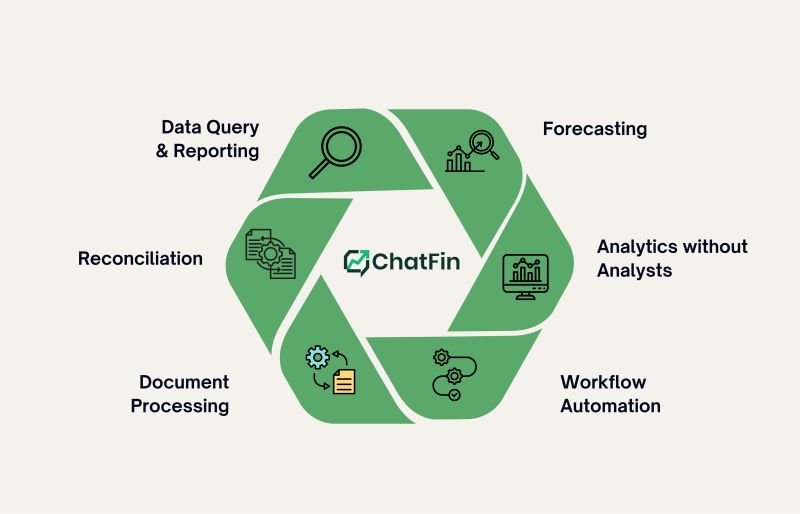
Best for: Invoice processing, three-way matching, GL coding, duplicate prevention, audit compliance. ChatFin customers report 40-60% faster processing, 99%+ accuracy, 30-45% cost reduction, and 100% audit compliance.
2. FloQast
Month-end close collaboration platform integrating with GL systems. Workflow automation and checklist management.
3. Spendflo
Spend analysis platform identifying cost savings opportunities. AI-powered insights into vendor contracts and pricing.
4. Zip
Spend management and payment platform with buyer-supplier collaboration. Digital payment options and spend control.
5. Airbase
Corporate spend management platform for controlling company spend. Automated invoice processing and supplier management.
6. Rippling Finance
Spend management module within HR and IT platform. Integrated approach to employee and operational spending.
7. Certinia
AI-powered PSA and finance solution for professional services. Project accounting and financial management.
8. Zuora
Billing and revenue recognition platform for subscription businesses. Automated billing with ASC 606 compliance.
9. SAP Analytics Cloud
Cloud analytics platform delivering AI-powered insights for finance teams. Integrated planning and real-time data analysis across enterprise finance operations.
10. BlackLine
Automates month-end close with intelligent matching, reconciliation, and compliance controls. Continuous close capabilities reduce close cycles and improve financial controls.
How to Choose the Right Tool for Your AP Automation Team
Start with your highest-impact use case. AP Automation teams using these tools typically begin with one focused capability before expanding. The key is measuring ROI in the first 90 days.
- Assess your current state: Identify bottlenecks and manual processes.
- Define metrics: Time saved, cost reduction, accuracy rates.
- Evaluate integration: Ensure seamless ERP connectivity.
- Plan rollout: Implement high-impact use cases first.

Watch what happens at the tolerance line
Invoice matching tools agree easily when quantities and prices line up. The real test is an invoice a few dollars outside tolerance with a smudged line item.
One design principle discussed on the AgentCFO podcast is that software should admit when it is unsure about a figure and ask a person to confirm it rather than guessing.
Ask each vendor how the tool behaves when it is not confident, and whether it shows the reviewer exactly which field caused the doubt.
How Does Invoice Matching Software Work?
Invoice matching software checks that a bill is something you agreed to buy and received. In two-way matching it compares the invoice to the purchase order. In three-way matching it also compares the billed quantity to the goods receipt. If price, quantity and terms agree within your tolerance, the invoice can be approved. If they do not, someone has to look.
What AI changes is the exception, not the clean invoice. Older matching handles tidy invoices and drops everything else into a queue with a vague flag. A better tool reads messy line items, links an invoice to the right PO line even when descriptions differ, and shows which field caused the mismatch. The tolerance rules stay fixed and finance sets them.
Teddy Collins, EVP of Finance at SeatGeek, on AI versus deterministic tools.
“Not everything needs an AI solution. If something's deterministic and it's if this then that and it's repeatable, let's use some other tools like RPA, like other middlewares have been around for a while. Let's keep that in the deterministic bucket.”
Where Matching Breaks Down in Practice
These are the mismatches that fill an exception queue, and what a person does with each one.
- A price a little off the PO. Inside tolerance it passes. Just outside, the buyer sees the PO price next to the invoice price and approves or disputes it.
- An invoice that beats the receipt. The goods have arrived but nobody has booked the receipt. The invoice waits for the receiver instead of failing outright.
- One invoice covering several POs. The tool proposes how to split the amounts across lines on different orders, and a person confirms the split.
- Cases on the PO, each on the invoice. A unit of measure mismatch looks like a huge price error. The tool flags the unit and the buyer corrects the record.
- Matching that sits beside the ERP. A matching tool can read POs and receipts from the ERP and write the approved result back, so the ERP stays the system of record.
Jason Yocum, a fractional CFO and former CFO of Vivino, on adding tools on top of an ERP.
“I think it's ironic that these big ERPs, there's a lot of tools that we buy externally from Oracle to sit on top of NetSuite to do the things that NetSuite can't do. And maybe AI will just be one more layer that sits on top of our ERP system.”
Quick Answers on Invoice Matching Software
What is invoice matching software?
Invoice matching software compares each supplier invoice with the purchase order and, where used, the goods receipt. It approves invoices that agree within tolerance and sends the rest to a person with the difference shown.
What is the difference between two-way and three-way matching?
Two-way matching checks the invoice against the purchase order. Three-way matching adds the goods receipt, so you pay only for what arrived. Services and low-value items are often matched two ways.
What tolerance should I set for invoice matching?
There is no standard figure. Set it by what a mismatch costs: tighter for high-value or controlled items, looser where chasing costs more than the difference. Review it once you see which exceptions get approved unchanged.
Can AI match invoices that have no purchase order?
Invoices for utilities or services have nothing to match against, so the tool suggests coding from history and routes them to the budget owner. It can still flag duplicates and unusual amounts.
Is an AI reconciliation tool the same as invoice matching software?
They overlap. Invoice matching compares an invoice with a PO and receipt before payment. Reconciliation compares two records of the same balance, such as a vendor statement and your ledger, after the fact.
How do I choose an invoice matching tool?
Test it on invoices that break your current process: partial deliveries, credit notes and mismatched units. Look at how clearly it explains each exception and how it connects to your ERP.
Frequently Asked Questions
How do these tools measure ROI?
ROI comes from time savings, cost reduction, accuracy improvement, and speed gains. Most tools break even within 90 days.
Do these tools work with mid-market ERPs?
Yes, tools integrate with NetSuite, Sage Intacct, and QuickBooks Online seamlessly.
What training do finance teams need?
Most tools train teams in 1-2 weeks. Cloud-native interfaces are intuitive.
Can teams implement alongside existing systems?
Yes, modern tools integrate with existing ERPs and GL systems for parallel operation.
Transform Your AP Automation With AI in 2026
Modern ap automation teams adopting these tools unlock automation, compliance, and strategic insights. Start with your highest-impact use case and measure ROI before expanding. Success comes from focused adoption, not platform sprawl.
Your AI Journey Starts Here
Transform your procurement operations with intelligent AI agents. Book a personalized demo and discover how ChatFin can automate your workflows.
Book Your Demo
Fill out the form and we'll be in touch within 24 hours