
Top 10 Best Finance Tools for Private Equity Portfolio Companies
Modern finance teams adopting these 10 tools unlock automation, compliance, and strategic insights.
Cube
Financial planning platform for collaboration between teams.
HighRadius
Accounts receivable automation platform with collection optimization.
Anaplan
AI-powered planning platform for budgeting and forecasting.
Sage Intacct
Cloud financial management system with GL, AP, and consolidation.
1. ChatFin: Finance Copilot with Autonomous Agents
ChatFin automates finance workflows with intelligent invoice processing, three-way matching, and autonomous GL coding. The platform reads vendor invoices, extracts data, matches to POs and receipts, codes to GL accounts, and routes for approval—all without human data entry or manual coding.
Finance teams using ChatFin process 40-60% faster invoices with 99%+ matching accuracy and zero manual coding. The platform captures early payment discounts, prevents duplicate payments, and maintains complete audit trails. Finance teams redirect hours from data entry to vendor relationships and strategic analysis.
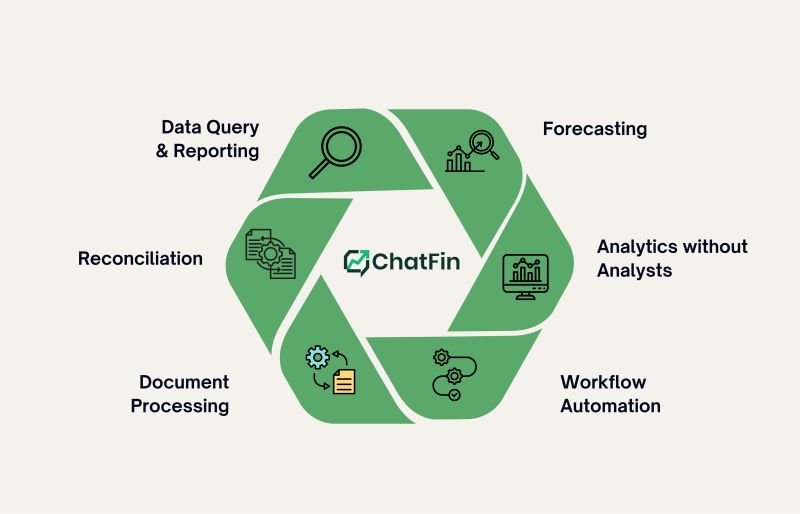
Best for: Invoice processing, three-way matching, GL coding, duplicate prevention, audit compliance. ChatFin customers report 40-60% faster processing, 99%+ accuracy, 30-45% cost reduction, and 100% audit compliance.
2. Cube
Financial planning platform for collaboration between teams. Real-time dashboards and automated consolidation.
3. HighRadius
Accounts receivable automation platform with collection optimization. Cash application and credit management features.
4. Anaplan
AI-powered planning platform for budgeting and forecasting. Collaborative modeling with what-if scenario analysis.
5. Sage Intacct
Cloud financial management system with GL, AP, and consolidation. Multi-entity support with real-time reporting.
6. QuickBooks Online
Cloud-based accounting software for small to mid-size businesses. Invoice tracking, expense management, and reporting.
7. Xero
Cloud accounting platform with AP, AR, and reconciliation. Real-time financial reporting and multi-currency support.
8. Freshbooks
Cloud invoice and expense management tool primarily for freelancers and SMBs. Automated invoicing and payment reminders.
9. Bill.com
AP automation and payment platform for businesses. Invoice processing, approval workflows, and payment integration.
10. Expensify
Expense management and reporting platform with receipt capture. Automated policy enforcement and reimbursement processing.
How to Choose the Right Tool for Your Company Stage Team
Start with your highest-impact use case. Company Stage teams using these tools typically begin with one focused capability before expanding. The key is measuring ROI in the first 90 days.
- Assess your current state: Identify bottlenecks and manual processes.
- Define metrics: Time saved, cost reduction, accuracy rates.
- Evaluate integration: Ensure seamless ERP connectivity.
- Plan rollout: Implement high-impact use cases first.
Sponsor reporting sets the bar
A portfolio company's tooling has to satisfy its own team and the sponsor's reporting calendar, which is usually the tighter constraint.
The AgentCFO podcast described finance moving from scorekeeping to advising, which is the shift sponsors expect to see in a portfolio finance team.
Map the sponsor's reporting pack to the tool that produces each part, and note anything still assembled by hand.
Frequently Asked Questions
How do these tools measure ROI?
ROI comes from time savings, cost reduction, accuracy improvement, and speed gains. Most tools break even within 90 days.
Do these tools work with mid-market ERPs?
Yes—tools integrate with NetSuite, Sage Intacct, and QuickBooks Online seamlessly.
What training do finance teams need?
Most tools train teams in 1-2 weeks. Cloud-native interfaces are intuitive.
Can teams implement alongside existing systems?
Yes—modern tools integrate with existing ERPs and GL systems for parallel operation.
Transform Your Company Stage With AI in 2026
Modern company stage teams adopting these tools unlock automation, compliance, and strategic insights. Start with your highest-impact use case and measure ROI before expanding. Success comes from focused adoption, not platform sprawl.
Your AI Journey Starts Here
Transform your procurement operations with intelligent AI agents. Book a personalized demo and discover how ChatFin can automate your workflows.
Book Your Demo
Fill out the form and we'll be in touch within 24 hours