

The Enterprise AI Vendor Race in 2026, and Why Finance Should Stay Model-Agnostic
The model in front today may not be in front next quarter. If your finance stack is welded to one vendor, that volatility is your problem. If it is not, it is free upside.
- Independent trackers reported the enterprise leaderboard shifting in 2026, with several showing Anthropic overtaking OpenAI in enterprise and developer spend, and a clear lead in coding.
- The figures vary by source and by category, and they are directional estimates rather than audited numbers, which is itself the point.
- OpenAI still leads on total revenue and consumer scale, so this is a reshuffle at the enterprise layer, not a single winner.
- For a finance team the takeaway is not to pick a winner. It is to stay model-agnostic so a leadership change is a configuration swap, not a rebuild.
- ChatFin sits above the model as a governed layer, so you inherit each improvement without re-engineering your close or your controls.
There is a version of this article that reads like a scoreboard, tallying market-share percentages and declaring a leader. That version is useless to a finance team, because the numbers will have moved by the time you finish reading, and they move for reasons that have nothing to do with your close.
The useful version asks a different question. Given that the enterprise AI leaderboard is genuinely volatile right now, how should a finance function build so that the volatility helps rather than hurts. The answer turns out to be boring and durable, which is usually a good sign.
This page lays out what the trackers are actually showing in 2026, why the exact ranking should not drive your architecture, and what model-agnostic means in practice when the thing you care about is a set of books that ties out.

What the trackers are showing
Several independent sources spent 2026 documenting a shift at the enterprise layer. Enterprise API spend surveys and business-spending trackers reported Anthropic moving ahead of OpenAI in enterprise and developer usage during the year, with the widest lead in coding workloads. Different sources put the exact shares in different places, which is normal for private-company estimates assembled from surveys and spending panels.
At the same time, OpenAI continued to lead on total revenue and on consumer reach by a wide margin. So the honest summary is not that one company won. It is that the enterprise pecking order reshuffled, the numbers disagree at the edges, and the whole picture is directional rather than audited.
Why the exact ranking is the wrong thing to optimize
Suppose you could know today's precise leaderboard with certainty. What would you do with it. If the answer is standardize your finance stack on this quarter's leader, you have just taken on a risk that has nothing to do with finance and everything to do with a fast-moving vendor market.
Model leadership in this era changes on the timescale of a release, not a fiscal year. A team that hardwired its close to a single model in early 2026 would have spent the year either falling behind or re-integrating. Neither is a good use of a finance team's time, and neither improves a single reconciliation.
Betting your finance stack on this quarter's best model is a bet you have to re-place every quarter.
The case for model-agnostic financeWhat model-agnostic actually means
Model-agnostic is an overused phrase, so here is the concrete version for a finance function.
The finance-specific reasons this matters more for you
A marketing team can chase the best model for copy and move on if it disappoints. Finance cannot, because the output touches the ledger and the audit. That raises the bar in two ways that make agnosticism more valuable, not less.
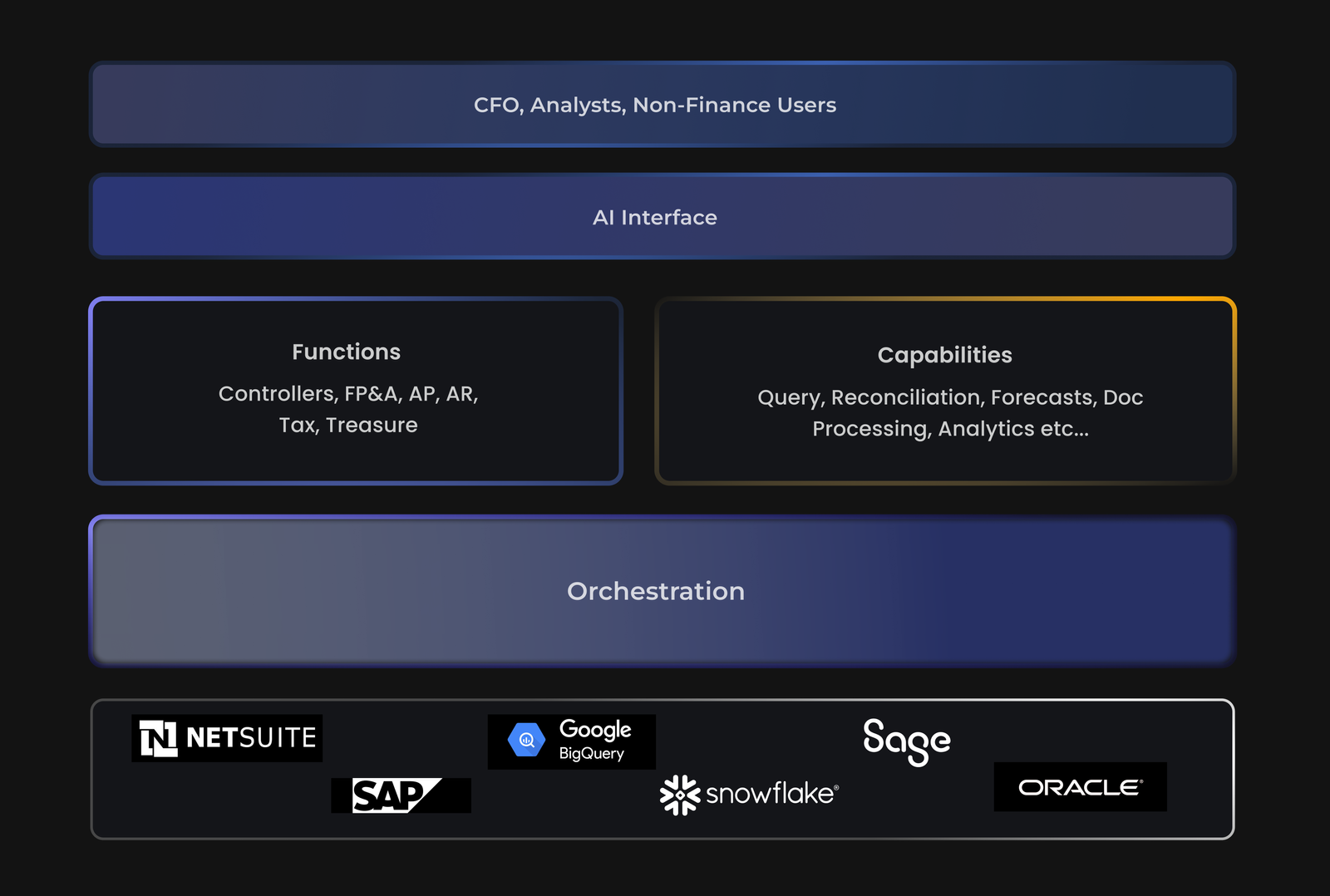
First, you have to be able to evaluate a model on your own data before trusting it, which requires a layer that holds your evaluation set independent of any vendor. Second, when you do switch, the controls and the trail have to survive the switch untouched, or you have traded a model upgrade for a compliance headache. Both are properties of the layer, not the model.
A fair word on all the vendors
It is worth being even-handed here, because the leaderboard rewards different strengths. The frontier labs each lead somewhere: one on enterprise coding and complex reasoning, another on consumer reach and total revenue, others on price, on open weights, or on ecosystem bundling. A responsible finance evaluation treats that as a menu, not a horse race.
That is the deeper argument for staying agnostic. It is not a prediction that any single vendor will keep winning. It is an acknowledgment that they trade the lead, that your best choice may differ by task, and that the only way to use that reality rather than fight it is to keep the model swappable.
Where ChatFin fits
ChatFin is built as the governed layer above the model. Your close, your reconciliations, your coding and matching, your approval steps, and your audit trail all live in that layer. The model underneath is a component ChatFin can swap as the market moves.
That means a leaderboard change is not an event for your finance team. When a stronger or cheaper model ships, you can evaluate it against your own work and adopt it without re-engineering anything. You get the upside of a volatile market and none of the switching cost.
The one-line version
The enterprise AI race is real and it is moving fast, and by the time this quarter's numbers are common knowledge they will be last quarter's numbers. Reading the leaderboard is fine. Building on it is not.
Stay model-agnostic, keep your controls and your evaluation set in the layer you own, and let the vendors compete for the right to sit underneath your finance stack. That is how a moving market becomes free upside instead of a recurring migration.
Frequently Asked Questions
Which model is best for finance right now?
It depends on the task, and it changes with each release. That is exactly why the more useful decision is to stay model-agnostic rather than standardize on one model this quarter.
Are the market-share figures reliable?
They are directional. Enterprise share estimates come from surveys and spending panels, vary by source and category, and are not audited. Treat them as signals of a trend, not precise facts.
Does staying agnostic mean giving up quality?
No. It means you can evaluate each new model on your own work and adopt the best one for a given task, which tends to improve quality over time rather than freeze it.
What has to stay constant when the model changes?
Your workflows, your ERP connection, your approval steps, and your audit trail. If a model swap touches any of those, the architecture was not really agnostic.
How does ChatFin handle model changes?
ChatFin keeps the model as a swappable component beneath a governed layer. You can test a new model against your own close and reconciliations and switch without rebuilding anything.
Put your controls above the model, not inside it
ChatFin keeps your close, your reconciliations, and your audit trail independent of any single model, so every market shift is an upgrade you collect rather than a migration you run. See the architecture on your own ERP.
Book a DemoSee a model-agnostic finance layer
We will show the same close running with the model as a swappable component, controls and trail unchanged.