
The Digital Finance Shift: How CFOs Are Prioritizing Transformation Over Operations
Deloitte's Q4 2025 CFO survey found that 50% of North American finance leaders now rank digital transformation as their top priority for 2026, overtaking enterprise risk management for the first time. The shift from financial scorekeeper to strategic co-pilot is accelerating faster than most teams are ready for.

- Transformation is Priority #1 50% of CFOs now rank digital finance transformation as their top 2026 priority, the first time it has displaced enterprise risk management.
- AI Confidence is High 87% of CFOs believe AI will be extremely or very important to finance operations. Only 2% say it won't matter.
- The Integration Gap 72% of finance leaders now use AI tools, up from 34% in one year. Yet only 1% have fully integrated AI into their workflows.
- FP&A Reinvented Finance planning is shifting from isolated, backward-looking reporting to continuous, collaborative, real-time scenario modeling.
- Change Management Wins 75% of organizations lack skills to fully leverage AI tools. Talent and trust-building are the real transformation levers.
- The CFO Role is Expanding 57% of CFOs now play a leading role in shaping overall company strategy, a sharp increase from the historical back-office position.
The CFO role is being redefined in real time. Finance leaders who spent the last decade managing risk and reporting are now being asked to co-pilot business strategy, lead AI adoption, manage cybersecurity exposure, and build the data infrastructure that makes everything else possible. The mandate has expanded. The question is whether the function has kept pace.
Digital Transformation is Now the Top Priority
Deloitte's Q4 2025 CFO Signals Survey of 200 North American CFOs found that 50% now rank digital transformation of finance as their top priority for 2026, overtaking enterprise risk management for the first time. 87% believe AI will be extremely or very important to finance department operations. 54% plan to integrate AI agents as a core part of their transformation strategy.
What changed is not just technology availability. It is the competitive cost of standing still. CFOs who moved early on finance automation are compressing close cycles, improving forecast accuracy, and running leaner teams. CFOs who waited are now watching the gap widen.
FP&A: From Reporting Function to Strategy Engine
FP&A is undergoing the most significant change of any finance function. The traditional model, where teams spent 80% of their time gathering data and 20% analyzing it, is inverting. AI-powered planning platforms shift finance teams from reactive, period-end reporting to continuous scenario modeling and real-time business partnership.
The 1% Problem: Adoption vs. Integration
The data from Workday's 2025 Financial Planning Trends report is striking. 99% of finance and business leaders believe AI adoption delivers business value. Yet only 1% have fully integrated AI into their work. 72% of finance leaders now use AI tools, up from 34% just one year prior, but using a tool and integrating it into daily workflows are fundamentally different things.
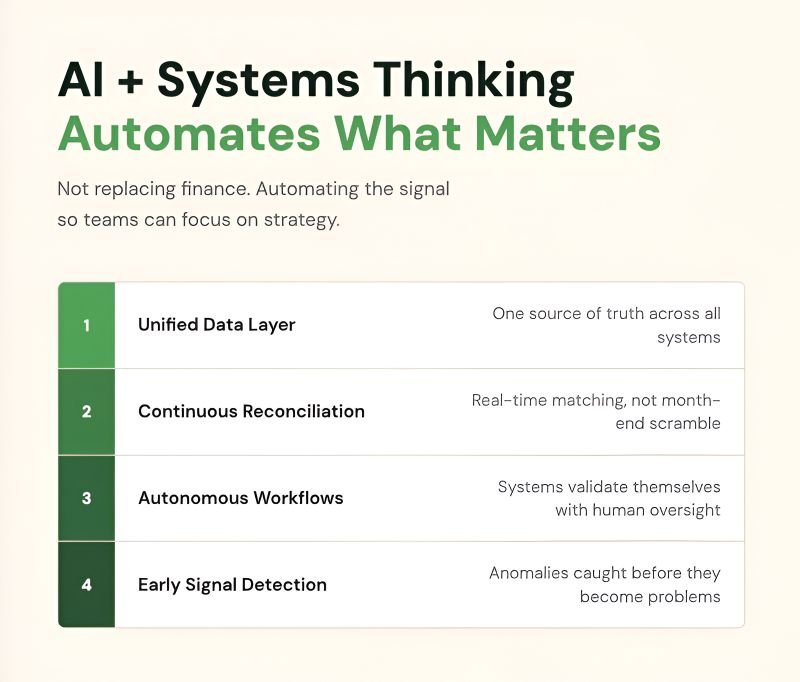
That gap matters because partial adoption often creates more complexity, not less. A team that uses AI to generate reports but still manually reconciles the underlying data has added a tool without removing the burden. True transformation requires rethinking the workflow, not just adding AI to the top of it.
"CFOs who leveraged advanced technology to improve efficiency and respond quickly to market dynamics will thrive in 2026, regardless of economic conditions." - Steve Gallucci, U.S. Leader of Deloitte's CFO Program
Change Management: The Variable Most Teams Underestimate
The biggest barriers to finance transformation are not the technology choices. Protiviti's 2025 Global Finance Trends Survey found they are organizational resistance to abandoning legacy systems, unclear ROI measurement, and data silos across business units. 75% of organizations acknowledge their teams lack the skills to fully leverage AI tools. Only 52% of employees trust their organizations to implement AI responsibly.
CFOs who succeed in transformation invest in the human side first. They communicate clearly about what AI will and will not replace. They build trust through small, visible wins before attempting full-scale rollouts. And they recognize that getting from 72% adoption to genuine integration requires a culture shift, not just a software deployment.
Measuring What Actually Matters
The CFO role in 2026 is not about cost reduction. It is about capability expansion. The finance functions that will define the next five years are the ones that measure Return on Change rather than just return on technology investment, and invest in their people's ability to use new tools as seriously as they invest in the tools themselves.
Transformation does not happen by memo. It happens when finance leaders build the story, invest in the skills, and hold the organization accountable to the outcomes they said they were going to deliver.
The ChatFin Advantage: Enterprise Finance Automation Platform
ChatFin is a finance AI super-agent platform that runs directly inside your ERP - NetSuite, SAP, Oracle, or Acumatica. Unlike disconnected point solutions that create more integration work, ChatFin connects AP, AR, reconciliation, forecasting, and compliance in a single autonomous system. With 100+ pre-built finance agents, ChatFin teams deploy agentic automation in weeks, not months. The platform learns your workflows, handles exceptions intelligently, and surfaces only true anomalies for human review.
Organizations deploying ChatFin report measurable results: 40-60% reduction in close cycle time, 80%+ automation rates on exception handling, and finance teams freed from tactical work to focus on strategic priorities. ChatFin does not replace finance judgment. It eliminates the mechanical work that masks it.
Learn more: 2026 Finance AI Deployment: CFO Investment Strategies and ROI Measurement
Additional resource: Finance Transformation: How CFOs Are Leveraging AI for Strategic Impact