

Suspense Is Not a Destination
Every clearing account should return to zero. The ones that do not are holding transactions nobody could code, and each month makes them harder to resolve.
A suspense or clearing account temporarily holds transactions that cannot yet be posted to their final account, and by design it should return to zero at the end of each cycle. A persistent balance means items entered and were never resolved. The correct treatment is to age the balance by item, assign each item an owner, and set a hard limit beyond which an item must be resolved or escalated rather than carried forward.
- A suspense account with a balance is a queue of unmade decisions, not an account balance in any meaningful sense.
- Age by item, not in total. A net balance near zero can conceal large offsetting items on both sides.
- Items become harder to resolve with time, because the person who created them and the context both disappear.
- The hard limit is the control. Without a defined age at which an item must be resolved or escalated, everything is carried forward.
- ChatFin ages every item, identifies the likely destination from the transaction detail, and prepares the clearing entries for approval.
Clearing accounts are among the most useful mechanisms in a ledger. They let a process continue when a piece of information is missing, on the understanding that the information will arrive shortly.
The understanding is the part that fails. An item lands in suspense because a cost centre was missing, a project code was invalid, a bank receipt could not be matched or an interface rejected a posting. Somebody intended to resolve it. Then the close finished, the month changed, and the item became part of the balance rather than part of anyone's work.
This page covers why net balances mislead, why ageing beats size as a priority measure, what makes old items expensive to clear, and how to run these accounts as a queue with a service level rather than as accounts with a balance.
Why the net balance misleads
Suspense accounts are frequently reviewed on their balance, and the balance is close to meaningless. Items enter on both sides, and a clearing account holding a large unmatched receipt and a large unmatched payment can net to almost nothing.
The number that matters is gross items outstanding and their age profile. An account with a balance of a few thousand and two hundred items dating back eighteen months carries far more risk than one with a large balance and three items from last week.
| Gross debits outstanding | Total unresolved debit items, regardless of what sits on the credit side |
| Gross credits outstanding | The same on the credit side, since these resolve to different destinations |
| Item count | How many decisions are outstanding, which is the workload measure |
| Age profile | Items bucketed by age, which is the risk measure |
| Oldest item | A single number that tells a reviewer more about the account than the balance does |
Reporting these five instead of a balance changes the conversation immediately, because it makes the workload visible rather than the net position.
Why old items cost more to clear
The resolution cost of an item rises sharply with age, and the reasons are practical rather than accounting.
Context disappears
The person who created the item has moved role or left, and the reason it could not be coded existed only in their head.
Supporting evidence ages out
Bank detail, carrier documentation and customer remittance advice are often retained for a limited period, after which the item cannot be sourced at all.
Periods close
Correcting an item in a closed or audited period requires more approval and more explanation than correcting it in the current one.
Ownership dissolves
An item nobody created and nobody owns tends to be resolved by writing it off, which is an accounting decision made for administrative reasons.
Reason four is the outcome most organisations end up with, and it is worth naming honestly. A write off of aged suspense items is not a clearing exercise, it is an admission that the underlying transactions can no longer be identified.

The hard limit that makes it work
Ageing reports on their own change nothing. Many organisations produce one monthly and the profile stays the same because nothing follows from it.
The mechanism that works is a defined maximum age with a consequence attached. An item that reaches the limit must be resolved, escalated to a named person, or written off with documented approval, and it cannot simply appear on next month's report unchanged.
Tracking the oldest item month over month is a single number that tells you whether the discipline is holding. If it rises every month, nothing is being resolved, whatever the balance is doing.
Where the items come from
Most suspense balances are dominated by a small number of sources, and identifying them turns a clearing exercise into a prevention exercise.
The first two are usually the largest by volume and both are amenable to automated resolution, because the information needed to identify the item generally exists in the ledger or in the document that accompanied the transaction.
Where the close platforms help
Reconciliation platforms handle the tracking side well. BlackLine, FloQast, Trintech and Numeric all support item level reconciliation, ageing, ownership assignment and escalation workflow, and will enforce the limit if it is configured.
What they do not do is work out what an item should have been coded to. The platform ages the item and routes it to a person, and that person still has to open the transaction, read the supporting document, work out the customer or the cost centre, and prepare the entry. Where an account holds hundreds of items, that manual research is why the balance persists despite good tooling.
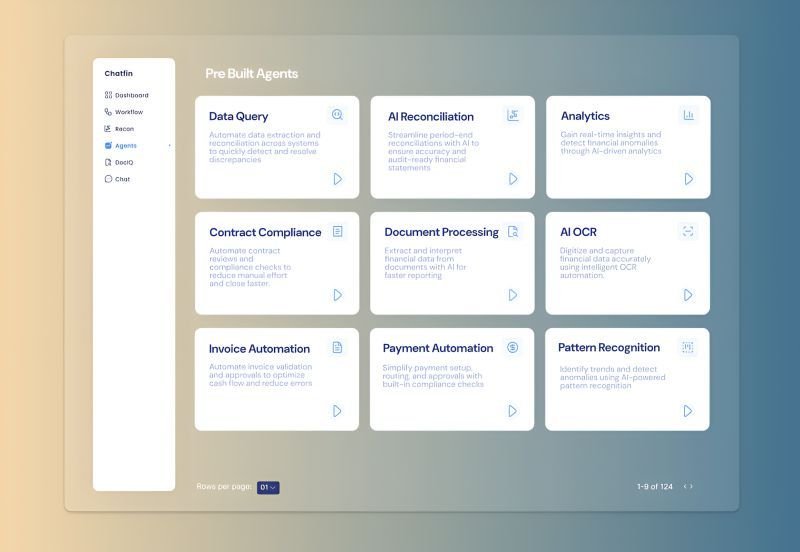
Identifying the likely destination from transaction and document detail is exactly what pre built finance AI agents do, and it is the same matching used in autonomous reconciliation.
How ChatFin clears the queue
ChatFin reads the suspense and clearing accounts at item level from your ERP, ages every item from its posting date, and separates gross debits from gross credits rather than reporting a net balance.
For each item, the autonomous reconciliation agent then attempts identification from the transaction detail and the supporting document: matching an unidentified receipt to an open invoice by amount and payer, resolving an interface rejection to the account mapping it should have used, or linking a goods received item to a later invoice. The document processing agent reads remittance advice and supporting paperwork where the ledger alone is insufficient. The conversational finance AI layer lets a controller ask which items have aged past the limit and who owns them.
| Reconciliation agent | Matches unidentified items to open invoices, receipts and expected postings by amount and reference |
| Document processing | Reads remittance advice and supporting documents to identify the payer or the correct coding |
| Analytics agent | Ages items, reports gross debits and credits separately and tracks the oldest item over time |
| Pattern recognition | Identifies the recurring sources feeding the account, which is what enables prevention |
| Governed write back | Prepares the clearing entry per item with the identification evidence, for approval |
Each clearing entry is prepared with the evidence for the proposed destination attached, and a person approves it before posting. Items ChatFin cannot identify are reported as such rather than defaulted anywhere, which keeps the unresolved population honest.

Clearing an account that has never been cleared
Work newest first. It is counterintuitive and it is the right order, because recent items are cheapest to resolve and reduce the population fastest.
Report gross, not net
Split the balance into gross debits and credits with a full age profile. The item count is usually the number that gets attention.
Resolve the last three months first
These are the cheapest to clear because the context and the evidence still exist. Clearing them also stops the population growing while you work.
Attack the oldest by source, not by item
Group aged items by their origin. Twenty unidentified receipts from one customer resolve as one conversation rather than twenty investigations.
Set the limit and the trend measure
Define the maximum age with a consequence, and track the oldest item monthly. Without this the account will refill.
The third step is what makes the aged population tractable. Individually, old items are expensive. Grouped by source, they usually collapse into a handful of causes that can each be resolved once.
A write off of aged suspense items is not a clearing exercise. It is an admission that the underlying transactions can no longer be identified.
ChatFin
Frequently Asked Questions
What is a suspense account and why should it be zero?
A suspense or clearing account temporarily holds transactions that cannot yet be posted to their final destination, usually because a piece of coding information is missing or a match has not been made. By design it should return to zero at the end of each cycle, because every item in it represents a decision that has not been completed. A persistent balance means those decisions were never made.
How should suspense accounts be reviewed?
By gross items and their age profile rather than by net balance. An account holding a large unmatched debit and a large unmatched credit nets to almost nothing while carrying substantial risk. Report gross debits outstanding, gross credits outstanding, item count, an age profile and the age of the oldest item, which together tell a reviewer far more than the balance does.
Why do old items in clearing accounts become so hard to clear?
Because the context disappears. The person who created the item may have left, supporting evidence such as bank detail or carrier documentation may have passed its retention period, and correcting an item in a closed or audited period requires more approval than correcting it in the current one. The usual outcome is a write off, which is an accounting decision taken for administrative reasons rather than a resolution.
Can ChatFin identify what suspense items should be coded to?
In most cases yes. ChatFin matches unidentified items against open invoices, receipts and expected postings using amount, reference and payer detail, resolves interface rejections to the account mapping they should have used, and reads remittance advice and supporting documents where the ledger alone is insufficient. Each proposed clearing entry is prepared with its identification evidence attached for a person to approve, and items that cannot be identified are reported as unresolved rather than defaulted anywhere.
See ChatFin age and identify the items in your clearing accounts.
ChatFin reads suspense and clearing accounts at item level, ages every item, and separates gross debits from gross credits instead of reporting a net balance.
It identifies the likely destination for each item from transaction and document detail, and prepares the clearing entry with the evidence attached for approval.
Book a DemoBring one suspense account with a persistent balance.
ChatFin will age the items, identify the likely destination for each from ledger and document detail, and show which sources are feeding the account.