
JD EDWARDS AI
The Safest Architecture for Connecting AI Agents to JD Edwards Without Modifying Source Code
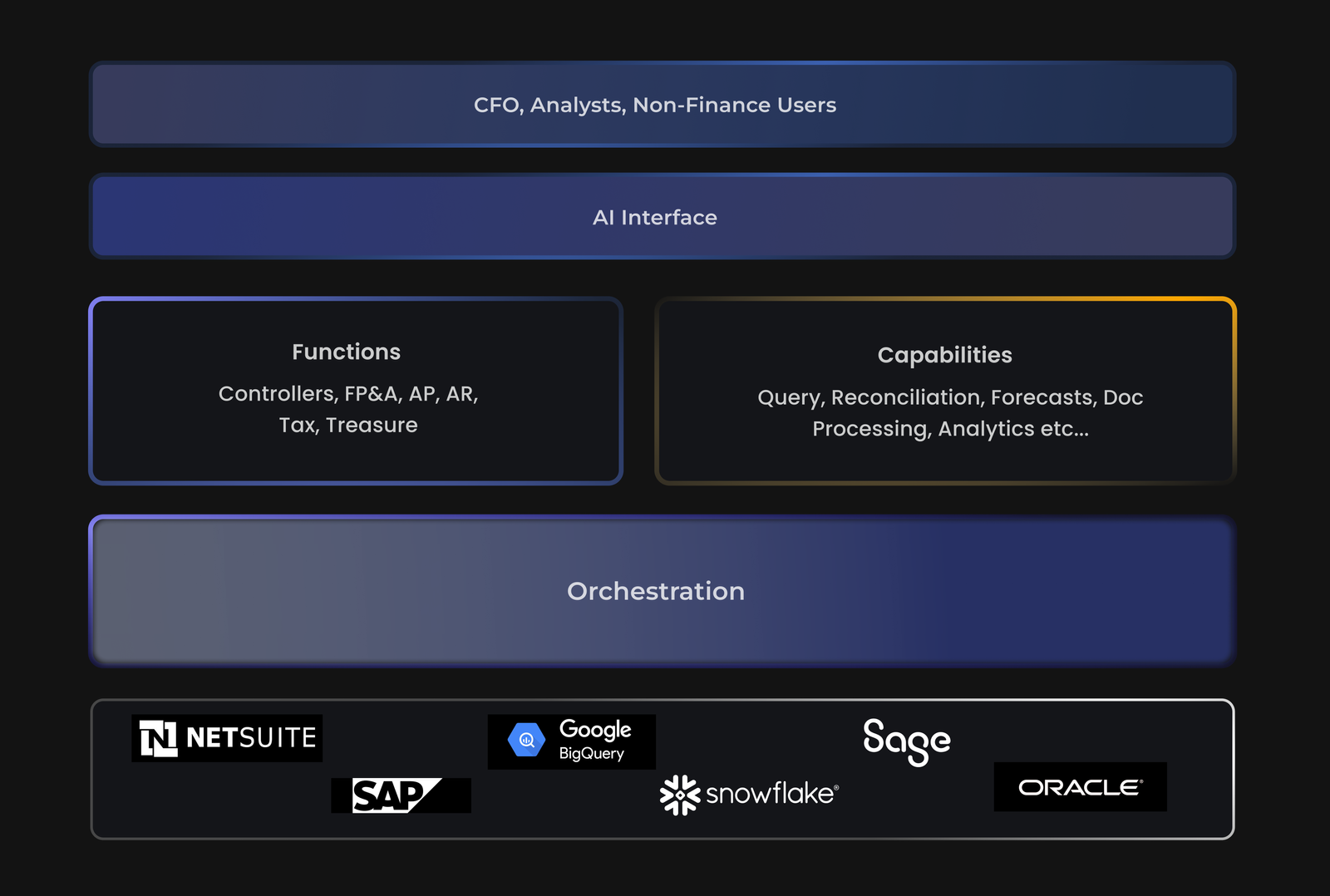
A handful of early decisions about where the integration touches JD Edwards decide whether it survives the next Tools Release.
- The safe boundary is the Application Interface Services layer and Orchestrator. Everything above it is application code you should not be modifying.
- No custom business functions, no modified applications, no new tables inside EnterpriseOne. Every one of those becomes a retrofit obligation at upgrade time.
- Reads may go to a replica for analytics. Writes must go through orchestrations so business function logic and integrity checks still run.
- Put a gateway between the agent and the AIS Server. It is where authentication, rate limits, payload checks and logging belong, and it keeps the ERP off the open network.
- ChatFin is deployed this way by design. It runs entirely on published interfaces and leaves nothing behind inside JD Edwards.
JD Edwards customers have a long memory for integration debt. Most sites are still carrying something a predecessor built into the application layer a decade ago, and every upgrade cycle someone has to prove it still works. The instinct to avoid repeating that is correct, and it should shape the AI architecture from the first design session.
The reassuring part is that the safest architecture is also the simplest. Oracle has already built the integration surface. The work is to use it and to resist the shortcuts that seem faster in month one.
The Layer Diagram That Matters
Think of five layers. At the bottom is the database. Above it is EnterpriseOne with its business functions and applications. Above that is the AIS Server and Orchestrator. Above that sits your agent platform. At the top is the user. The rule is that your integration lives in layer four and speaks only to layer three. It never reaches past Orchestrator into the application, and it never reaches around it into the database for writes.

Why finance needs the extra care
Other teams can afford an AI experiment that fails. Finance cannot, because its errors reach the auditors, the lenders and the board.
You're held to a level of rigor and accountability that other teams at a company might not be.
Caitlin Haberberger, on the AgentCFO podcast
Keep the AI layer separate from the JDE core, as the diagram below does. An upgrade should never be the moment you discover what the agent was touching.
What You Must Not Do
These four shortcuts account for almost every JD Edwards integration that becomes an upgrade problem. Each of them looks reasonable in isolation and each of them creates a permanent obligation.
The Reference Pattern
What remains after removing those options is a clean and unusually durable design. It has four components and each has one job.

Reads, Writes and the Replica Question
Reads and writes deserve different treatment, and conflating them is a common design error. Heavy analytical reads against a production JD Edwards instance are a performance risk, and there is nothing wrong with pointing them at a replica or a reporting copy provided everyone understands the latency.
Writes are the opposite. There is no acceptable path other than through the application logic, because that logic is what makes the resulting record valid. An agent that writes around it is creating data your integrity reports will eventually reject.
Permissions and the Service Account Trap
The single most common security compromise in these projects is a shared service account with broad rights, used for every user's requests. It makes development easy and it destroys the meaning of your audit trail, because every action is attributed to the same identity regardless of who asked.

Proving It Survives an Upgrade
The architectural claim is that nothing in this design is affected by an Applications Update or a Tools Release, because every touchpoint is a published interface. That claim is testable and you should test it rather than trust it.
The practical method is to apply the update in a test environment and run the agent's full action set against it before production. Because the surface is small, a documented set of orchestrations and endpoints, this is a short exercise.
How ChatFin Is Deployed
ChatFin follows this pattern deliberately. It runs outside EnterpriseOne, connects through AIS with a session that respects your role design, and executes exclusively through published orchestrations that you approve. No business function is modified, no custom application is installed and no table is created inside JD Edwards.
If ChatFin were removed tomorrow, your JD Edwards environment would be byte for byte what it was before, minus the transactions your team approved. That is the test a good architecture should pass.
"If removing the AI platform would leave scars inside the ERP, the architecture was wrong before the first line of code."
Add AI Above the ERP, Not Inside It
ChatFin connects to JD Edwards EnterpriseOne entirely through AIS and Orchestrator. No source code changes, no custom objects, no modified business functions, and a documented action surface you can revalidate after any update.
The safest JD Edwards AI architecture is the one that leaves nothing behind inside JD Edwards.
Frequently Asked Questions
What is the safest way to connect AI agents to JD Edwards?
Run the agent outside EnterpriseOne and let it reach the system only through the AIS Server and published orchestrations, behind an API gateway. That boundary means no business functions are modified, no custom applications are installed and no tables are created inside JD Edwards, so nothing needs retrofitting at upgrade time.
Can AI agents write directly to JD Edwards tables?
They should not. Writing directly to tables such as F0911 or F0411 bypasses business function validation, automatic accounting instructions and batch integrity, which produces records that fail integrity checks later. All writes should go through a single purpose orchestration so the application logic still runs.
Will this architecture survive a Tools Release or Applications Update?
It is designed to, because every touchpoint is an interface Oracle publishes and maintains. The action surface is small enough to revalidate quickly: inventory the orchestrations and endpoints in use, replay them against an updated test environment, compare outputs, and retain the evidence for internal audit.