
Real-Time Finance Close: From 7-Day Crunch to Continuous Closing
Traditional close is a month-end crunch: everyone stops working, focuses on close activities for 7-10 days, and submits financials. Continuous closing distributes these activities throughout the month. Close work happens continuously, not in a burst. Timelines compress to 2-3 days. AI agents reconcile daily, post accruals automatically, validate completeness in real-time. Here is how real-time close transforms finance operations in 2026.
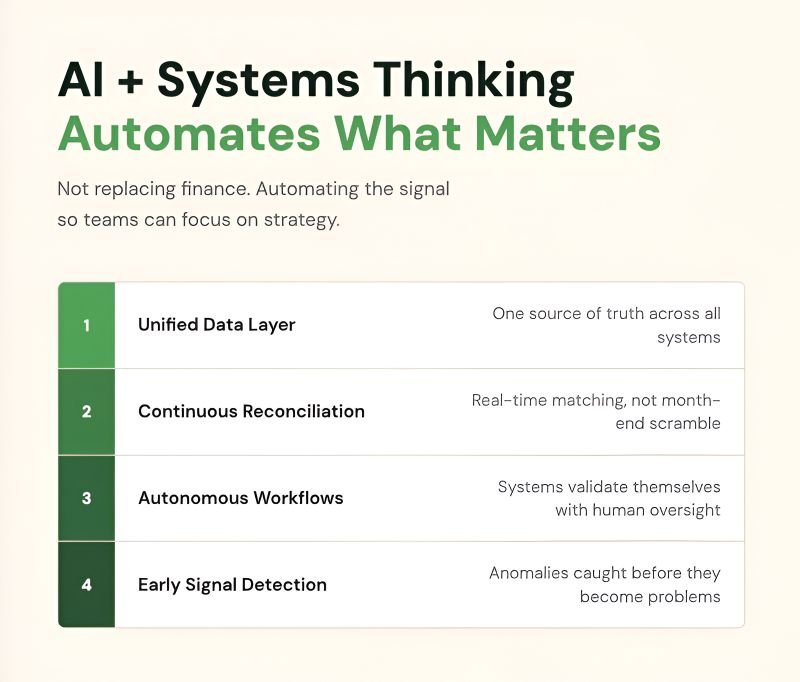
- 70% Timeline Compression Close cycles compressed from 7-10 days to 2-3 days through continuous closing approach. AI agents reconcile and post continuously.
- Continuous vs Batch Traditional close batches all work into month-end. Continuous closing spreads work across period. Agents handle daily reconciliation, accrual posting, validation.
- 5.8B Close Automation Market Finance close automation market reached 5.8 billion dollars in 2026. Growing 12 percent annually as organizations race to compress close cycles.
- Real-Time Visibility Continuous closing provides real-time financial visibility. Financials available same-day. Management has current numbers, not day-old data.
- Accounting Staff Productivity Close time crunch eliminated. Accounting staff focus on high-value analysis, not scrambling to close books. Job satisfaction increases, turnover decreases.
The month-end close is the most painful finance operation in most organizations. For 7-10 days, accounting teams stop all other work and focus entirely on close activities: reconciling accounts, posting accruals, validating GL balances, generating close reports. It is chaos. Teams work late nights, executives pressure for faster close, quality suffers. Continuous closing changes this fundamentally. By distributing close work throughout the month, organizations eliminate the month-end crunch entirely. Close happens continuously. AI agents handle reconciliation and accrual posting daily. Final close takes 2-3 days, not a week.
The Month-End Crunch: Yesterday's Approach to Finance Close
Traditional finance close batches all closing activities into a single intense period. On the last day of the month, GL closes. Reconciliation begins. Accruals are posted. Variance analysis happens. Reports are generated. Everything happens at once. This creates bottlenecks, stress, and errors. Teams scramble. Timelines slip. Quality suffers because everyone is tired and under pressure.
Continuous Closing: Spreading Work Throughout the Month
Continuous closing inverts the traditional model. Close activities happen daily, not monthly. On day 1, agents reconcile yesterday's transactions. On day 2, agents post accruals. Throughout the month, GL accounts are continuously validated against source systems. By month-end, 80% of close work is already complete. Final close window is 2-3 days, not a week.
"Organizations moving from traditional close to continuous closing report 70 percent reduction in close timelines and 95 percent reduction in close-related errors. Continuous closing is no longer experimental. It is becoming standard practice." - Gartner Close Automation Report 2026
The Technology Stack: AI Agents Orchestrating Real-Time Close
Real-time close requires three capabilities: automated reconciliation, autonomous accrual posting, and continuous validation. AI agents handle all three. Modern ERP systems like SAP S/4HANA, Oracle Fusion, and Microsoft Dynamics 365 are embedding agentic capabilities directly into close processes. Agents run continuously, processing transactions, matching GL entries, validating balances.
The Business Impact: Faster Close, Happier Teams, Better Decisions
Organizations deploying continuous closing report dramatic improvements. Close cycles compress 70%. Accounting staff spend zero time on repetitive close tasks. Management has real-time financial visibility instead of stale month-old data. Board meetings can happen earlier with current financials. External auditors have more time to work through financials with management, not scrambling in month-end crunch.
Continuous Closing Is the New Standard
By 2026, organizations still using traditional month-end close are outliers. Continuous closing is becoming the standard. CFOs that move to continuous closing will have competitive advantage: faster reporting, better data quality, happier teams, and real-time financial visibility for decision-making. The question is no longer whether to move to continuous closing. The question is how fast you can implement it.