
JD EDWARDS AI
What Middleware, API Gateway or Connector Do You Need to Connect an AI Agent to JD Edwards?

JD Edwards already ships its integration layer in AIS and Orchestrator, so the usual addition is a gateway for control.
- Orchestrator and the AIS Server are the integration layer. You do not need an enterprise service bus to reach JD Edwards from an AI agent.
- An API gateway is the one component worth insisting on. It gives you a single controlled entry point, authentication, rate limiting and logging.
- An integration platform earns its place when many systems are involved or when transformation and queueing are required, not merely for one agent.
- Network placement matters more than product choice. The AIS Server should not be reachable from the public internet under any design.
- ChatFin connects through AIS and Orchestrator behind your gateway, with no additional middleware licence required for the JD Edwards side.
Integration questions tend to attract heavyweight answers, partly because the last generation of ERP integration required them. JD Edwards sites in particular carry the memory of building interfaces through a service bus with a mapping layer and a queue for every transaction type.
That was the right architecture for file based batch integration between systems that could not speak to each other. It is not the right architecture for a single agent making authenticated REST calls to a server designed to receive them.
What JD Edwards Already Gives You
Before deciding what to buy, it is worth being precise about what is already present in a supported 9.2 environment, because it covers most of what an agent integration needs.

Fewer moving parts to break
Every middleware layer added between JD Edwards and an AI tool is one more thing that can fail silently at month end.
Why worry about integrations breaking, when the work your salesperson does should help the finance team just by virtue of it being a single data set.
Craig Sullivan, on the AgentCFO podcast
Use what JDE already exposes before adding a gateway, as the comparison below does. The integration you never built is the one that never breaks.
The One Component Worth Insisting On
An API gateway is the component we would not deploy without. It is not required to make the connection work, which is precisely why it gets skipped, and it is the difference between an integration you can govern and one you can only describe.
When an Integration Platform Is Justified
A full integration platform is a real cost in licence, skills and latency, and it should be justified by requirements rather than habit. There are cases where it clearly is.
Where Teams Over Engineer
Three patterns appear repeatedly in JD Edwards AI projects, and each adds cost, latency and failure modes without adding control. They are worth naming because each one sounds prudent in a design review.
The common thread is inserting a component that duplicates something JD Edwards already does. Every additional hop is another place for data to age, another credential to manage and another thing to revalidate at upgrade time.
Network and Security Placement
Product choice matters less than where the components sit. The design constraint is that the AIS Server is an internal service and should remain one under every deployment option.

A Minimal Reference Stack
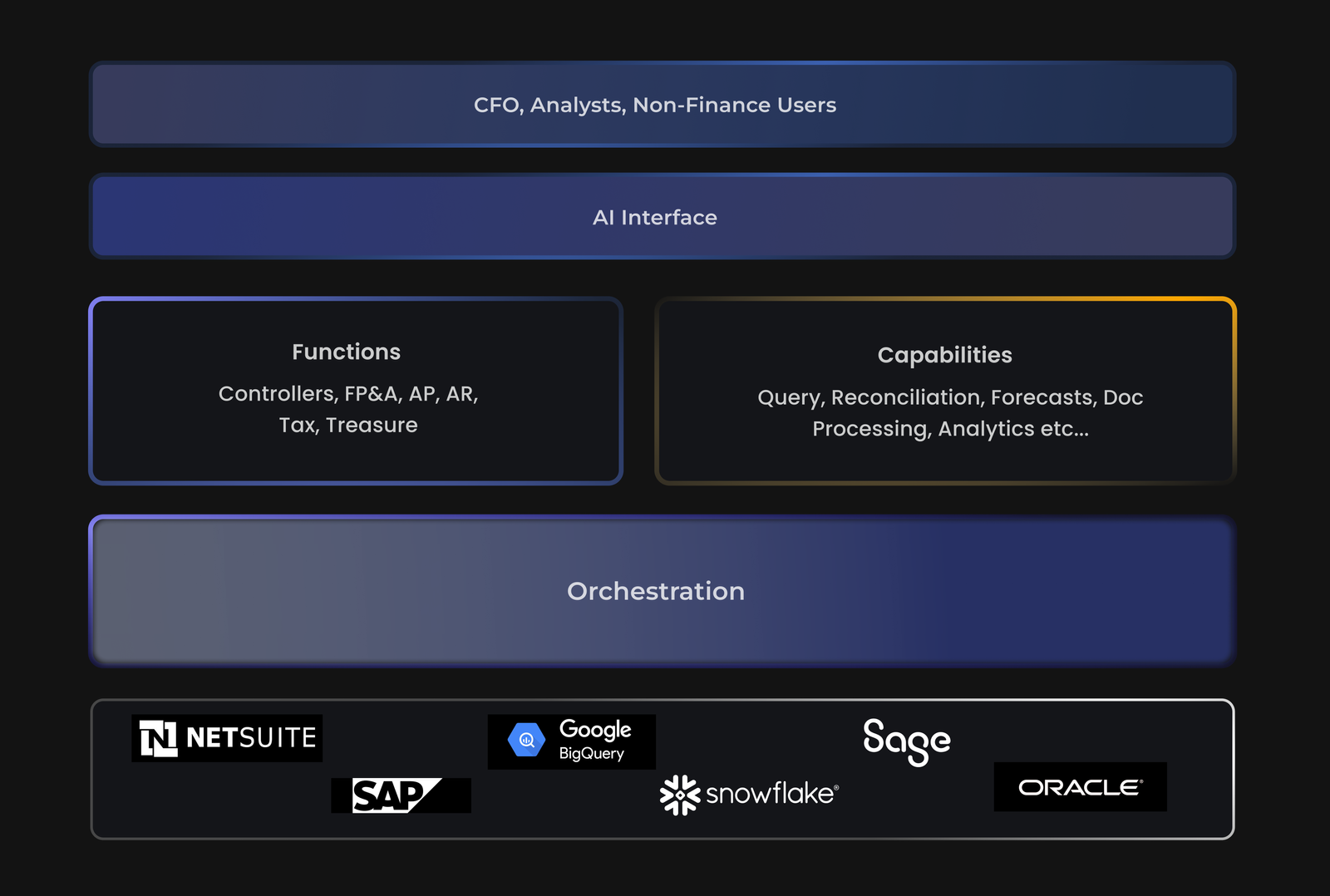
For most JD Edwards sites adding a finance AI agent, this is the entire required stack. It is short on purpose, and adding to it should require a stated reason.
"Most JD Edwards AI projects need a gateway and a whitelist, not an integration platform. Orchestrator already is the integration platform."
What This Means for Timelines
The practical consequence of a short stack is a short project. When the components are a gateway, an existing AIS Server and a set of orchestrations, the work is configuration and review rather than construction, and the calendar is driven by your own change control rather than by development.
ChatFin connects through this stack directly. There is no additional middleware licence needed on the JD Edwards side, no data warehouse to stand up first, and no custom connector service to maintain afterwards.

Use the Integration Layer You Already Own
ChatFin connects to JD Edwards EnterpriseOne through the AIS Server and published orchestrations behind your API gateway, with no additional middleware licence, no data warehouse dependency and no custom connector to maintain.
Orchestrator is already the integration platform. The only component most teams need to add is a gateway.
Frequently Asked Questions
Do I need middleware to connect an AI agent to JD Edwards?
Usually not. The AIS Server and Orchestrator are the integration layer, exposing REST endpoints and named callable services that an agent can use directly. The component worth adding is an API gateway in front of the AIS Server for authentication, rate limiting, payload inspection and independent logging. A full integration platform is justified when many systems, heavy transformation or guaranteed delivery are required.
Should the AI agent read from a data warehouse instead?
Only for heavy analytical work where a few hours of latency is acceptable. Copying JD Edwards into a warehouse so an agent can read it adds latency to every answer, creates a second copy of your ledger to secure, and still leaves you unable to write. Operational questions that lead to action should read live through the data service.
Can the AIS Server be exposed to the internet for this?
No. The AIS Server should remain an internal service under every deployment option. Reach it through an API gateway over a controlled network path, use current TLS throughout including between the gateway and the AIS Server, and keep credentials in a secrets manager with rotation rather than in configuration files.