
Microsoft Copilot in Excel for Financial Analysis
Copilot is useful inside a workbook and blind outside it. That boundary is the whole story for finance. This covers what it does with a model, what it cannot reach in the ERP, and where teams hit the wall. AI assistants for finance.
- Copilot brings generative AI across Word, Excel, Outlook, PowerPoint and Teams with deep enterprise integration.
- Power Platform plus Copilot Studio enables low-code AI agents for business-process automation.
- Enterprise-grade compliance (HIPAA, FedRAMP, SOC 2) with tenant-level admin policies.
- License tiers and IT configuration create real adoption complexity for finance teams.
- Copilot automates office productivity, not finance operations like AP, reconciliation or close.
Microsoft's generative AI is embedded across Word, Excel, Outlook, Teams, Power Platform and GitHub. For finance teams already inside the Microsoft ecosystem which describes most enterprise finance departments Copilot offers the path of least resistance to AI adoption.
But path of least resistance and path to maximum impact are rarely the same thing. Understanding the gap between what Copilot delivers and what finance operations actually need is critical for every CFO making AI investment decisions right now.
Core Capabilities That Matter for Finance

Copilot speeds the work, the analyst owns it
Copilot can build formulas, summarise a table and suggest a chart in seconds. The risk sits with analysts who accept its output without checking the logic.
That's the part that fears me is when people just let AI be the answer versus the augmentation.
Paul Barnhurst, on the AgentCFO podcast
Use Copilot for the mechanical work and keep the analyst responsible for every assumption in the model.
Where Copilot Falls Short for Finance Operations
“Merged cells are a blasphemy. Humans read them fine. AI gets confused about whether this belongs to this column or that row.”
Horizontal Productivity AI vs Vertical Finance AI
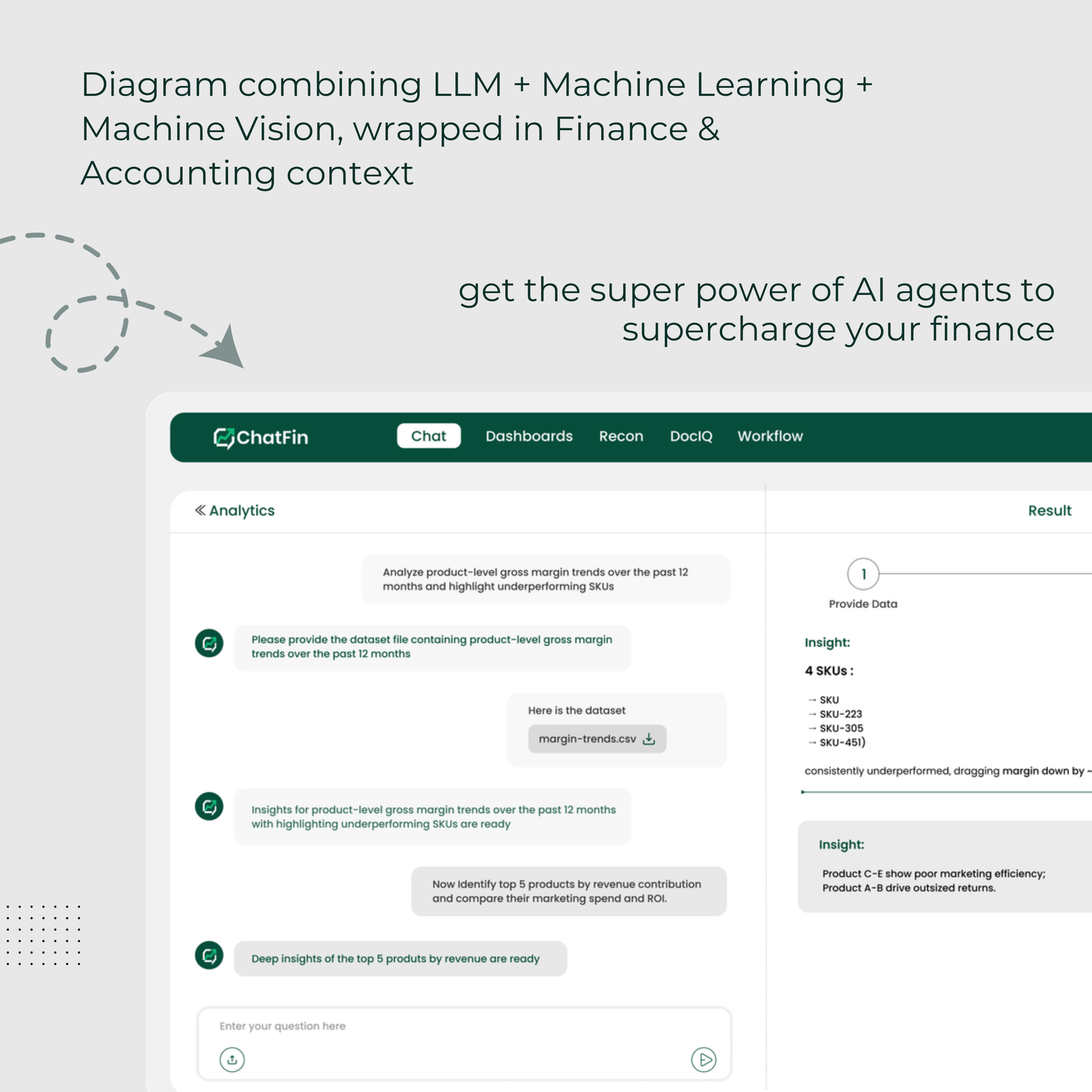
Copilot is a horizontal AI layer that adds intelligence to general productivity tools; ChatFin is a vertical AI platform built specifically for finance workflows. The breadth of Copilot is its strength for general productivity, and the depth of a finance-native platform is its strength for finance transformation. The smartest organizations use both: Copilot for communication, analysis and presentation tasks, and ChatFin for the production finance workflows AP automation, reconciliation, close management where domain expertise and ERP integration determine outcomes.
Building finance automation on a productivity copilot is like using Excel to run your ERP: it works for simple cases but breaks down at production scale.

What This Means for Finance Leaders
If your organization is deploying Copilot across the enterprise, finance teams will get value from it Excel Copilot alone can justify the investment for FP&A productivity, Teams summarization saves meeting overhead, and the compliance framework provides governance. But do not confuse Copilot deployment with finance transformation. The workflows that consume 60 to 80 percent of finance capacity transaction processing, reconciliation, close activities and compliance documentation require purpose-built automation. Copilot will not match invoices to purchase orders, reconcile bank statements across entities, or manage a close checklist with segregation of duties.
Microsoft Copilot 365 for Excel expanded its financial-analysis capabilities with automated statement analysis, AI variance explanations and natural-language formula generation. Teams report spreadsheet-analysis time down 40 to 60 percent, with fewer formula and data-consistency errors.
Best-in-Class Productivity AI, Not a Finance Operations Platform
Copilot is the most comprehensive enterprise AI deployment in history, and for general productivity it is the clear leader. But breadth is not depth. Finance operations require domain knowledge, specialized workflow automation, ERP connectivity and compliance controls that horizontal AI cannot provide.
ChatFin is the finance-native layer that complements your Microsoft investment, automating the production workflows Copilot was never designed to handle.