
LLaMA 3 On-Premise AI: Privacy-First Finance Automation with Open Models
There is one requirement that no amount of vendor assurance can satisfy: the ledger cannot leave the building. For finance teams under that constraint, open-weight models are not a philosophical preference. They are the only architecture that works, because the weights come to your data instead of your data going to someone else's API.
- Security teams routinely approve self-hosted open weights running on internal hardware while explicitly prohibiting the same model's hosted API. The model is not the risk. The data path is.
- Meta's Llama family is the most widely deployed open-weight ecosystem, and it remains the default starting point for teams that want inference with no per-token API call leaving the network.
- Llama 3 (8B and 70B) is still the workhorse for on-premise finance deployments. Llama 4 Scout, at 109B total parameters with 17B active, is the current option when you need a larger context window.
- The weights are free. The operation is not. Budget for GPU capacity, an inference stack (vLLM or NVIDIA NIM), quantization work, monitoring, and a migration path when a better model lands.
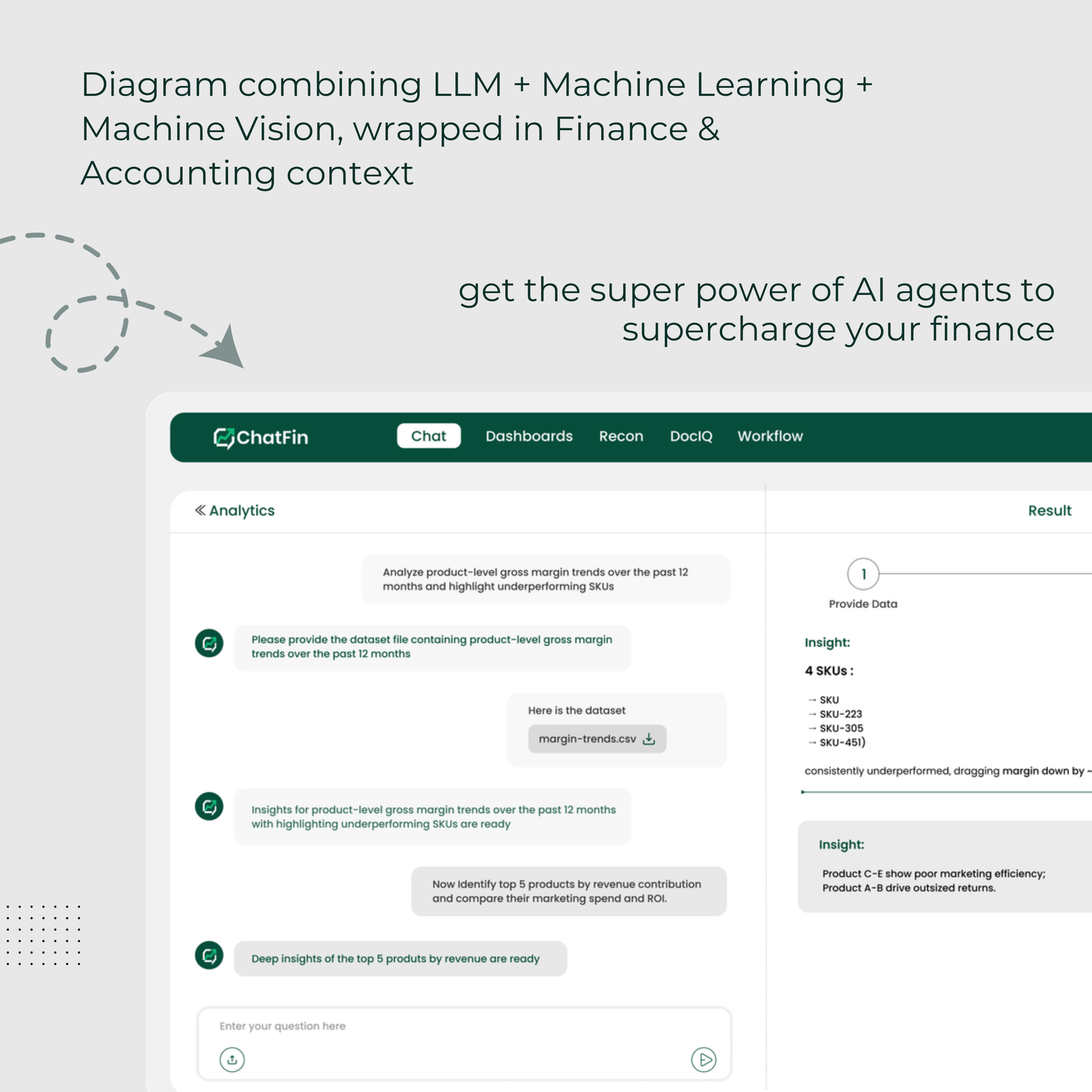
- ChatFin is model-agnostic by design, so the reasoning layer can sit on self-hosted open weights inside your own boundary rather than on a third-party endpoint.
Most conversations about AI in finance skip the only question the security review actually cares about. Not how accurate the model is. Not what it costs per million tokens. Where does the general ledger physically go when a question is asked about it?
For a regulated bank, a government contractor, a healthcare group under HIPAA, or any European entity with a strict data-residency position, the answer has to be nowhere. That single constraint eliminates the entire hosted-API category and lands you, by elimination, on open weights running on hardware you control.
Why open weights are the only answer to a data-residency constraint
A hosted API is a data-processing agreement with a third party. You can negotiate zero-retention terms, you can encrypt in transit, you can get the SOC 2 report. What you cannot do is make the tokens not leave. For most companies that is a perfectly acceptable trade. For a subset, it is a hard stop, and the pattern shows up repeatedly in security reviews: the same model that is blocked as a hosted service is approved when the weights are downloaded and served on internal infrastructure.
Which model, in practice
Llama 3 opened this door and it is still the model most on-premise finance deployments actually run. The 8B variant serves classification, extraction, and routing tasks comfortably on a single GPU. The 70B variant handles reasoning tasks that matter, at a hardware cost most mid-market finance teams can justify. Llama 4 changed the ceiling: Scout carries 109B total parameters with only 17B active per token, which makes a very large context window practical on a single high-end GPU. Maverick, at 400B total across 128 experts, needs a multi-GPU rack and is not a laptop exercise no matter what the word open implies.
"The model is not the risk. The data path is. That is why a security team will block the API and approve the weights."
The honest operating cost
Free to download quietly becomes expensive to operate the moment you need real uptime. Published analysis of realistic minimum production self-hosting lands in the range of $125,000 to $190,000 a year once you count infrastructure, the engineer who keeps it up, and the recurring work of migrating to whatever model beats the current one six months later. That is still frequently cheaper than API spend at volume, but it is not zero, and pretending otherwise is how open-source projects get cancelled in month seven.

What this means for a finance stack specifically
Finance data is the hardest case for a hosted model and the easiest case for a self-hosted one. It is structured, it is bounded, and the questions asked of it are repetitive. You are not asking a model to be creative. You are asking it to reconcile, classify, extract, and explain against a chart of accounts it has seen ten thousand times. That is exactly the workload where a well-tuned open model closes most of the gap with a frontier API, and where the remaining gap matters less than the fact that the data never moved.
Keep the Ledger Where It Is. Bring the Model to It.
ChatFin is model-agnostic by design. The reasoning layer can run against self-hosted open weights inside your own network boundary, or against a hosted API where policy allows, without changing the ERP integration underneath. Talk to us about the deployment shape your security review will actually approve.
If the answer to "where does the ledger go" is "nowhere," you do not have a model problem. You have an architecture requirement, and open weights are the only architecture that satisfies it.