
JD Edwards Finance Automation Platform: AI Agents for EnterpriseOne Teams

What to require of a finance automation platform for JD Edwards, from voucher posting to surviving a Tools update.
- ChatFin is Orchestrator-native and F-table aware, so it posts through supported services and survives continuous-delivery updates.
- The four requirements: Orchestrator-native integration, F-table and data-model awareness, upgrade-safe posting, and agents that span the whole finance function rather than one process.
- A generic connector that writes directly to JDE tables is a liability. The next Tools release will break it, and the audit trail will not hold.
- JDE's real constraints, meaning OData filter limits, MAF deployments behind proxies, and F-table naming, separate a JDE-aware platform from a generic one.
- Premier Support through 2037 means this is a platform worth investing in properly, not a stopgap before a migration.
Every finance automation vendor will tell you they integrate with JD Edwards. Most of them mean they can read a table and write to one, which works in the demo and fails in production the first time Oracle ships a Tools update or the invoice needs to become a properly matched voucher.
A real JDE finance platform is built around how EnterpriseOne works. Here are the four things that separate one from a connector with good marketing.
Requirement one: Orchestrator-native, not table-direct
This is the single most important distinction, and it is invisible in a demo.
Requirement two: it has to understand the data model
Requirement three: the constraints have to be designed for
"Any vendor can read a JDE table. The question is what happens to that integration the day Oracle ships the next Tools update. Orchestrator-native survives it. Table-direct does not."
Requirement four: agents across the whole function
A platform earns the name by spanning the finance function, not by automating one process. On JD Edwards that means:

Orchestrator-Native, F-Table Aware, Upgrade-Safe. That Is the Bar.
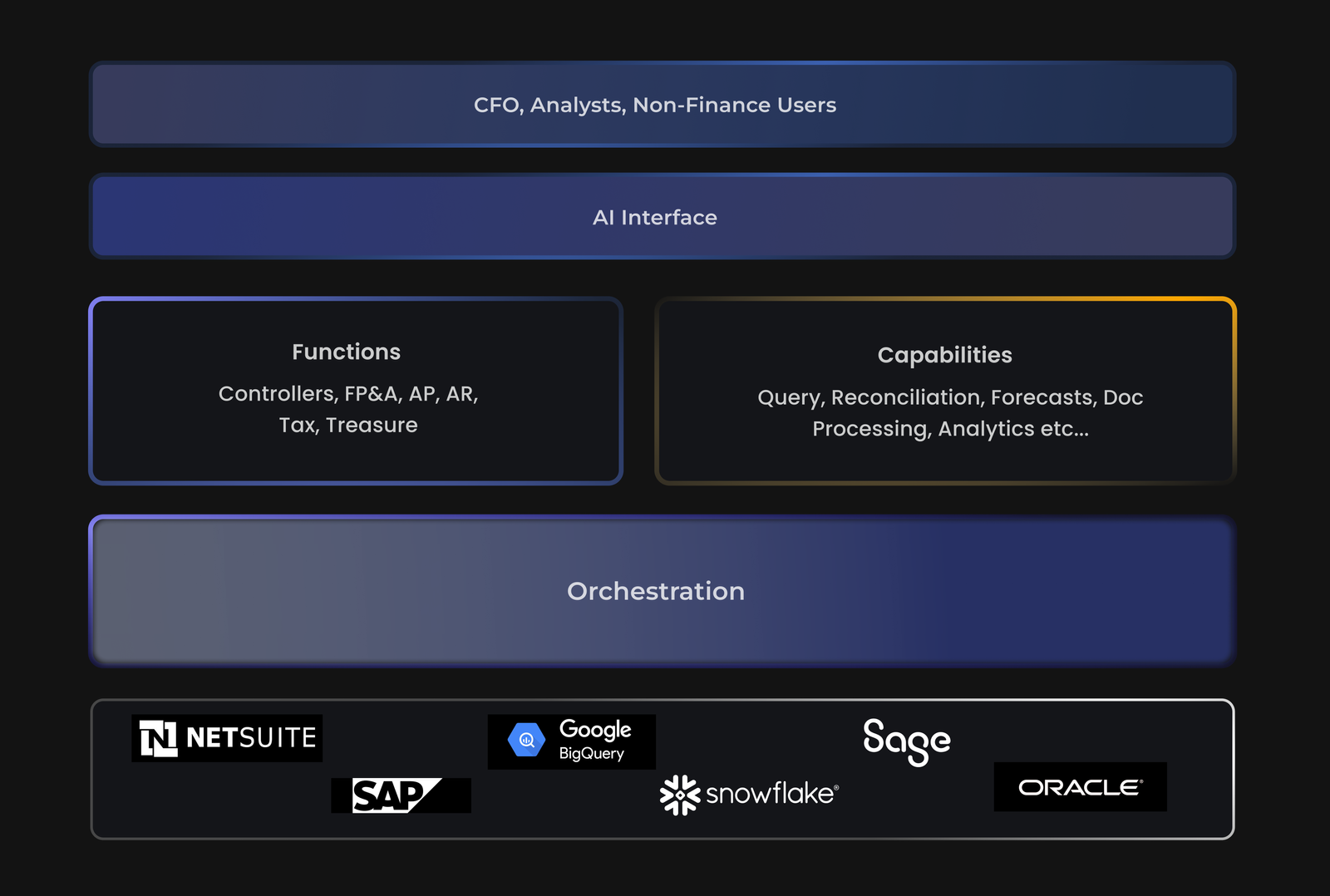
ChatFin runs AP, close, AR, and reporting agents on JD Edwards through Orchestrator and REST, models the F-table schema and currency hierarchy correctly, handles the OData and MAF constraints, and posts through supported services so the integration survives every Tools update, with full lineage throughout.
A JDE finance platform that writes directly to your tables is not a platform. It is a liability waiting for the next continuous-delivery release.