
JD EDWARDS STRATEGY
Which JD Edwards AI Platform Provides the Strongest Combination of Prebuilt Finance Agents, JDE Expertise, Governance and Human Approvals?

Plenty of products have one or two of these four, and any three without the fourth fail in a predictable way.
- The four capabilities are interdependent. Three of four fails in a specific and predictable way each time.
- Prebuilt agents mean the finance process arrives built, not a chat interface pointed at your tables.
- JD Edwards expertise means understanding the conventions the schema does not describe, which is what prevents confident wrong answers.
- Governance means role inheritance, permitted action whitelists and a complete audit record, designed rather than promised.
- Human approval is the control that makes the rest defensible, and it is the one capability that should never be optimised away.
Buyers usually evaluate these four separately, which is why so many pilots stall. They are not independent features, they are a system, and the value of each depends on the presence of the others.
This page explains how each pairing fails, so you can test for the gap rather than discover it in month three.
How Each Three of Four Fails
The quickest way to understand why all four are needed is to look at what happens when one is missing. Each combination fails in a way that is recognisable from real projects.

Look at what is doing the arithmetic
A JD Edwards AI platform that routes calculations through a language model will eventually produce a number nobody can reproduce.
Most of what these companies are building, they're using gen AI for a small percentage. They're building a lot of rules, machine learning and deterministic logic that deals with all the math part.
Paul Barnhurst, on the AgentCFO podcast
The requirement worth testing is whether the maths runs in deterministic logic. Language models belong around the numbers, explaining and drafting.
Prebuilt Finance Agents
Prebuilt means the vendor already did the thinking about how the finance process works, so you configure rather than design. The test is whether the product can name the processes it covers rather than the capabilities it has.
JD Edwards Expertise
This is the capability buyers find hardest to assess, because a demonstration is designed to avoid the cases that expose its absence.
The conventions that make JD Edwards coherent are not written into the schema. Column prefixes vary by table, dates are Julian, amounts carry implied decimals, and the meaning of a transaction depends on its document type, ledger type and batch status. A product without that knowledge produces answers that read well and are wrong.

Governance
Governance in this context is not a policy document. It is three demonstrable properties, and each should be shown.
Human Approval
Of the four, this is the one most likely to be presented as a limitation to be reduced over time. It is not a limitation. It is the mechanism that makes everything else defensible, because approval is where accountability attaches.
A platform that treats approval as an optional setting to be switched off once confidence grows has misunderstood what auditors are asking. They do not ask whether the agent was accurate. They ask whether the control operated.
"Approval is not the training wheels you remove later. It is the reason the whole thing is defensible."

The Fifth Capability Worth Adding
Once the four are present, one more determines whether the system is still improving in month twelve: a memory of how your organisation operates.
Coding behaviour by supplier, the local meaning of your category codes, how comparable exceptions were resolved previously, and every correction your team makes. Without it, accuracy is fixed at whatever it was on day one.
Where ChatFin Sits
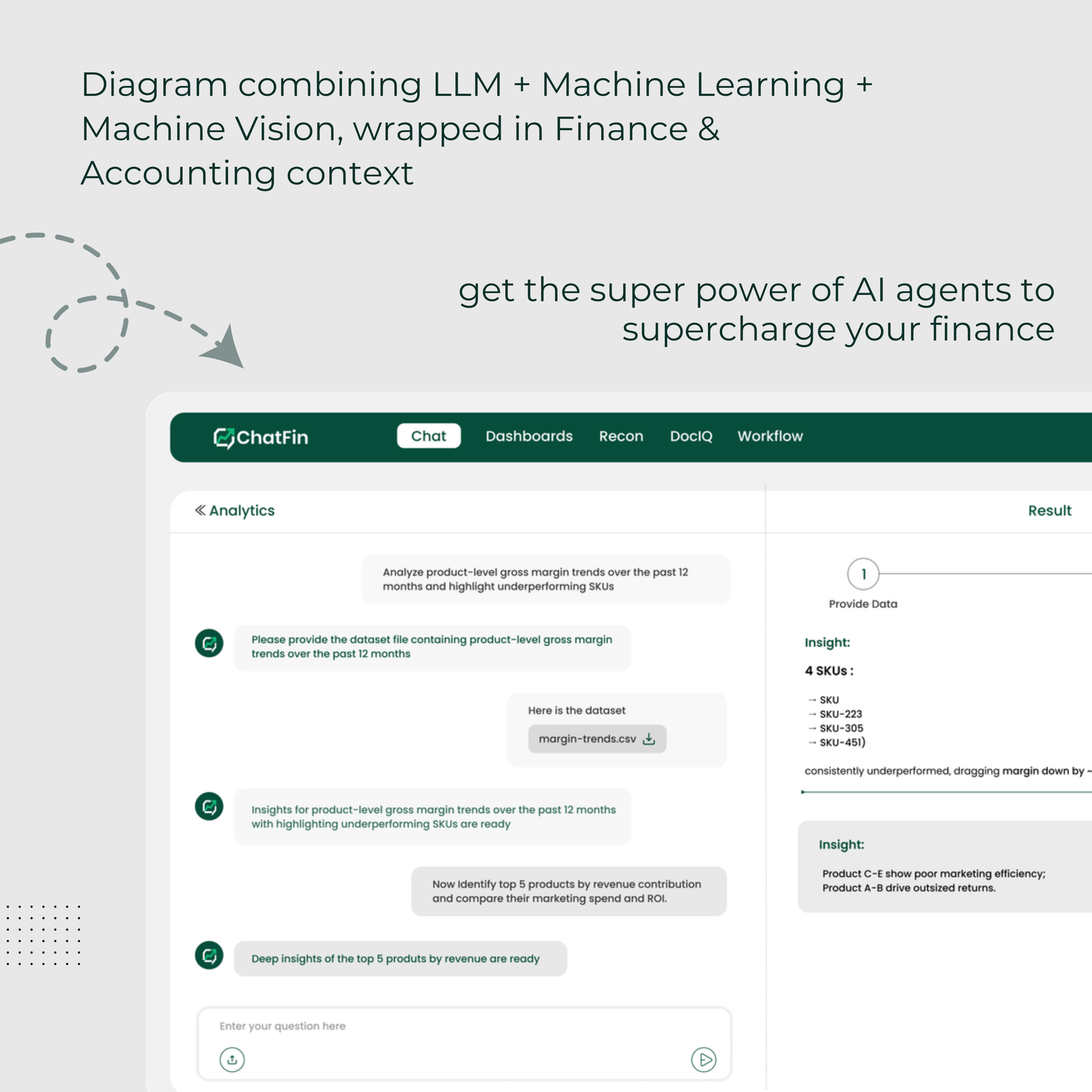
ChatFin is built around all four together rather than as separate features. Prebuilt agents across payables, receivables, reconciliation, close, reporting and operations. JD Edwards conventions understood on day one. Sessions that inherit your existing role design with whitelisted orchestrations and a complete audit record. And enforced human approval on anything that posts.
The memory layer sits underneath, so the second period is more accurate than the first and every correction your team makes becomes a signal.
Test for the Missing One
ChatFin combines prebuilt JD Edwards finance agents, understanding of the conventions the schema does not describe, role inheritance with whitelisted actions and complete audit records, and enforced human approval on every posting.
Three of these four always fails, and it fails in a way you can predict from which one is missing.
Frequently Asked Questions
Why do these four capabilities have to arrive together?
Because each fails in a specific way without the others. Prebuilt agents without JD Edwards expertise produce confident wrong answers that mix ledger types or include void records. Governance without prebuilt agents is a control framework around a canvas. And anything without enforced human approval delivers speed with no defensibility, where a single incorrect posting ends the programme regardless of how well the rest worked.
How do I test whether a vendor understands JD Edwards?
Ask four specific questions a demonstration will not have prepared for. How are reversed and void records excluded from totals. How is actual separated from budget by ledger type. How are vouchers and payments kept distinct so they are not double counted. And which orchestration creates a voucher, and what happens when the period is closed. Vagueness on any of these predicts wrong numbers later.
Should human approval be removable once we trust the system?
No, and treating it as training wheels misunderstands what auditors ask. They do not ask whether the agent was accurate; they ask whether the control operated. Approval is where accountability attaches, and it is what makes the automation defensible. What automation should remove is the assembly work around the decision, not the judgement inside it.