
Finance Transformation Requires Redesigning Workflows, Data, and Ownership: Not Just Tools
Buying an AI tool without redesigning workflows, data ownership, and accountability guarantees failed ROI. Finance transformation is an operating model change, not a software purchase. 70% of digital transformations fail because organizations underestimate the process and people work required.
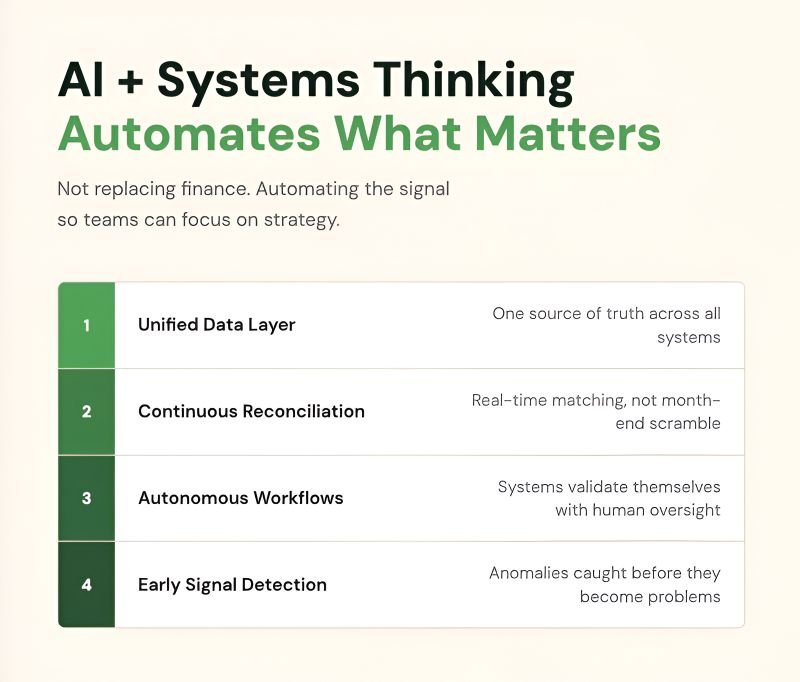
- Transformation Failure Rate 70% of digital transformations fail to meet objectives, primarily because of inadequate process and people change. Tools amplify broken processes.
- Workflow Redesign First Organizations that redesign workflows before deploying AI see 3x higher automation ROI. The tool is secondary to the operating model.
- Data Ownership Barrier 54% of finance teams cite undefined data ownership as the top barrier to AI adoption. Without clear ownership, data quality fails and AI outputs become unreliable.
- Accountability and Ownership Role clarity and task ownership must be redesigned before tools. Ambiguity about who owns which processes guarantees transformation failure.
- Operating Model vs Software Finance transformation is fundamentally an operating model change. Tool selection is the last decision, not the first. Process comes first.
Finance leaders often approach transformation backwards. They identify a pain point, research tools, and buy something. The tool arrives. Consultants implement it. Nothing changes operationally, and the project fails.
The pattern repeats across industries. 70% of digital transformations miss their targets. The common denominator: they treated transformation as a technology problem when it is fundamentally a process and operating model problem.
Why Tools Fail Without Workflow Redesign
70% of digital transformations fail to meet their targets. The majority fail because of inadequate process and people change, not technology limitations. Organizations that buy tools expecting them to fix broken workflows guarantee failure.
A tool deployed into a broken workflow simply makes the broken workflow faster. If your close process is siloed between multiple systems with unclear ownership, an AI tool will just accelerate the same silos. The transformation fails silently.
Data Ownership Is the Hidden Barrier
54% of finance teams cite lack of defined data ownership as the top barrier to AI adoption. Without clear ownership, data quality degrades and AI outputs become unreliable. Most organizations have data. Few have clear owners.
When no one owns the GL reconciliation process, it drifts. When no one owns customer master data quality, duplicates proliferate. Deploy an AI system into that environment, and it learns from corrupted inputs. The problem is not the tool. It is structural.
Role Accountability Determines Success
Finance teams often have fuzzy role definitions. The senior analyst does reconciliations. Sometimes. The accountant handles manual entries. Usually. When responsibilities blur, they do not get done. Organizations that redesign finance workflows before deploying AI see 3x higher automation ROI. The difference is clarity.
Transformation requires defining roles tightly: Who owns the GL? Who approves exceptions? Who investigates variances? Who responds when the system flags an anomaly? If those answers are unclear before the tool arrives, they will be unclear after.
Tools amplify broken processes. Transformation requires fixing the operating model first, then deploying technology to support it.
What Successful Finance Transformation Looks Like
Organizations closing the books in 3 days and staying there did not buy the right tool. They redesigned their workflows. They clarified data ownership. They redefined roles. Then the tool made them efficient.
The sequence matters: (1) Map current workflows and identify bottlenecks. (2) Define owners for critical data sets. (3) Redesign workflows for clarity and speed. (4) Restructure roles and accountability. (5) Deploy tools that support the new operating model. Skip any step, and transformation fails.
Transformation Is Not a Technology Project
Finance leaders evaluating AI platforms should begin with their operating model, not feature lists. The best tool in the world will not fix a finance organization with unclear ownership, fuzzy workflows, and role ambiguity. The worst tool will amplify those problems.
Successful finance transformation starts with process and people. Tools are the last decision, not the first. Get the operating model right, then deploy automation to support it.
Research & Sources
The ChatFin Advantage
ChatFin works inside your ERP and operates within your redesigned workflows and data model. The platform does not replace your operating model design. It amplifies it. Organizations that deploy ChatFin after clarifying data ownership, redesigning workflows, and redefining roles see immediate results: faster close, cleaner data, and finance teams freed from manual work.
Learn more: Financial Close Automation Guide