
Finance API Integration: Eliminating Manual Data Entry with AI
65% of financial institutions implement AI for data analysis and processing. API-driven finance automation eliminates manual data entry, reduces integration failures, and connects ERP systems, banks, and third-party platforms in real-time. Here is how finance leaders are building seamless, AI-powered system architectures in 2026.
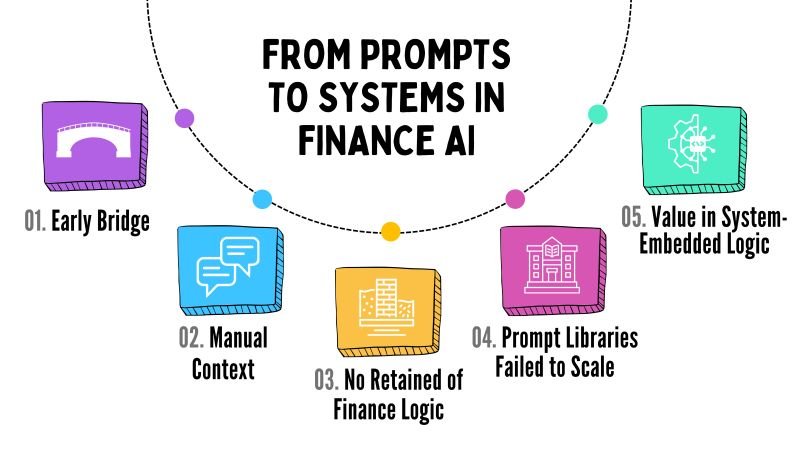
- Institutional Adoption 65% of US financial institutions actively implement AI for data analysis and document processing.
- Market Growth Global AI in finance market projected at $73.9B by 2033, up from $17.7B in 2025, at 19.5% CAGR.
- API Architecture Monolithic systems replaced by modular, API-driven architecture enabling real-time data exchange and seamless integration.
- RPA to AI Evolution Finance automation evolved from rule-based RPA to adaptive AI agents capable of learning and decision-making.
- Integration Challenges RPA/API breakage is the #1 cause of automation failure; AI agents handle dynamic system changes seamlessly.
Finance teams spend thousands of hours transferring data between systems. AP invoices move from email to OCR to ERP. Bank transactions flow from banking platforms to accounting systems. Payroll data transfers from HR to GL. Each handoff is a manual step, a point of failure, and a source of error. API-driven AI automation eliminates these handoffs by connecting systems directly and automating the data translation, validation, and posting.
From Monolithic to Modular Finance Architecture
The era of monolithic ERP systems managing all finance functions is ending. API-driven architecture enables finance teams to assemble best-in-class solutions: core ERP for GL, specialized platforms for AP, treasury, FP&A, and AI agents orchestrating them all.
APIs are the connective tissue. They enable real-time data exchange between systems. Rather than batch uploads every night, data flows continuously. Invoices are processed instantly. Bank balances update in real-time. GL balances cascade automatically. Modular architecture gives CFOs flexibility to choose best-of-breed solutions while maintaining seamless data flow.
The AI vs. RPA Evolution
Finance automation started with RPA (robotic process automation). Bots performed repetitive tasks: read email, extract invoice number and amount, enter into ERP, save approval. The problem: bots break. When ERP screen changes, API endpoint moves, or bank portal redesigns, the bot fails and manual processing resumes. Bots are brittle.
AI agents are different. They understand context, adapt to screen changes, and handle exceptions. Instead of a script that reads one field from one location on one screen, an AI agent understands "extract the invoice total" and finds it regardless of where it appears. AI agents reduce integration fragility and handle dynamic system changes automatically.
Real-World Integration Scenarios
Consider accounts payable automation. A traditional RPA approach requires separate bots for email processing, invoice matching, PO verification, and ERP posting. Each bot breaks independently. Instead, API-driven AI orchestrates the entire workflow: email arrives, AI extracts invoice data using vision models, matches to PO via API call to procurement system, queries GL via ERP API to verify coding, and posts to ERP automatically. When a bank portal changes its website, the vision model adapts instantly because it understands the semantic meaning of fields, not their pixel location.
Treasury provides another example. Instead of downloading bank statements, formatting them for import, and posting manually, API integration with banking platforms delivers real-time transaction data. AI reconciles it against GL postings, flags anomalies, and updates cash forecasts in real-time. Treasury teams gain intraday visibility into cash positions instead of waiting for end-of-day statements.
API-driven AI automation reduces integration fragility and handles dynamic system changes automatically.
Institutional Adoption and Market Growth
The shift is accelerating. 65% of US financial institutions are implementing AI for data analysis and processing. Top use cases include data analysis and reporting (47%), document processing (41%), and credit underwriting (35%). Cloud-based integration platforms are commoditizing API connectivity, making integration affordable for mid-market companies, not just enterprises.
The Bottom Line
Finance automation is moving from rigid, brittle RPA to adaptive, intelligent AI agents orchestrated through APIs. Organizations that build API-first architecture with AI agents reduce integration failure, eliminate manual data entry, and gain real-time visibility across systems. By 2026, finance teams without API-driven automation are managing finance with spreadsheets and manual processes. Those with it are operating autonomous finance systems that run end-to-end without human intervention.