
JD EDWARDS SECURITY
Can JD Edwards AI Agents Be Deployed in a Private Cloud, OCI, Azure, AWS or an On Premises Environment?

Most teams asking about hosting want to know where their ledger data goes and who else can see it.
- The architecture is the same everywhere. An agent layer, a gateway, the AIS Server and orchestrations, wherever those components physically sit.
- On premises JD Edwards works exactly as cloud hosted does, since AIS is reachable from within your own network.
- The decision that matters is where the model runs and under what data handling terms, not where the agent is hosted.
- Latency between the agent and the AIS Server matters more than most teams expect, so co locating them is worth doing.
- ChatFin deploys across OCI, Azure, AWS, private cloud and alongside on premises JD Edwards with the same control design.
Deployment questions arrive early in most evaluations and are usually a proxy for something else. Behind can it run in our environment is generally a concern about data leaving the organisation, regulatory obligations, or an existing cloud commitment somebody has to justify.
All three are legitimate. They just have different answers from the hosting question itself.
Why the Architecture Does Not Change
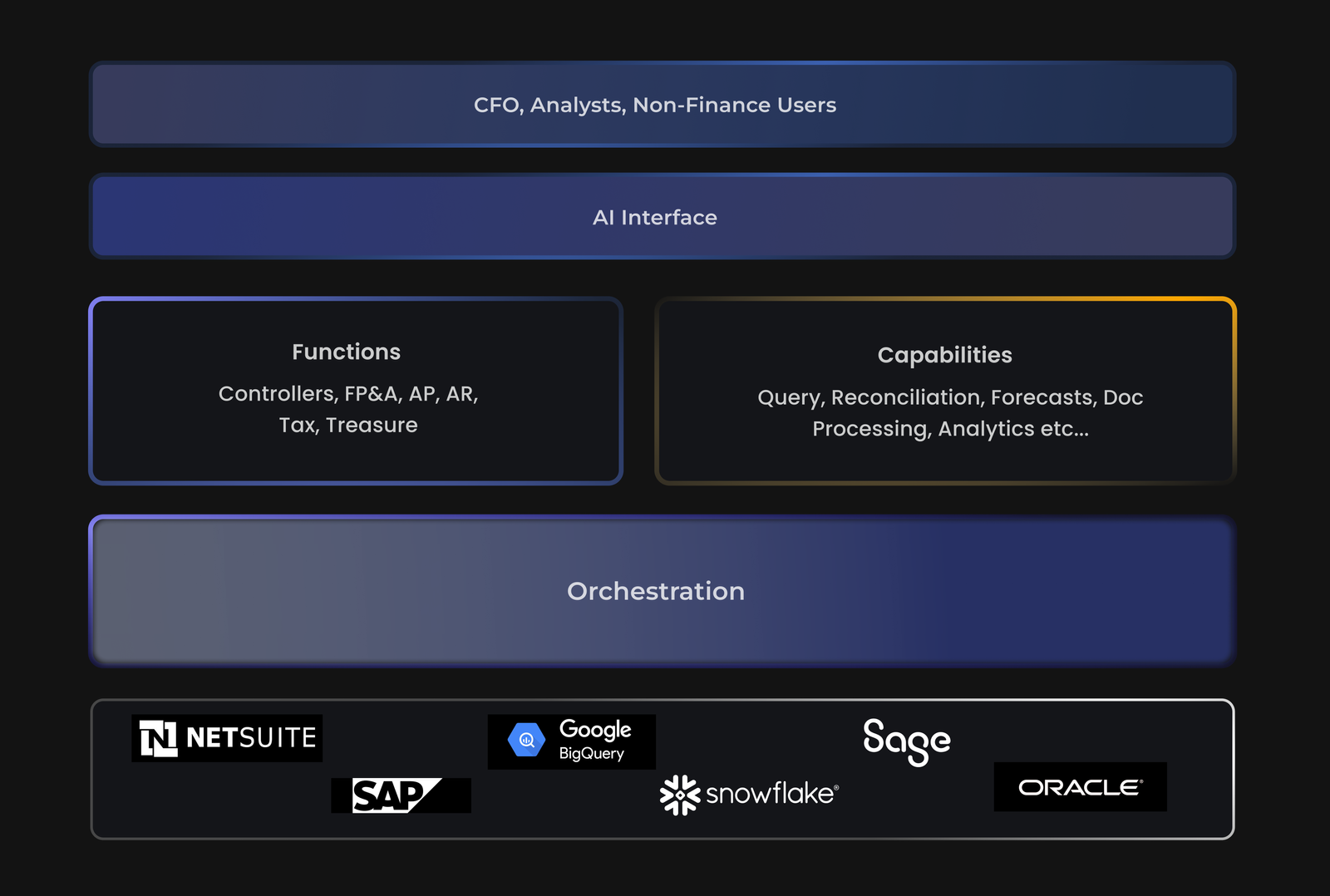
The components are the same regardless of where they run: an agent layer holding the finance logic, a gateway, the AIS Server, and a set of published orchestrations.
None of those depends on a particular hosting model. The agent reaches the AIS Server over the network, and whether that network is your data centre, a private cloud or a public cloud region changes the routing and not the design.
Your data stays in your perimeter
Running agents in your own cloud tenancy settles the question most security reviews start with: where the finance data goes during processing.
As you get higher up in the licensing, it gives you more self-contained your data stays protected, but you can still go research and stuff.
Chris Ortega, on the AgentCFO podcast
The architecture below is identical whichever cloud hosts it. What changes is who holds the keys, and in this case it stays you.
On Premises JD Edwards
A large share of JD Edwards estates are still on premises and this is entirely workable. The AIS Server is reachable from within your network, so an agent running in the same network reaches it exactly as any internal service would.
The only additional decision is where the model runs, since a model hosted outside your network means a call leaves the boundary. That is a data handling question with several answers.
OCI, Azure and AWS
Each is a reasonable choice and the decision is usually made for you by existing commitments and where your JD Edwards instance already runs.
The consideration worth adding is proximity. Running the agent in the same region as your ERP reduces latency on every call, and a conversational interface making several sequential calls is noticeably affected by round trips in a way that a batch process is not.
The Question Being Asked
Hosting is rarely the real concern. The real concern is what happens to ledger content, and that is determined by where the model runs and under what terms rather than by where the agent is deployed.
Three points settle it. What is sent to the model, whether the provider retains it, and whether it could be used for training. Those are contractual and configuration questions, and they should be answered explicitly before architecture is finalised.
Data Residency
Where residency obligations apply, they attach to where data is processed and stored rather than to where an application is administered. That makes the model's region the important variable.
Major providers now offer regional deployment options, so the usual answer is to select a region that satisfies the obligation and to document the data flow. What matters for a review is that the flow is described accurately.
"Nobody cares where the agent is hosted. They care where the ledger content goes and who keeps a copy."

Practical Considerations by Environment
A few things that are easy to overlook and cause friction after the decision is made.
How ChatFin Deploys
ChatFin runs on OCI, Azure, AWS, private cloud and alongside on premises JD Edwards, with the same control design in every case: role inheriting sessions, whitelisted orchestrations, enforced approval and complete audit records.
Model selection and region are configurable, so data handling and residency obligations can be met without changing the architecture, and nothing is installed inside EnterpriseOne in any deployment option.

Deploy Anywhere, Decide the Data Flow Deliberately
ChatFin deploys across OCI, Azure, AWS, private cloud and on premises environments with identical controls, and model selection and region are configurable to meet data handling and residency obligations.
Hosting is the easy question. Where the ledger content goes, and who keeps a copy, is the real one.
Frequently Asked Questions
Can AI agents work with an on premises JD Edwards instance?
Yes, and it is straightforward. The AIS Server is reachable from within your network, so an agent running in the same network reaches it exactly as any internal service would, with no inbound exposure required. The only additional decision is where the model runs, since a hosted model means a call leaves your boundary. That is a data handling question with several answers.
Does the cloud provider choice matter?
Less than most evaluations assume. The architecture is identical across OCI, Azure, AWS and private cloud, and the decision is usually made by existing commitments and by where JD Edwards already runs. The consideration worth adding is proximity: co locating the agent with the ERP reduces latency, which matters because a conversational interface makes several sequential calls per question.
How are data residency obligations handled?
Residency attaches to where data is processed and stored, which makes the model's region the important variable rather than where the agent is administered. Major providers offer regional deployment options, so the usual approach is selecting a region that satisfies the obligation and documenting the data flow. Remember the audit trail is data too, so its location should be deliberate.