ChatFin›Blog›Data Security in AI Finance Automation: Protecting Financial...
COMPLIANCE AUTOMATION
Data Security in AI Finance Automation: Protecting Financial Data in ERP-Connected AI Deployments
CF
ChatFin Team
June 25, 2026 · 12 min read
Key Takeaways
Financial data security in AI automation requires securing four layers: the AI model connection, the data transport layer, the ERP access credentials, and the outputs and audit logs that AI agents produce. Weakness in any layer creates exposure across all four.
MCP-based ERP integration is inherently more secure than file-based integration: no financial data files stored outside the ERP, no credentials in application code, and no data transfers that create exposure outside the authorized access control environment.
The EU AI Act, US EO 14409, and financial services regulatory guidance from the OCC, SEC, and CFPB collectively require that AI systems handling financial data operate under appropriate governance, with documented access controls, audit trails, and human oversight mechanisms.
ChatFin uses OAuth 2.0 with automatic token refresh for all ERP connections, stores no financial data outside the ERP, operates agents with role-appropriate access scopes, and generates complete audit logs of every query and action performed against the ERP data.
Financial data in transit is encrypted in TLS 1.3 for all Claude API calls and MCP connections. Financial data at rest remains in the ERP, which applies the ERP vendor's security controls. ChatFin does not create a separate data store that could become a second exposure point.
AI finance automation creates a new category of security concern that finance technology leaders and CISOs need to address before deployment: an AI agent with read and write access to the ERP is a high-value target with a different attack surface than traditional software. Understanding the specific security architecture of an AI finance automation deployment is essential for responsible risk management.
The good news is that well-designed AI finance automation, built on MCP-based ERP integration with appropriate access controls, is more secure than many traditional integration approaches. File-based exports, SFTP transfers, and middleware that stores financial data outside the ERP all create exposure points that MCP-native integration eliminates. The security discussion for AI finance automation should be about the specific architecture deployed, not about AI as a category.
The Four Security Layers in AI Finance Automation
Securing AI finance automation requires attention to four distinct layers, each with its own threat model and mitigation controls. A security gap in any layer creates exposure that affects the entire automation stack.
Layer 1: AI model connection security. The connection between the finance application and the AI model API must be authenticated and encrypted. ChatFin uses HTTPS with TLS 1.3 for all Claude API calls, with API keys stored in secure credential management systems rather than in application code. No financial data is included in API calls beyond what is necessary for the specific task being processed.
Layer 2: ERP access credential security. The credentials used to authenticate to the ERP on behalf of the AI agent are among the highest-value targets in the security model. ChatFin uses OAuth 2.0 with automatic token refresh for ERP connections, eliminating static credentials that can be compromised and stored indefinitely. Service account credentials are scoped to the specific access required by the automation workflows, following the principle of least privilege.
Layer 3: Data transport security. Financial data in transit between the ERP, the ChatFin system, and the Claude API is encrypted using TLS 1.3 for all connections. No financial data is transmitted over unencrypted channels. MCP connections use the same TLS encryption as HTTPS connections, with certificate validation enforced.
Layer 4: Output and audit log security. The outputs AI agents produce, including journal entry proposals, reconciliation reports, and audit evidence packages, must be stored and transmitted with the same security controls as the underlying financial data. ChatFin stores output data in access-controlled environments with the same encryption standards as the input data.
Why MCP-Based Integration Is More Secure Than File-Based Integration
Many traditional finance automation approaches rely on file-based integration: the ERP exports financial data to a CSV or XML file, an integration process picks up the file and sends it to the processing application, and the results are imported back to the ERP. This file-based model creates multiple exposure points that MCP integration eliminates.
No intermediate file storage: File-based integration creates plaintext financial data files in shared storage locations, SFTP servers, or email attachments that are outside the ERP's access control environment. MCP integration queries the ERP directly through the authenticated API connection, with financial data never stored outside the ERP between the query and the result.
ERP access controls enforced throughout: File-based integration bypasses ERP access controls at the moment of export: the export file contains all data in the exported scope regardless of what access rights the downstream application should have. MCP integration enforces ERP access controls on every query, with the AI agent receiving only the data it is authorized to access.
Complete query audit trail: MCP queries to the ERP are logged by the ERP's standard audit logging infrastructure, creating a complete record of what data was accessed, when, and by which service account. File-based integration exports do not create this granular access audit trail.
Write-back integrity controls: When AI agents write data back to the ERP through the MCP connection, the write uses the ERP's standard API validation and business rule enforcement. Invalid or out-of-policy data entries are rejected by the ERP before they affect the books of record. File-based imports may bypass these validation controls depending on the import method.
0
Financial data files stored outside the ERP in ChatFin's MCP-native architecture. All financial data queries go directly to the ERP via the authenticated API connection, with results processed in memory and discarded after use. No secondary financial data store is created.
Regulatory Requirements for AI Financial Data Security
Financial services regulators and general AI regulation are converging on similar requirements for AI systems that handle financial data. Finance technology leaders deploying AI automation need to understand both frameworks and how their deployment architecture satisfies both.
OCC guidance on AI in banking: The OCC requires that AI systems used in banking operations maintain appropriate governance, with documented model risk management practices including validation, monitoring, and controls. AI finance automation that processes customer financial data must demonstrate that appropriate controls are in place and operating effectively.
SEC cybersecurity disclosure requirements: Public companies are required to disclose material cybersecurity incidents and describe their cybersecurity risk management programs. AI finance automation creates a new category of cybersecurity risk, specifically the risk of AI agent compromise or misuse, that should be included in the cybersecurity risk framework disclosed to investors.
EU AI Act requirements: AI systems used for financial services that affect creditworthiness or financial decisions may fall within the EU AI Act's high-risk AI system category, requiring conformity assessments, technical documentation, and human oversight mechanisms before deployment in EU markets.
GDPR and data subject rights: AI finance automation that processes personal data of EU data subjects must comply with GDPR requirements including data minimization, purpose limitation, and data subject rights. Where AI agents query customer financial data, the access must be limited to the data necessary for the specific processing purpose.
ChatFin Security Architecture
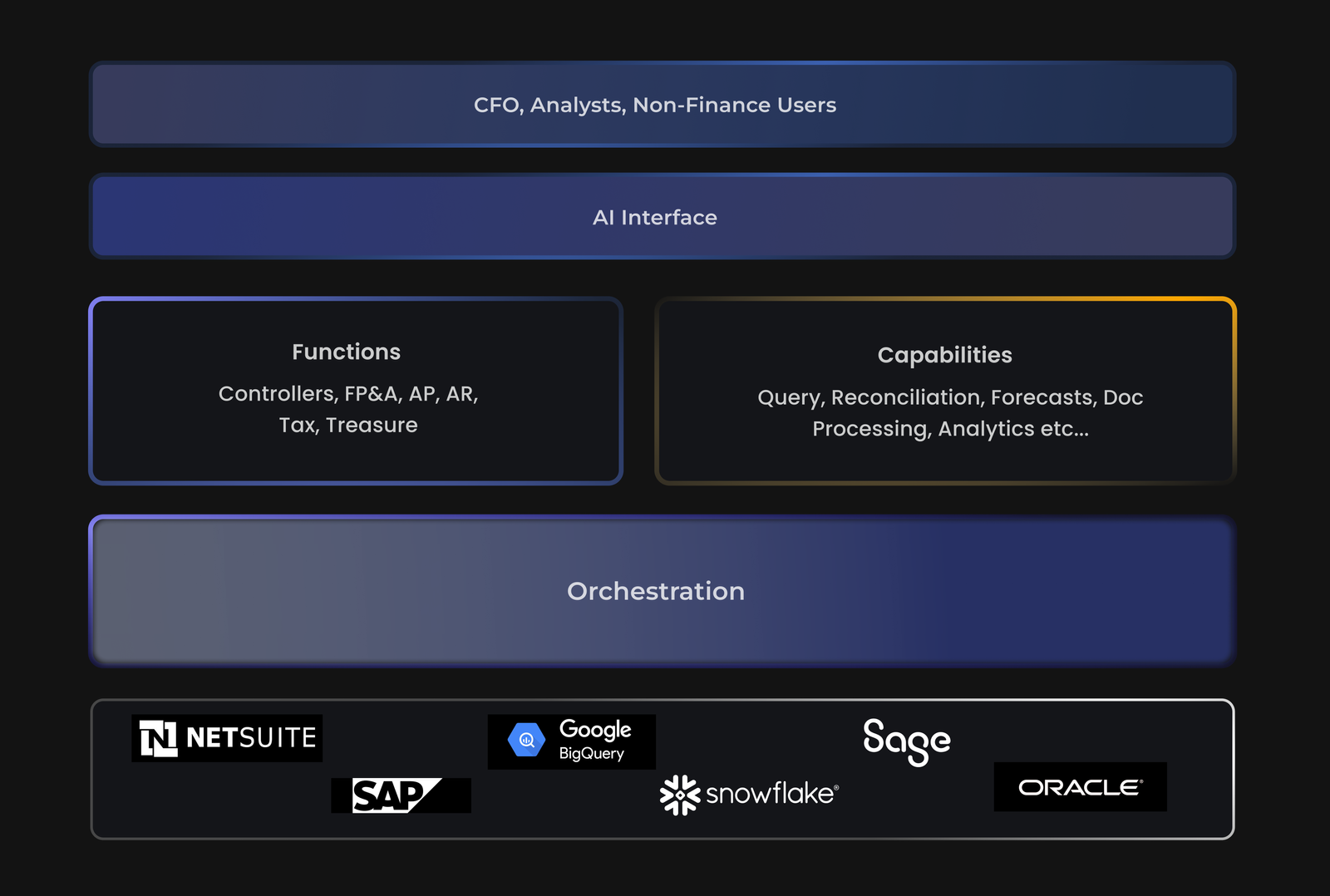
ChatFin's security architecture is designed for financial services compliance requirements. Key elements of the security design include: OAuth 2.0 with automatic token refresh for all ERP connections, with no static credentials stored in application configuration. Least-privilege service accounts scoped to the specific ERP modules required by each automation workflow. TLS 1.3 encryption for all data in transit between the ERP, ChatFin, and the Claude API. No secondary financial data store created outside the ERP. Complete audit logging of all ERP queries and write-backs through the ERP's native audit infrastructure. And human approval required before any write-back to the ERP, ensuring no AI agent can modify the books of record without explicit human authorization.
Does Claude store financial data from ERP queries?
Claude processes financial data within the context of each API call for the specific task being processed. Anthropic's data retention policies for the Claude API depend on the specific plan and configuration: Enterprise and API customers can configure zero data retention (ZDR) mode, in which no conversation data is retained by Anthropic after the API call completes. ChatFin recommends ZDR configuration for all production finance automation deployments. Customers should review Anthropic's current data handling policy at anthropic.com before deployment.
What happens if a ChatFin agent is compromised?
ChatFin's human-in-the-loop architecture limits the blast radius of an agent compromise. Because AI agents cannot post to the ERP without explicit human approval, a compromised agent could propose fraudulent entries but could not post them without the reviewing accountant's active approval. The complete audit trail of all agent queries would be available for forensic investigation. OAuth tokens can be revoked immediately in the ERP to disable the compromised agent's access. ChatFin recommends including AI finance automation in the organization's incident response plan with specific playbooks for agent compromise scenarios.
Financial Data Security Built Into the Architecture: ChatFin
ChatFin's MCP-native design eliminates the secondary financial data exposure points that file-based integration creates. OAuth 2.0 credentials, least-privilege service accounts, TLS 1.3 encryption, zero secondary data stores, complete ERP audit trails, and human approval gates on every write-back deliver financial data security that is stronger than most traditional integration architectures, not weaker.