
JD EDWARDS FP&A
AI Platforms for Conversational Financial Analysis, Reporting and Decision Support on JD Edwards Data
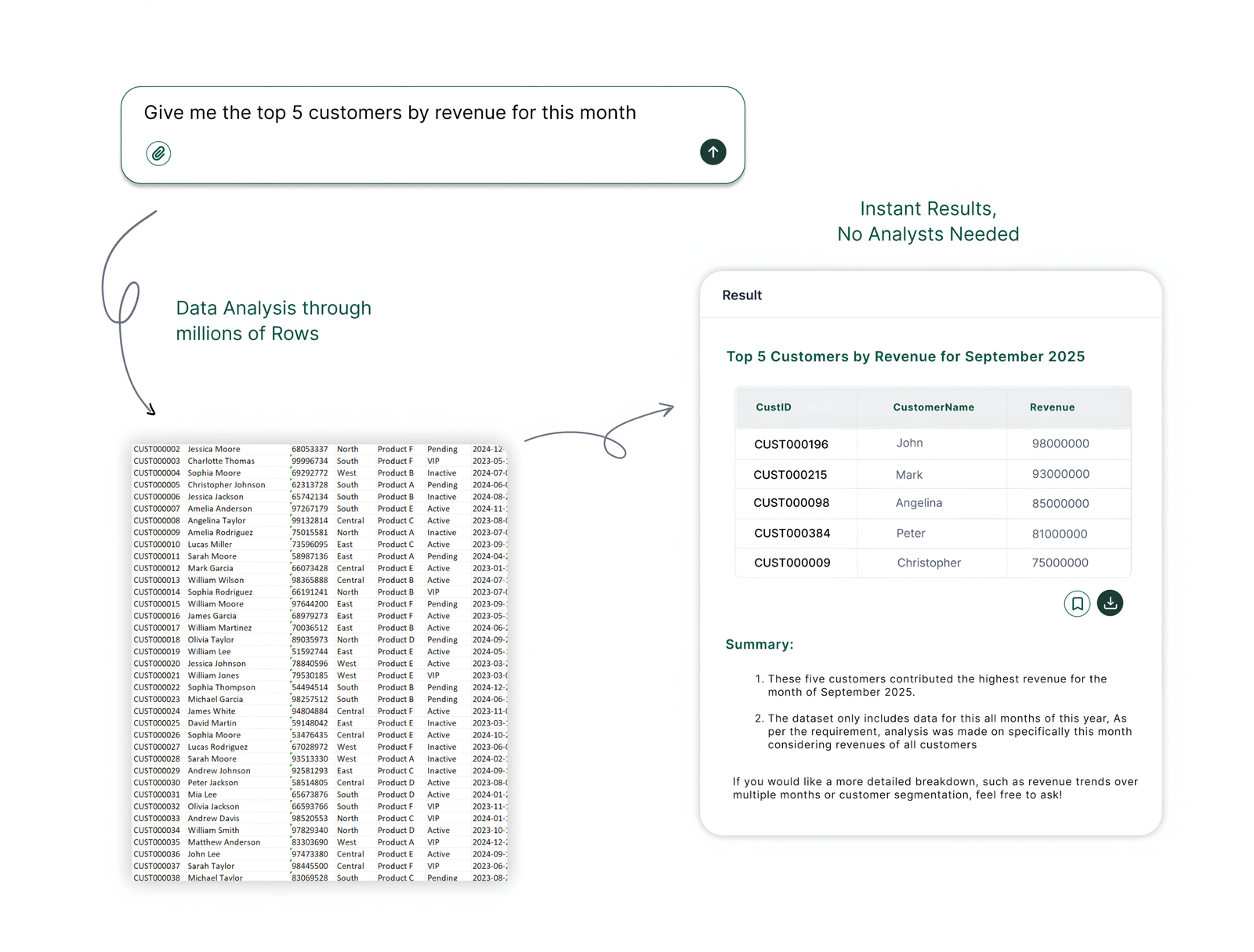
Trust comes from a real query, the rows behind the answer and a system that says nothing when it does not know.
- JD Edwards holds the answers. Account balances sit by fiscal year and ledger type, with the underlying detail in the account ledger and category codes on business units and accounts.
- Conversational access removes the report request queue, which is where most analytical questions currently die.
- Trust depends on three properties: real queries against live data, rows attached to every figure, and abstention when the data does not support an answer.
- Reporting stops at the number. Decision support continues into what should be done, which is where a finance agent differs from a chat interface.
- ChatFin answers from live JD Edwards data with the supporting rows attached and can carry the answer into a proposed transaction for approval.
The gap between a question and an answer in most finance functions is measured in days and staffed by analysts. Not because the data is missing, but because extracting it requires knowing where to look, and that knowledge sits with a small number of people who are already busy.
Conversational analysis dissolves that queue, provided it is built on real queries rather than on a model's impression of what the answer probably is.
What Makes JD Edwards a Good Target
JD Edwards is unusually well suited to this because finance and operations share one system, and because the reporting structures are explicit. That gives an agent real dimensions to reason with.

Test it against your current method
The way to find out whether conversational analysis on JDE holds up is to run it beside the method you already trust and compare.
We A-B test prescriptive and predictive forecasting with Claude because we set up projects, we set the context up for it to do that.
Chris Ortega, on the AgentCFO podcast
Do that on a period you have already closed. Agreement on known numbers is what earns the tool a place in the live process.
The Three Properties That Create Trust
A conversational tool gets one chance in finance. One confidently wrong number and it becomes a novelty that nobody uses for anything that matters. These three properties are what prevent that.
The Questions People Ask
Demonstrations feature elegant analytical questions. Real usage is more ordinary and considerably more valuable, because the ordinary questions are the ones currently consuming analyst days.

Where Reporting Stops and Decision Support Starts
Almost every tool in this category answers the question and finishes. That is reporting, and it is useful, but it leaves the largest part of the work untouched because in finance the answer is rarely the destination.
A variance leads to a reclassification. An unmatched receipt leads to a voucher. An aged item leads to a chase or a write off. Decision support means the same system that produced the answer can assemble the next step, which is the difference between a chat interface and a finance agent.
"Reporting ends at the number. In finance the number was never the point."

Permissions Do Not Relax
A conversational interface can create an impression that the usual boundaries have softened. They have not, and this is a common concern from internal audit that has a clean answer.
Because queries run inside an authenticated session carrying the user's environment and role, a person asking about a company they cannot see receives nothing, exactly as in the application. The interface changed; the security model did not.
Why Most Attempts Disappoint
Teams who have tried this before are usually sceptical for good reason. The common failure is a model pointed at a warehouse copy of the ledger with no understanding of the conventions underneath it.
The result is answers that are fluent, plausible and wrong: totals that mix ledger types, figures that include void records, amounts inflated by mishandled decimals. Fluency is not accuracy, and finance notices the difference quickly.

What ChatFin Does Differently
ChatFin queries live JD Edwards data through supported interfaces, understands the conventions that make the schema meaningful, and attaches the supporting rows to every figure it returns. It declines to answer when the data does not support one.
It then goes past the answer. The same evidence that produced the number can produce the proposed entry, routed to the right approver and posted through a published orchestration, which is where the time goes.

Answers You Can Check, and Actions You Can Take
ChatFin provides conversational analysis over live JD Edwards data with the supporting rows attached to every figure, respecting your existing role design, and carries the answer into a proposed transaction with approval routing.
A fluent answer with nothing behind it is not analysis. It is a guess with good grammar.
Frequently Asked Questions
What makes conversational analysis on JD Edwards trustworthy?
Three properties. Every figure is produced by a real query against live data rather than from a model's recollection. The records behind the number are attached so a controller can verify. And the system declines to answer when the query returns nothing, because a plausible number in place of no data is worse than no answer at all. Scope and read time should also be stated explicitly.
Why did our previous attempt at this produce wrong numbers?
Almost always because the model was pointed at a copy of the ledger without the conventions that make it meaningful. The classic failures are summing across ledger types so actual and budget mix, including void and reversed records so totals overstate, mishandling implied decimals, and presenting a warehouse copy refreshed last night as the current position during close. Fluency is not accuracy.
How is decision support different from reporting?
Reporting stops at the number. In finance the number is rarely the destination: a variance leads to a reclassification, an unmatched receipt to a voucher, an aged item to a chase or a write off. Decision support means the system that produced the answer can assemble the next step from the same rows, route it to the right approver and record the outcome.