
JD EDWARDS AI
How to Connect ChatGPT, Claude, Azure OpenAI or OCI Generative AI to JD Edwards EnterpriseOne

A language model reaches JD Edwards only through the tools you expose, how they authenticate and what you allow them to do.
- The model never talks to the database. It calls tools, and those tools call the AIS Server or a published orchestration, which is where authentication and permissions live.
- AIS authentication is token based. A call to the token request service returns a session token carrying username, environment and role, and later calls reuse it, so the JD Edwards security model still applies.
- Split tools into read and write. Read tools use the data service and form service. Write tools call a single purpose orchestration and return a reference, never raw table access.
- Model choice matters less than tool design. ChatGPT, Claude, Azure OpenAI and OCI Generative AI all work when the tool layer is correct, and all fail the same way when it is not.
- ChatFin is that tool layer, already built for finance, with approval gates in front of every write and a record of every call.
The most common failed attempt looks like this. Someone exports a general ledger extract, pastes it into a chat window, gets a plausible answer, and concludes the integration is nearly done. It is not. What made that demonstration work was a human doing the retrieval, and the moment you remove the human you need a real interface.
The good news is that JD Edwards gives you one. The AIS Server exposes REST endpoints, Orchestrator wraps applications and data into callable services, and both were designed for this kind of external caller. What follows is how the pieces fit.
The Architecture in One Paragraph
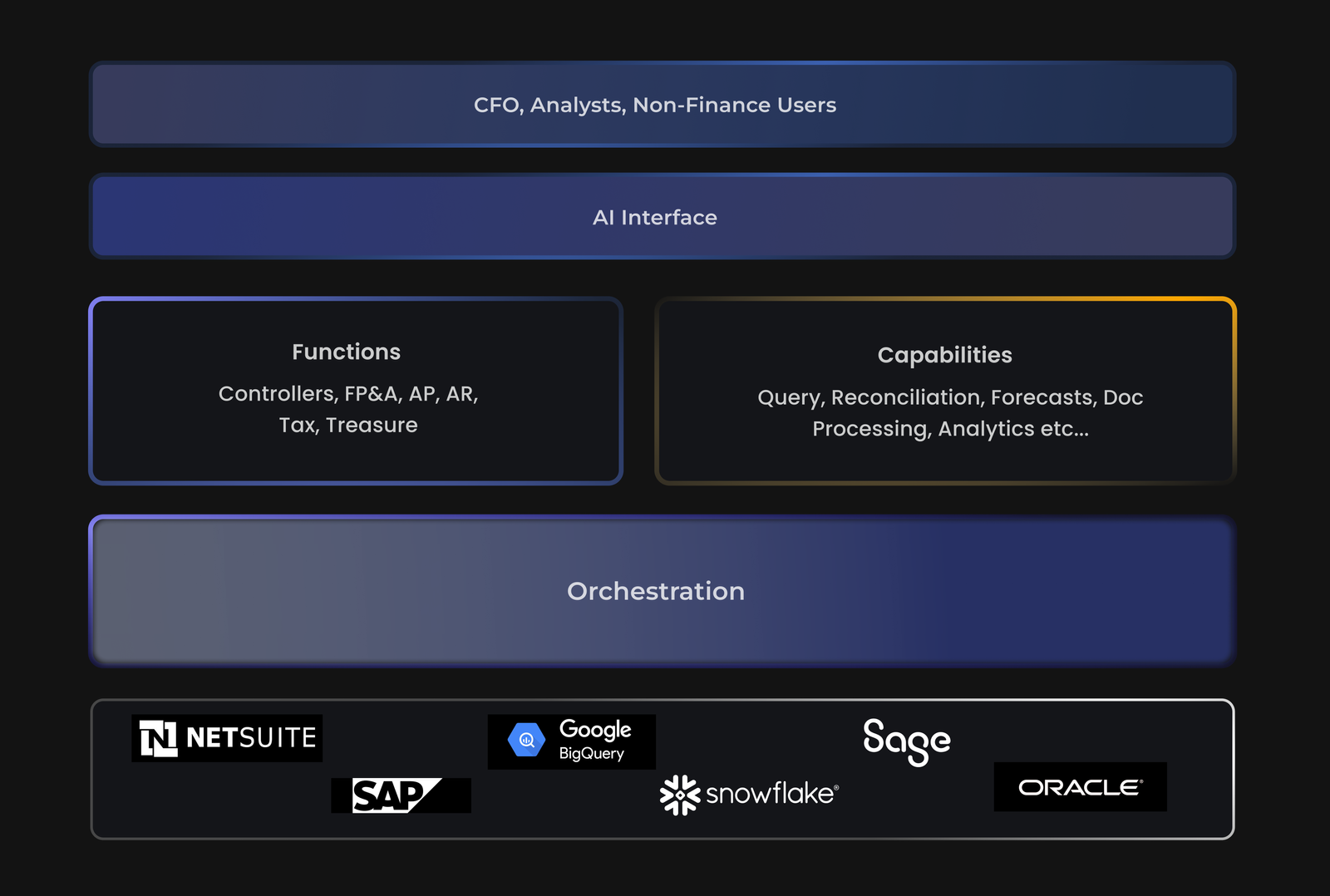
A user asks a question. The application sends the question to the model along with a list of tools it may call. The model picks a tool and supplies arguments. Your middle layer executes that tool against JD Edwards, applies whatever policy you have defined, and returns structured data. The model then explains the result. The model has no credentials, no network path to the ERP and no ability to invent a transaction, because everything it can do is an entry in that tool list.
It is already happening without you
Someone on your team has probably pasted JD Edwards output into a personal ChatGPT account already. The choice is between a governed connection and an ungoverned one.
You have people that are using these personal tools that are doing work for your business.
Chris Ortega, on the AgentCFO podcast
A sanctioned architecture like the one below is how you bring that usage inside your controls. Banning it rarely works.
Authentication Against the AIS Server
This is the part teams usually get wrong on the first attempt, either by embedding a single powerful account everywhere or by trying to open a session per request. The AIS token model is straightforward once you follow its intent.
Designing the Read Tools
Resist the temptation to expose a single generic query tool that accepts arbitrary SQL. It feels flexible and it produces an unbounded attack surface plus results nobody can validate. Narrow tools with typed arguments are easier to secure, easier to test and easier for the model to use correctly.

Designing the Write Tools
Writes need a different design philosophy from reads. A read that goes wrong returns a bad answer. A write that goes wrong creates a transaction in your ledger. The correct pattern is that the model never writes. It requests a write, and something else decides.
Model by Model, Briefly
Once the tool layer exists, the model is a component you can swap. The differences that matter in practice are deployment location, data handling terms and how well the model follows a tool schema under pressure.

The Controls Finance Will Ask For
Internal audit will not evaluate your prompt. They will ask who can do what, how it is evidenced, and what happens when it goes wrong. Design for those three questions from the beginning and the review is short.
In practice this means the agent's permissions are visible and limited, every action is logged with its inputs and approver, and there is a defined path for reversing something that should not have happened.
Build It or Adopt It
Building this yourself is entirely feasible and a competent team can get a read only assistant working in a few weeks. The effort is not the connection. It is everything after: the finance logic, the approval workflow, the audit record, the memory of how your organisation codes transactions, and the long tail of exception handling that decides whether people keep using it.
ChatFin is that layer as a product. It connects to JD Edwards through AIS and Orchestrator, exposes finance tools rather than raw table access, gates every posting behind human approval, and keeps the audit trail. You choose the model. The controls do not change.
"The model is the easy part. The tool layer between the model and the ledger is the product."
Connect the Model to a Controlled Layer, Not to the Ledger
ChatFin gives ChatGPT, Claude, Azure OpenAI or OCI Generative AI a governed path into JD Edwards through AIS and Orchestrator, with finance tools instead of raw queries, approval on every write and a full audit trail.
Every safe integration has the same shape: the model requests, the layer decides, a person approves, and the record survives.
Frequently Asked Questions
Can ChatGPT or Claude connect directly to JD Edwards?
Not directly. A language model has no database access and no credentials. It calls tools you define, and those tools call the JD Edwards AIS Server or a published orchestration. That intermediate layer is where authentication, permissions, approval and logging live, and it is the part that determines whether the integration is safe.
Which authentication method should the integration use?
Use the AIS token request service to establish a session, then reuse the token for subsequent calls. The response carries the username, environment and role, so the agent operates inside your existing JD Edwards security model. Avoid embedding a single high privilege service account for all users, because it flattens your permission design and weakens the audit trail.
Is OCI Generative AI a better fit than ChatGPT for JD Edwards?
It can be, mainly for architectural reasons rather than model quality. Orchestrator has been able to authenticate to OCI services using the OCI API signature since Tools Release 9.2.8.2, so an OCI model keeps the call inside the Oracle estate. If your enterprise standard is Microsoft, Azure OpenAI gives you the equivalent benefit inside your own tenant.