
FRONTIER AI
Claude Fable 5 vs Mythos 5 for Finance Teams: Which Model Fits Your Workflow
Anthropic launched two Mythos class models on June 9, 2026. Fable 5 is the generally available version, and it ships with safety classifiers that hand certain requests to Claude Opus 4.8. Mythos 5 shares the same underlying capability without those classifiers and is offered only through a limited access program. For a finance team the choice is less about raw power and more about which safety posture fits regulated work.
- Fable 5 and Mythos 5 both launched on June 9, 2026 as Anthropic's Mythos class, sitting above the Opus tier in capability.
- Fable 5 is generally available and includes always on safeguards that route flagged requests in areas like cybersecurity and biology to Claude Opus 4.8. Mythos 5 is the same capability without those classifiers, available only in limited access through Project Glasswing.
- For nearly every finance workflow, Fable 5 is the relevant option. The safeguards almost never touch normal accounting, close and analysis work, and when they do the fallback still returns a strong answer.
- Raw model tier is rarely the constraint in finance. The constraint is connecting the model to your ledger safely and keeping a human on every write.
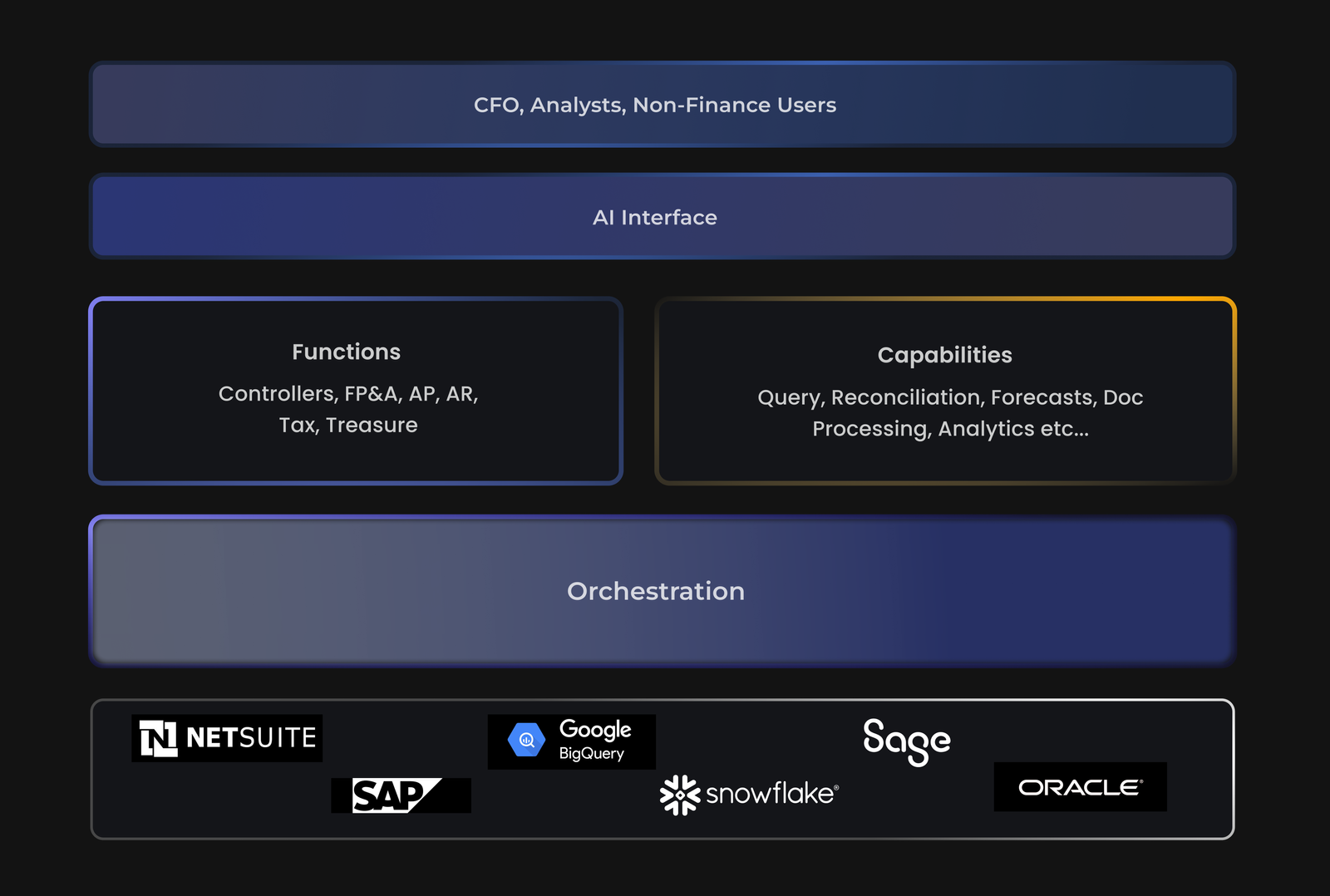
- ChatFin lets you apply capable models to finance work on your existing ERP with governed, human approved write back, so the safety posture of the workflow does not depend on the raw model alone.
The naming can be confusing, so start with the plain version. In June 2026 Anthropic introduced a class of models above the Opus tier.
Fable 5 is the one you can use through normal channels. Mythos 5 is the same core capability, offered without the extra safety classifiers, and it is restricted to a small set of trusted organizations under a program Anthropic calls Project Glasswing.
The difference is not performance. Both are described as state of the art across nearly all tested benchmarks.
The difference is the safety layer. Fable 5 carries classifiers that detect a narrow set of high risk request types, mainly in cybersecurity and biology, and automatically routes those to Opus 4.8 instead.
For a finance team, that distinction rarely changes day to day work, but it is worth understanding before you standardize on a model.
What Fable 5 and Mythos 5 actually are
Both models run with always on adaptive thinking, a very large context window and high output limits, which suits document heavy finance work such as reading a full set of statements, a data room or a long contract. The single meaningful difference is the safety classifier layer.
Fable 5 includes it. Mythos 5 does not, which is why Mythos access is gated to organizations that have been vetted and, in some periods, has been subject to government export controls.
In practice this means Fable 5 is the model a finance team can plan around. It is the widely released Mythos class option, and its safeguards are designed to be nearly invisible outside a narrow band of sensitive domains that have nothing to do with accounting.
When the safeguards would ever matter to finance
The classifiers in Fable 5 trigger on a small set of request types, and Anthropic has said they fire in a low single digit share of sessions overall. Finance work sits far from the domains those classifiers watch.
Reconciling a bank feed, drafting variance commentary, testing a control or summarizing a contract does not resemble the cybersecurity or biology requests the safeguards are built to catch.
On the rare occasion a request does get routed, the fallback is Opus 4.8, which is itself a strong model. So even the worst case for a finance user is a slightly less powerful answer on an edge case, not a refusal or a broken workflow.
That is a reasonable trade for a safety posture that keeps the model appropriate for a regulated environment.
For a finance team, Fable 5 is the practical choice. The safeguards almost never touch the work, and when they do the fallback is still a capable model.
Why the raw model tier is rarely your bottleneck
It is tempting to assume that a more powerful model automatically means better finance automation. It does not, because the hard part of finance automation is not reasoning about a well posed question.
It is getting clean data out of the ERP, keeping the model inside its permissions, routing every proposed change to a reviewer, and logging the whole chain so an auditor can follow it.
A frontier model with no connection to your system of record and no control layer is a very smart intern with no desk, no login and no manager. The tier of the model sets the ceiling on answer quality.
The workflow around it decides whether that answer ever becomes finished, sourced, approved work.

A simple decision for finance teams
If you are choosing a model to run analysis, drafting and diligence support, Fable 5 is the default Mythos class answer, with Opus 5 and Opus 4.8 as strong alternatives depending on cost and availability.
Mythos 5 is not something most finance teams need to pursue, since its only difference is the removal of safeguards that finance work does not run into anyway.
The more important decision is not which model, but how the model touches your books. Keep reads and writes separated.
Let the model read freely and propose changes, and require a human to approve anything that posts. That way the safety of your process comes from the workflow, not only from the model's own classifiers, and it stays stable even as you swap models over time.
The context window is the feature finance should care about
If there is one Mythos class attribute that genuinely changes finance work, it is not the benchmark score. It is the very large context window and high output limit.
Finance is a document heavy discipline. A single question about revenue often requires the model to hold the contract, the invoice history, the recognition schedule and the prior period commentary in view at the same time.
A model that can take all of that in one pass reasons about it more coherently than one that has to be fed the same material in fragments.
This matters for diligence and for month end alike. In a diligence setting, a large window lets a model read an entire data room section and reconcile figures across documents rather than one file at a time.
In a close, it lets the model consider a full account's activity, its history and the related policy together before proposing a treatment. The capability is real, but it only becomes useful output when the model is pointed at the right data through a connection to your systems, which is a workflow question rather than a model question.
Where ChatFin fits
ChatFin sits between capable models and your ledger. It connects to your ERP, applies the appropriate model to close, reconciliation, reporting and analysis, and requires human approval on every write with the source attached.
Because the control layer belongs to ChatFin and not to the raw model, your governance does not change when you move from one model to another.
That is what makes the Fable versus Mythos question smaller than it looks for finance. You get frontier capability where it helps, and the safety of the process comes from a workflow that would keep any model inside your controls.
Capable models, governed workflow. That is the combination that fits finance.
ChatFin applies frontier models to real finance work on your existing ERP, with human approval and a full audit trail on every change. The model provides the reasoning.
ChatFin provides the controls that make it safe to use on the books.
Pick the model on capability and cost. Put the safety where it belongs, in a workflow that reviews every write.
For finance, the safest model is the one wrapped in a workflow that keeps a human on every posting.