
ChatGPT for FP&A Teams: Forecasting, Scenario Planning, and Budget Automation in 2026
61% of US FP&A teams now use AI in at least one core workflow per AFP 2026. This guide covers exactly how ChatGPT integrates with Anaplan, Pigment, Vena, and Planful, and which prompt structures produce board-quality output in minutes.
- AFP 2026 Data:61% of US FP&A teams use AI in at least one core workflow, the majority concentrated in assumption documentation, sensitivity narration, and variance commentary rather than quantitative modeling.
- ChatGPT Strengths:ChatGPT and ChatGPT o3 are strongest as narrative and documentation accelerators for FP&A, drafting assumption rationale, scenario descriptions, and board summaries in minutes rather than hours.
- Platform Integration:ChatGPT integrates with Anaplan, Pigment, Vena, and Planful as a narrative layer on top of quantitative FP&A platforms, not as a replacement for them.
- Budget Automation:AI saves 35–45% of total annual budget process hours, per IMA 2025, with the largest gains in assumption documentation and budget narrative consolidation.
- Scenario Planning:Structured ChatGPT prompts produce board-quality scenario narratives, bear/base/bull framing, assumption rationale, and management response recommendations, in under 10 minutes per scenario.
- HBR Research:Companies that integrated AI into FP&A workflows in 2025 reported 28% higher forecast accuracy at 90-day horizons compared to peers using traditional manual forecasting, primarily due to faster assumption revision cycles enabled by AI.
Financial planning and analysis is being transformed by AI faster than almost any other finance function.
FP&A teams have always been the intellectual engine of the finance function, responsible for the forecasts, scenarios, and financial narratives that shape how executives, boards, and investors understand the business. But historically, the mechanics of FP&A work, building models, documenting assumptions, drafting scenario narratives, writing budget commentary, have consumed so much time that the strategic analysis FP&A teams are uniquely positioned to provide gets crowded out by the operational demands of just keeping the planning process running.
That is changing in 2026. AFP's annual FP&A Benchmarking Survey found that 61% of US FP&A teams now use AI in at least one core workflow, a figure that represents a doubling from 31% in 2024.
The use cases are concentrated not in quantitative modeling (where dedicated platforms like Anaplan, Pigment, and Planful remain superior) but in the narrative and documentation layer: assumption documentation, scenario framing, sensitivity analysis narration, and board-ready planning summaries. ChatGPT, particularly the o3 reasoning model, has emerged as the default tool for FP&A narrative work, functioning as a drafting accelerator that compresses hours of writing into minutes of review.
This guide covers exactly how US FP&A teams are using ChatGPT in 2026: the highest-value use cases, the specific prompt structures that produce board-quality output, how ChatGPT integrates with leading FP&A platforms, and what the 35–45% time savings in the budget process actually looks like in practice.
Where ChatGPT Adds the Most Value in FP&A
Not all FP&A tasks benefit equally from ChatGPT. The highest-value applications are concentrated in tasks that require structured writing based on quantitative inputs, where the analysis has already been done and what remains is articulating the implications clearly.
See the AI Budget vs. Actual Reporting Automation guide for the specific workflow.
ChatGPT Integration with Leading FP&A Platforms
ChatGPT is most powerful in FP&A when integrated with dedicated planning platforms, not as a standalone tool, but as the narrative layer that sits on top of each platform's quantitative output. Here is how the integration works with the four leading US FP&A platforms.
| Platform | Integration Method | ChatGPT Best Use Case | Platform Native AI |
|---|---|---|---|
| Anaplan | Anaplan CloudWorks API triggers or manual export → ChatGPT prompt workflow | Narrative commentary on model outputs, scenario descriptions, assumption documentation | AIMI (quantitative forecasting), ChatGPT adds the narrative layer |
| Pigment | Scenario exports in structured format; direct ChatGPT narrative generation | Complex scenario framing; board-quality narrative for multi-variable scenarios | Native AI (2025 release); ChatGPT produces richer board narrative |
| Vena Solutions | Excel-native: copy Vena output tables directly into ChatGPT prompts; Microsoft 365 Copilot integration | All FP&A narrative tasks; no format conversion required from Excel | Microsoft 365 Copilot for Finance for M365 subscribers |
| Planful | REST API data exports; programmatic feed into ChatGPT prompts | Full management commentary narratives, scenario planning documents, board CFO letters | Planful Predict (structured variance explanations); ChatGPT for full narrative |
"Companies that integrated AI into FP&A workflows in 2025 reported 28% higher forecast accuracy at 90-day horizons, primarily due to faster assumption revision cycles enabled by AI.", Harvard Business Review 2026
Effective ChatGPT Prompt Structures for FP&A: The CART Framework
The difference between mediocre and board-quality ChatGPT output in FP&A is almost entirely in prompt structure. The CART framework produces consistently high-quality output across all FP&A narrative tasks.
Example prompt using the CART framework for scenario planning: "Context: B2B SaaS company, $85M ARR, Q2 2026 board presentation. Data: Base case assumes 22% ARR growth; bear scenario assumes 12% growth driven by enterprise budget freezes affecting 30% of our pipeline.
Rationale: Three enterprise prospects ($8M combined TCV) have paused procurement processes citing macro uncertainty.
Task: Write a bear scenario narrative of 200 words including (1) scenario assumption rationale, (2) ARR and free cash flow impact, (3) leading indicators to monitor, (4) management response actions. Format: Four labeled paragraphs."
ChatGPT o3 for Advanced FP&A Reasoning
OpenAI's o3 model (released Q1 2025) introduced a step-change in multi-step financial reasoning capability that directly benefits FP&A work. Unlike the base GPT-4o model, o3 uses extended reasoning chains to work through complex financial logic, making it significantly more reliable for tasks like: calculating the impact of a revenue shortfall on covenant compliance across multiple debt instruments, reasoning through the tax implications of a restructuring scenario, or evaluating the sensitivity of a terminal value calculation to WACC assumptions.
For FP&A teams, the practical difference is that o3 can be given more complex, multi-step financial questions and produce reliable quantitative reasoning as part of its response. The caveat remains that all ChatGPT numerical output should be independently validated; o3 reduces but does not eliminate arithmetic errors in complex multi-step calculations.
The Annual Budget Process: A 6-Week AI-Assisted Timeline
| Week | Phase | ChatGPT Application | Time Saved |
|---|---|---|---|
| 1 | Budget Kickoff | Draft budget instruction memo to BU leaders; generate FAQ document for 15 most common budget questions | ~6 hours |
| 2 | Template Distribution | Annotate template cell calculation logic; AI data validation flag rules reduce back-and-forth | ~4 hours |
| 3–4 | BU Review | Draft summary memos for each BU budget submission; generate gap analysis narrative vs. CFO targets | ~8 hours |
| 5 | CFO Challenge | Draft challenge questions for each BU based on assumption analysis; produce reconciliation narrative | ~5 hours |
| 6 | Board Prep | Draft CFO budget narrative for board presentation; generate board-level scenario summary (base/bear/bull) | ~8 hours |
Total AI time savings in the budget process: 31–45 hours for a mid-market FP&A team, compressing the effective 6-week cycle by approximately 1.5 weeks per IMA's 2025 Finance Technology Adoption Survey.
Frequently Asked Questions
How are FP&A teams using ChatGPT in 2026?
According to AFP's 2026 FP&A Benchmarking Survey, 61% of US FP&A teams use AI in at least one core workflow. The most common applications are: assumption documentation (drafting the written rationale behind forecast assumptions), sensitivity analysis narration (explaining what changes in revenue or margin assumptions do to the full-year model), scenario framing (structuring bear/base/bull scenario descriptions for management), and variance commentary (drafting explanations for budget vs.
actual deviations). ChatGPT is used most often as a drafting accelerator for these narrative tasks rather than as a standalone financial modeling engine.
Can ChatGPT build financial forecasts?
ChatGPT can assist with financial forecast construction but is not a replacement for dedicated FP&A platforms like Anaplan, Pigment, or Planful.
ChatGPT's strengths in forecasting include: structuring driver-based forecast models by outlining revenue driver trees and cost allocation logic, writing assumption narratives that explain the reasoning behind specific growth rate or margin targets, translating statistical forecast output from tools like Excel's FORECAST.ETS into plain-language management summaries, and generating sensitivity tables when given a structured input prompt. Dedicated FP&A platforms remain superior for large-scale multi-entity modeling.
What is the best ChatGPT prompt for FP&A scenario planning?
The most effective ChatGPT prompts for FP&A scenario planning follow a structured input format: provide the base case forecast assumptions (revenue growth rate, gross margin, headcount plan), specify the scenario type (bear/base/bull or named macro scenarios like 'Fed rate +200bps'), define the key variable being stressed, and ask for a structured narrative output covering: (1) the scenario assumption rationale, (2) the projected P&L impact range, (3) the leading indicators that would confirm the scenario is unfolding, and (4) the recommended management response. The CART framework (Context, Actuals, Rationale, Task) produces consistently board-quality output.
How does ChatGPT integrate with Anaplan for FP&A automation?
ChatGPT integrates with Anaplan through two primary pathways: OpenAI's API integration layer (using Anaplan CloudWorks to trigger ChatGPT API calls from model actions) and direct prompt workflows where FP&A analysts export Anaplan model outputs to structured Excel or JSON formats and feed them into ChatGPT as context for narrative generation. Anaplan's own AI capability (AIMI, Anaplan Intelligent Modeling Intelligence) handles quantitative forecasting within the platform; ChatGPT is most effective as the narrative and documentation layer on top of Anaplan's quantitative output.
How much time does AI save FP&A teams on the annual budget process?
AI automation saves FP&A teams an estimated 35–45% of total annual budget process hours, per IMA's 2025 Finance Technology Adoption Survey.
The time savings are concentrated in three areas: assumption documentation (AI drafts written assumption rationale, saving 2–4 hours per business unit); budget template preparation and distribution (AI-assisted template generation and data validation, saving 8–12 hours for a 20-entity budget process); and budget narrative consolidation (AI drafts the CFO budget summary and key assumption narrative for board presentation, saving 6–10 hours). For a mid-market company running a 6-week budget process, these savings can compress the total cycle by 1.5–2 weeks.
Conclusion
ChatGPT's role in FP&A in 2026 is specific, high-value, and clearly defined: it is the best available tool for transforming quantitative financial analysis into clear, structured, board-quality narrative at a fraction of the time previously required. The 61% adoption rate in US FP&A teams reflects a profession that has identified this use case and is acting on it.
The FP&A teams extracting the most value are those that have operationalized ChatGPT into their regular workflows, not as an occasional assistant but as a systematic step in the assumption documentation, scenario planning, and management reporting process.
They have built prompt templates, integrated ChatGPT with their Anaplan or Pigment platforms, and trained their analysts on the CART framework. The result is an FP&A function that produces more, writes better, and has more time for the strategic analysis that actually differentiates a finance function.
FP&A teams that treat ChatGPT as a permanent workflow tool, not a productivity experiment, will be the ones that their CFOs ask to do more strategy and fewer spreadsheets.
Bring AI Into Your FP&A Workflow with ChatFin
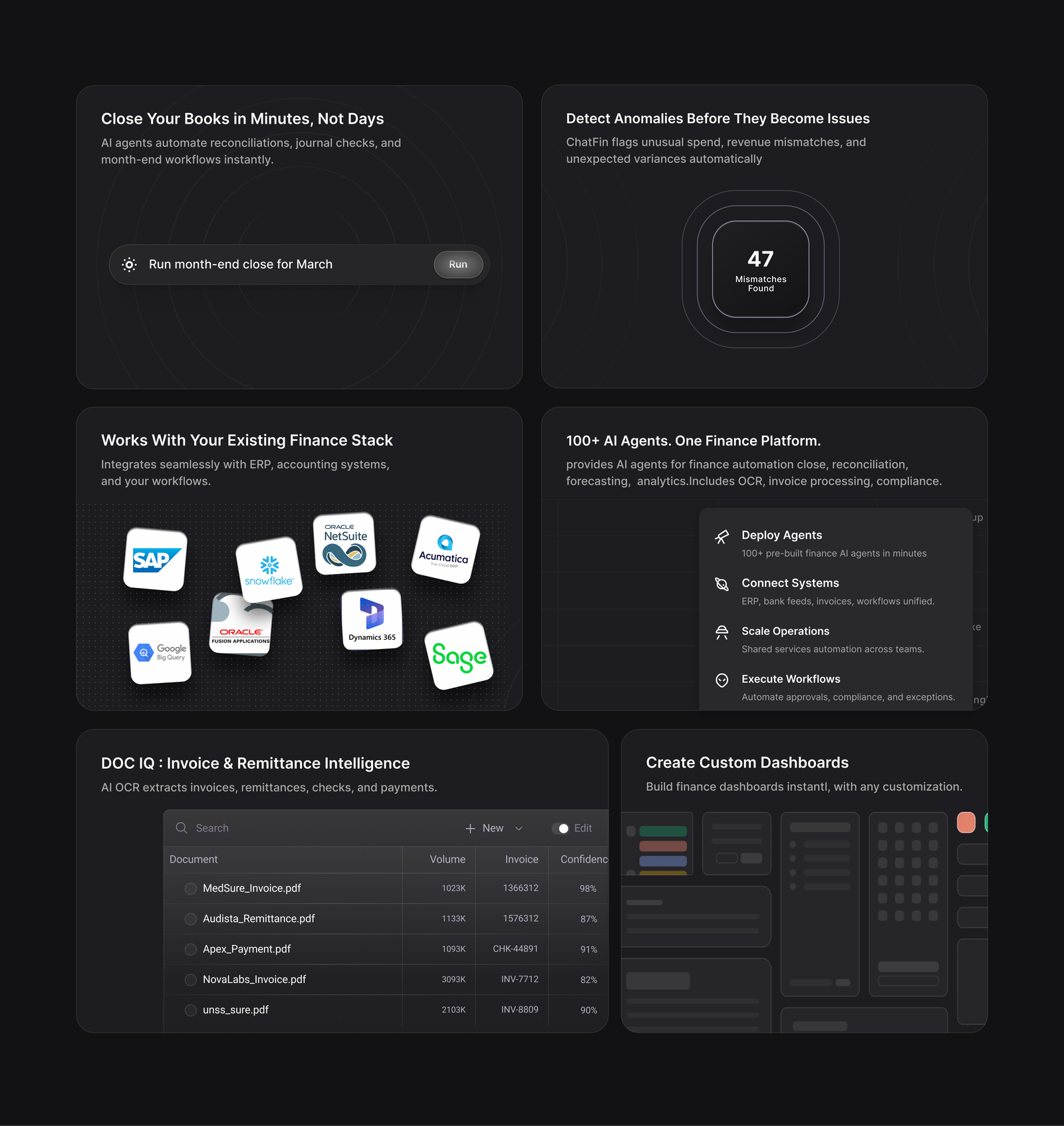
ChatFin integrates with Anaplan, Pigment, Planful, and your ERP to automate scenario narratives, assumption documentation, and budget commentary, saving 35–45% of your FP&A bandwidth.
Request a Demo
See ChatFin's FP&A AI platform in action.
Your AI Journey Starts Here
Transform your finance operations with intelligent AI agents. Book a personalized demo and discover how ChatFin can automate your workflows.
Book Your Demo
Fill out the form and we'll be in touch within 24 hours