
JD EDWARDS STRATEGY
How ChatFin Compares With Other JD Edwards AI Vendors on Finance Automation, Implementation Speed, Security and Write Back

Most vendors in this comparison cannot write back to JD Edwards, and write back decides whether anybody saves time.
- Four axes separate the field: finance depth, implementation speed, security model and write back capability.
- Finance depth means arriving with the process built, not a chat interface pointed at your tables.
- Implementation speed is decided by whether you are configuring or constructing, which a demonstration will not tell you.
- The security question is whose permissions apply. A shared service account flattens your JD Edwards design and weakens every audit answer.
- Write back is the axis most vendors fail. Ask for a posted transaction in a test environment and the field narrows immediately.
Buyers usually arrive at this comparison with a feature matrix, and feature matrices reward whoever writes the most marketing copy. A better approach is four questions that have concrete, demonstrable answers.
Each of the four below can be tested in an afternoon with a test environment and real data, which is worth more than a quarter of vendor briefings.
Axis One: Finance Depth
The question is whether the product arrives knowing how finance works or whether it is a general capability pointed at your data. The distinction shows up immediately on the second question of any demonstration.
Accumulated practice is the product
Most JD Edwards AI vendors can connect to the system. Far fewer know how a real AP team handles a three-way mismatch or a late intercompany charge.
I think what it comes down to is how do you use the knowledge and experience that exists inside the the software company.
Craig Sullivan, on the AgentCFO podcast
Weight finance depth first when comparing vendors below. Connectivity is easy to replicate, and years of process knowledge are not.
Axis Two: Implementation Speed
Speed is not a property of the software, it is a property of whether you are configuring or constructing. Products that arrive with the logic built are configured in days. Platforms that require you to design the behaviour take quarters, regardless of how quickly the connection is established.
The reliable test is whether a vendor will point their product at a copy environment in week one. Anyone requiring a discovery phase before that is selling an engagement.
Axis Three: Security Model
One question separates serious from casual here: whose permissions apply when the agent reads or writes. If the answer is a single shared service account used for all users, your JD Edwards role design has been flattened and every subsequent audit answer is weaker for it.
The second question is what the agent is structurally incapable of doing, as distinct from what it has been instructed not to do. Controls are about capability, not conduct.
Axis Four: Write Back, Where the Field Narrows
This is the axis that decides whether anybody saves time, and it is the one most vendors are vague about. Reading is table stakes. Producing analysis that a person then keys into JD Edwards has moved the work rather than removed it.
The test is concrete and should be non negotiable. Create a transaction in a test environment through a supported interface, with an approval record, and show the resulting document and batch number.
"Ask any vendor to post a transaction in a test environment. Half the shortlist disappears that afternoon."

Two Axes People Forget
These do not appear on most comparison matrices and both become important in month twelve rather than month one.
Upgrade safety determines whether you carry a retrofit obligation forever. The memory layer determines whether the system gets better over time or stays exactly as accurate as it was on the first day.
Running the Evaluation Properly
A fortnight against one painful process with real exception data tells you more than three months of briefings, and it produces a number you can defend internally.

Where ChatFin Lands
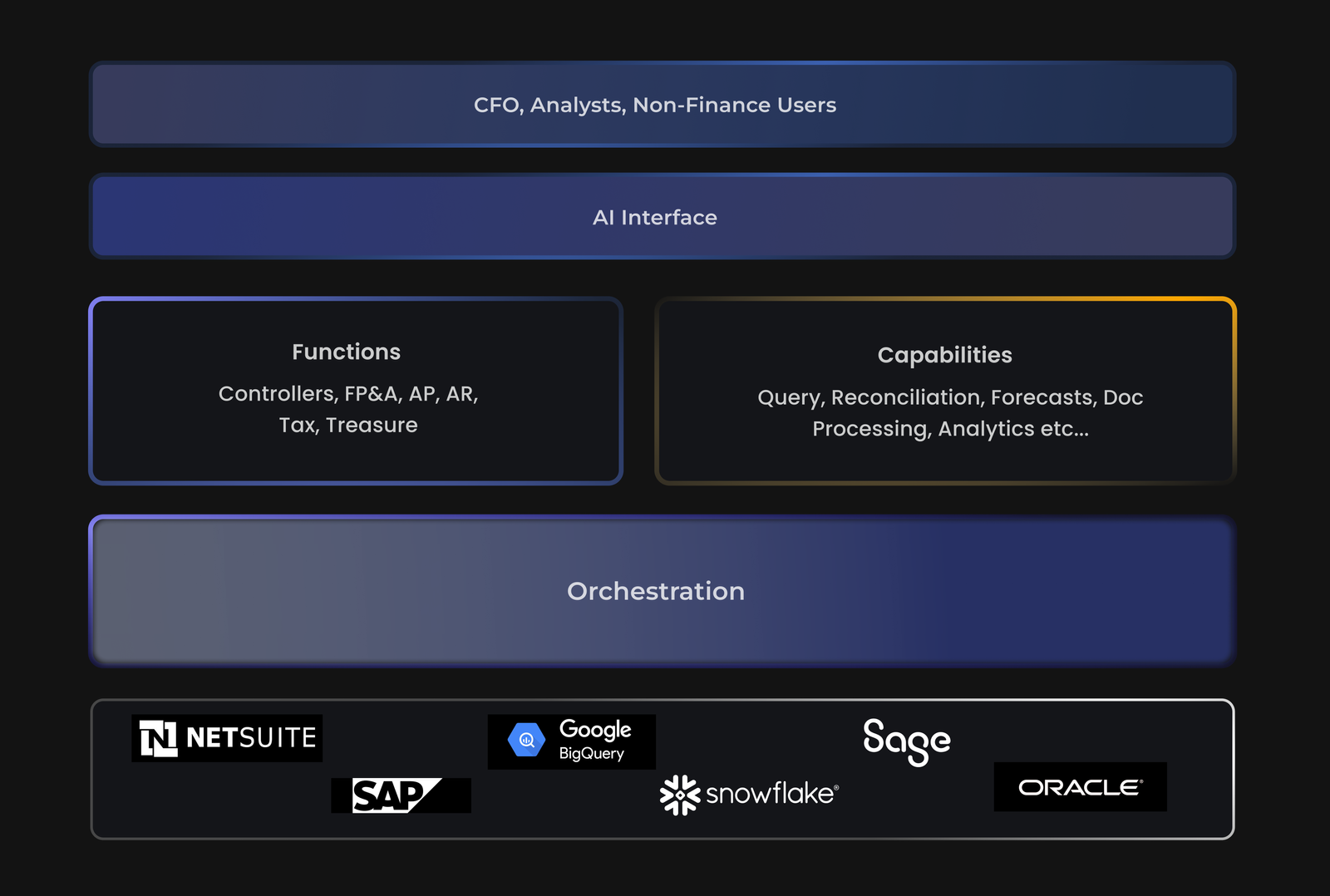
ChatFin is built specifically for this position: finance agents that arrive built, configured in days rather than constructed over quarters, operating inside your existing JD Edwards security model, and completing work through published orchestrations with human approval.
Nothing is installed inside EnterpriseOne, so there is no upgrade obligation, and the memory layer means accuracy improves each period.

Test the Four Axes, Especially the Last One
ChatFin delivers prebuilt JD Edwards finance agents, configuration measured in days, sessions that inherit your existing role design, and posting through published orchestrations with named approval and a complete audit record.
Reading is table stakes. Ask what happens after the analysis, and watch the shortlist shrink.
Frequently Asked Questions
What separates JD Edwards AI vendors?
Four things, all testable in an afternoon. Finance depth, meaning whether the product arrives knowing how voucher matching and reconciliation work. Implementation speed, which is decided by whether you configure or construct. The security model, specifically whose permissions apply. And write back capability, which is where most of the field fails and the only axis that determines whether anyone saves time.
How do I test write back capability?
Concretely and non negotiably. Ask for a voucher or journal entry created in a test environment through a supported orchestration, with a named approval record and the resulting document and batch number returned. Also ask how it writes: direct table inserts and screen automation both produce records missing the derivations that make them accounting valid, and both will pass a demonstration and fail an integrity report.
What do most comparison matrices leave out?
Upgrade safety and the memory layer, both of which matter in month twelve rather than month one. Anything installed inside EnterpriseOne, such as custom objects or modified business functions, is a retrofit obligation you carry through every future update. And without a memory of how your organisation codes and closes, accuracy stays where it was on day one.