
Build AI Reconciliation Agents: Complete Development Guide 2026
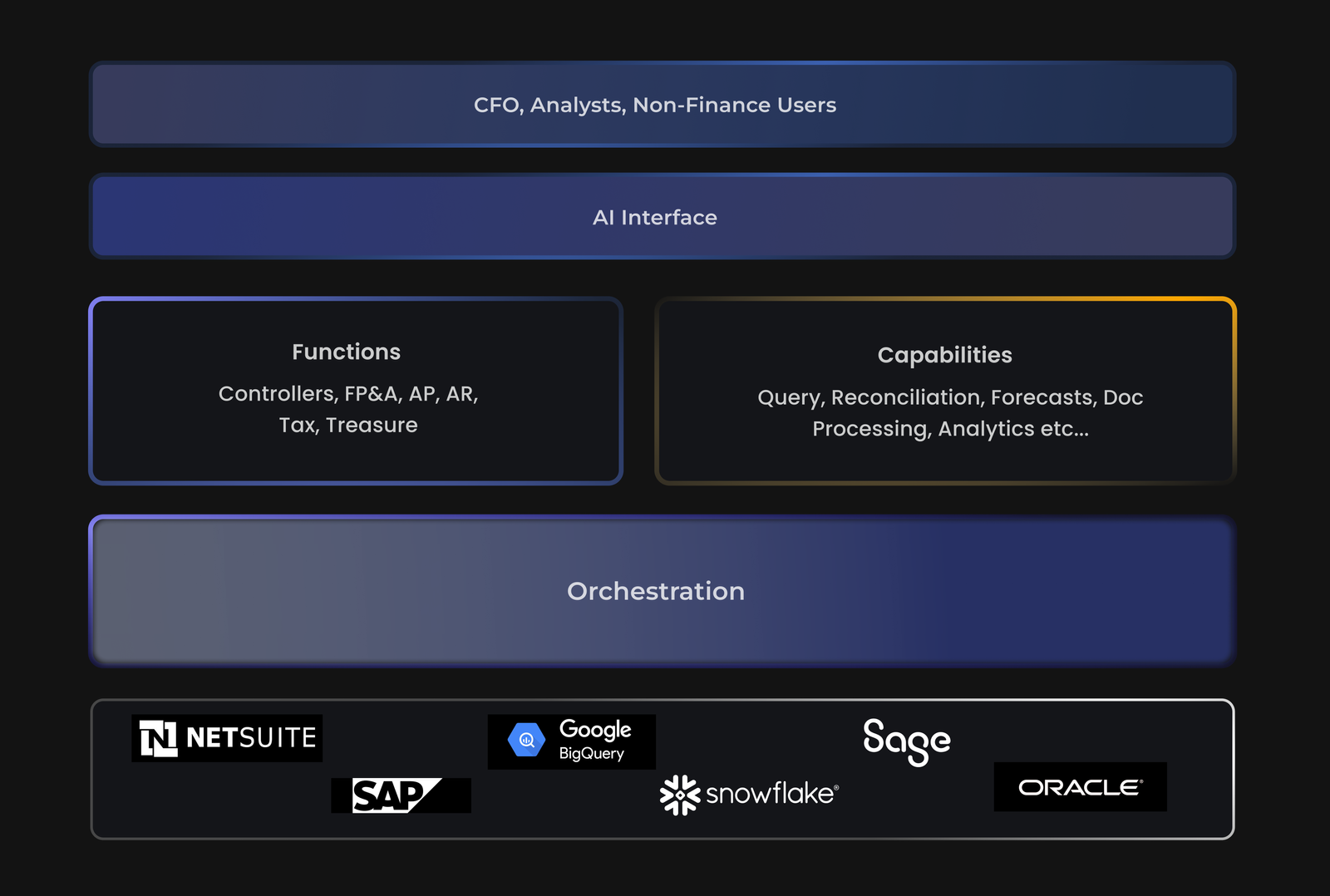
Reconciliation is the natural first agent to build in finance: high volume, clear inputs, and a definable notion of correctness. This is a development-level guide to how a reconciliation agent is actually architected, the matching pipeline, the rules-plus-reasoning split, grounding and audit trails, and an honest take on when to build versus buy.
- A reconciliation agent has a clear pipeline: ingest sources, normalize, match deterministically, reason over exceptions, propose adjustments, and post with a trail.
- The winning design combines deterministic rules for the easy 60 to 70% with LLM reasoning for the exceptions that push auto-match to 85 to 95%.
- Grounding is non-negotiable: every match and adjustment must trace to source records, or the agent is confidently wrong.
- Human-in-the-loop is a design requirement, not an afterthought; the agent clears the routine and escalates judgment with context.
- Building is instructive but heavy; a proven agent that already handles edge cases, ERP posting and audit trails often beats a multi-quarter build.
Reconciliation is where most teams that want to build finance AI start, and for good reason: the inputs are structured, the goal is well defined, and success is measurable. It is also more subtle than it looks once real-world exceptions arrive.
This guide walks the architecture of an AI reconciliation agent at a development level, and ends with an honest build-versus-buy view.
The pipeline
At a high level, a reconciliation agent is a pipeline. It ingests the sources to be reconciled (bank feed, subledger, GL), normalizes them into a common representation, matches what it can deterministically, reasons over the residual exceptions, proposes adjustments, and posts the result with documentation. Each stage has its own failure modes, and the quality of the agent is mostly decided by how the last two stages handle the cases the first ones cannot.

Rules plus reasoning: the core design choice
The central architectural decision is how to combine deterministic matching with model reasoning. Pure rules clear the clean 60 to 70% of items quickly and cheaply, and you should use them for exactly that. The remaining items, partial matches, timing differences, many-to-one relationships, inconsistent references, are where LLM reasoning earns its place, lifting auto-match to 85 to 95%. The mistake is using a model where a rule suffices, or a rule where only reasoning will do; the good design routes each item to the cheaper sufficient method.
The build documents the process
Few finance teams have written down how their reconciliations actually work. Building an agent forces every matching rule and exception path onto the page.
Downloading my information into an SOP doesn't feel like it has a strong ROI. I'd rather focus on other things until I can just download myself into the matrix.
Adam Swoverland, on the AgentCFO podcast
Treat the rule definitions you write for the agent as the reconciliation documentation, and keep them where auditors and new hires can read them.
Grounding and audit trails
Two properties separate a demo from a production finance agent. Grounding: every proposed match and adjustment must trace to specific source records, so the agent cannot invent a reconciliation that looks plausible but is not real. Audit trail: every decision, automatic or human, is logged with its basis, so the work is provable to auditors. In finance, an agent that cannot show its work is not usable, however good its match rate looks.
Build versus buy, honestly
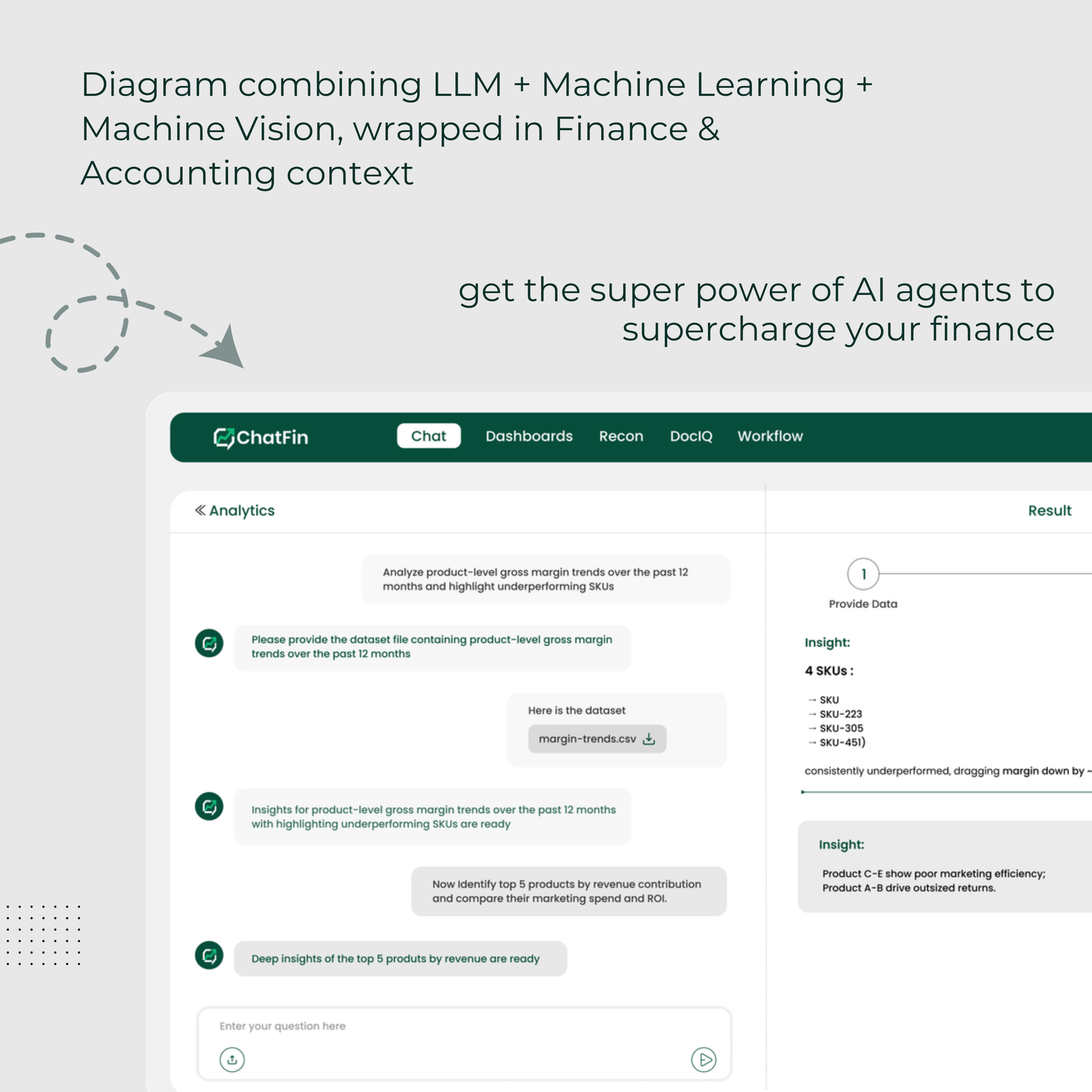
Building a reconciliation agent is a genuinely useful exercise, and for a unique internal process it can be the right call. But be clear-eyed: the last 10% of edge cases, the ERP write-back, the audit trail, the ongoing maintenance as formats change, are most of the work, and they are exactly what a proven platform has already solved. ChatFin's reconciliation agents ship with that hard part done, running on top of your ERP, so for most teams buying reaches production faster than building. If you do build, the architecture above is the shape to follow.

Anyone can build a reconciliation agent that matches the easy 70%. The engineering is all in the exceptions, the grounding, and the write-back, which is also where a proven platform earns its keep.
Follow the Architecture, or Skip to Production
A reconciliation agent is a pipeline of ingestion, deterministic matching, exception reasoning, grounding and audited posting. ChatFin ships that pipeline production-ready on your ERP, edge cases, write-back and audit trail included.
Build it to learn, or deploy ChatFin to reconcile in production now, with the hard 10% already solved.
What Is an AI Reconciliation Tool?
An AI reconciliation tool compares two sets of records that should agree, such as a bank feed and the cash account, or a subledger and the GL, and explains the differences. Rules clear the items that match exactly. A model reads the ones that do not: a reference typed differently, one payment covering three invoices, a cheque that clears next month.
Which reconciliation you build first changes the design. A bank reconciliation has dates and amounts to lean on. An intercompany one has two ledgers that disagree on timing and currency. A supplier statement check starts from a document someone else formatted. Pick one type, write down how your team does it today, and build the agent around that instead of aiming for a general reconciler.
Caitlin Haberberger, CFO of Verdant, talks about the monthly close process and reconciling accounts.
“On the accounting side, you're going through a monthly close process. There's these things that are happening point in time. You're reconciling accounts, you're closing the books.”
Reconciliations Worth Building an Agent For
Each case is a reconciliation a finance team already runs every period, with its own kind of exception.
- A bank reconciliation with timing differences. A cheque issued on the last day of the month clears days later. The agent tags it as timing, carries it forward and reports only the items that stay unexplained.
- A supplier statement against the AP ledger. Each line on the supplier's statement is compared with the ledger, and the output is a list of invoices the supplier has that you do not, and credits you hold that they have not applied.
- An intercompany balance that does not net to zero. Both sides are drawn at the transaction level, and the agent points to the entry booked in one entity but not the other.
- Writing the reconciliation down first. Take a reconciliation you already run and list its steps, tolerances and known exceptions in the order you work them. That list becomes the agent's rules and its documentation.
- Names and references that do not line up. Payer names on the bank side rarely match the customer names in the ledger. The model groups likely matches and the accountant confirms them once.
- Replaying a closed period. Run the agent against last quarter, where the right answers are known, and compare what it cleared and flagged with what your team did.
Ashok Manthena, host of the AgentCFO podcast, talks with guest Adam Swoverland about building a reconciliation template.
“If you're thinking, let's say you're making a reconciliation template, building that just in text, all these steps is actually very complicated. The easiest way is to build an Excel template. ... I tried it and it's very complicated just directly converting it into text. So the best way is to convert that into Excel first and let AI read the Excel and come up with its own process.”
Paul Barnhurst, The FP&A Guy, talks about using AI to clean up data.
“Do the first pass of my variance commentary, write my emails, clean up my data. ... I got a list instead of writing that stupid long formula or algorithm to try to figure out if it's Delta because it's Delta Air, Delta Airlines, Delta Inc in 10 different ways, AI can do that a lot quicker than you can.”
Quick Answers on AI Reconciliation Tools
What is an AI reconciliation tool?
Software that matches two sets of financial records, clears what agrees, and explains what does not. It combines fixed matching rules for clean items with a model for messy ones, and it keeps a record of every decision for review.
Can a general chatbot do my reconciliation?
For a small one-off file, it can give a useful first pass. For a monthly process it lacks ingestion, a trail back to source records and a way to post adjustments. Check any chatbot result against the records, and expect the output to need review.
How do I test an AI reconciliation tool before using it on live accounts?
Replay a closed period. Compare what the tool cleared, flagged and proposed with what your team did, and study every difference. If it matches your reviewed result on the clean items and flags the hard ones, move to a live month with review.
What data does an AI reconciliation tool need?
The two sources to compare, usually a bank or subledger file and a ledger export, with reference fields intact. It also helps to supply notes on how past exceptions were resolved, since those show the tool what your team treats as acceptable.
Which reconciliations should I automate first?
Start with high-volume ones that have reliable references, such as bank and card accounts. Intercompany and subledger reconciliations follow once the matching logic and the review habit are proven on the simpler ones.
Does an AI reconciliation tool post adjusting entries?
That depends on how you configure it. A cautious setup has the tool propose the adjustment with its reasoning and source records, and a person posts it through the ERP. Move toward more automation only after the proposals prove right.
How many reconciliation items can rules match without AI?
Rules clear the clean 60 to 70 percent of items quickly and cheaply, using exact and tolerance-based matching. The rest, such as partial matches, timing differences, many-to-one relationships and inconsistent references, need model reasoning, which the guide says lifts auto-match to 85 to 95 percent.