
Best AI Agents for Oracle NetSuite Financial Close
NetSuite added real AI to the close in 2026. Here is what the native tools do, where they stop, and how an agent layer carries the cross-module close on top of them.

- NetSuite's 2026 releases brought genuine close AI: Intelligent Close Manager, generative bank matching, Intelligent Flux Analysis, and Ask Oracle. Turn these on first.
- The native tools monitor and assist inside NetSuite. They do not carry a workflow across bank, subledger, and report as one motion, and much of the EPM agentry needs a separate license.
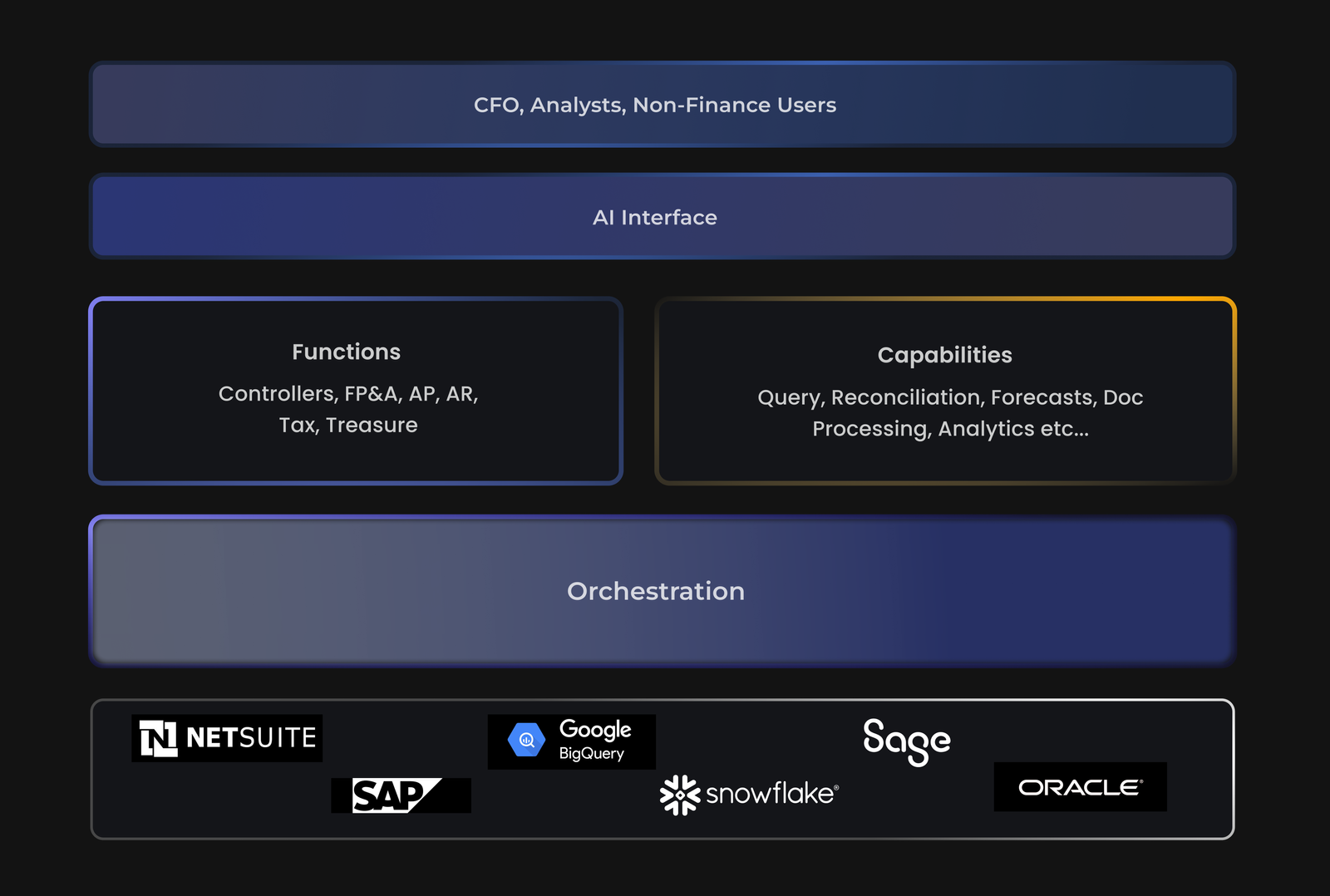
- A dedicated agent layer carries the cross-module close on top of NetSuite, reading through SuiteQL, RESTlets, and SuiteAnalytics Connect and writing back as approved payloads.
- NetSuite stays the system of record. Every agent action keeps its trail, and a named controller signs.
NetSuite spent 2026 putting AI into the close for real. The Intelligent Close Manager gives finance a live command center, generative bank matching lifts the auto-match rate, Intelligent Flux Analysis drafts variance explanations, and Ask Oracle answers plain-language questions against your data. If you run NetSuite, the honest first move is to turn these on.
They are strong, and they are also bounded. The native tools monitor and assist inside NetSuite. What they do not do is carry a full close workflow across the bank feed, the subledgers, and the board report as one coordinated motion. That gap is where a dedicated agent layer earns its place.
Turn on the native NetSuite AI first
NetSuite 2026.1 introduced the Intelligent Close Manager, an AI-powered command center that tracks close readiness, ranks tasks by estimated impact, and hyperlinks straight to the journal or reconciliation. Alongside it, generative bank transaction matching extracts richer structured bank data to raise the auto-match rate and cut manual line-by-line matching.
The 2026.2 release went further, adding Intelligent Flux Analysis that drafts plain-language explanations for why an account balance moved between periods, plus reconciliation assignment assistance and an AI transaction matching assistant that recommends a single likely match and shows its reasoning. Ask Oracle, part of NetSuite Next, answers ad-hoc questions in plain English without a saved search.
None of this is a bolt-on you have to buy separately for the core capabilities, and most teams need only an hour or two to get comfortable. If you are on NetSuite and have not enabled these, that is the first and cheapest win available to you.
Ledger data is noisier than it looks
Matching entries is complicated by timing and accruals, which is why naive automation on the close disappoints.
Because almost always, if you're looking at journal entries and financial, there's too much noise because of timing and accruals.
Paul Barnhurst, on the AgentCFO podcast
Give the agent the accounting rules for timing and accruals, or it will flag differences that are not differences.
Where the native AI stops
The native tools are built to monitor and assist inside NetSuite. The Intelligent Close Manager tells you where the close stands, but a person still works each exception. Bank matching raises the auto-match rate, but the unmatched remainder and the cross-account view still land on a human.
The deeper agentry, continuous reconciliation and the planning agent, lives in NetSuite EPM, a separately licensed product many mid-market teams do not run. And even with everything on, the workflow that ties a bank break to a subledger entry to a flux narrative to a board note is still assembled by people moving between screens.
That is the specific gap: NetSuite now sees the close clearly, but seeing is not carrying. An agent layer carries the workflow across modules, using the native AI as the foundation rather than competing with it.
Reconciliation the agent layer carries end to end
How it runs
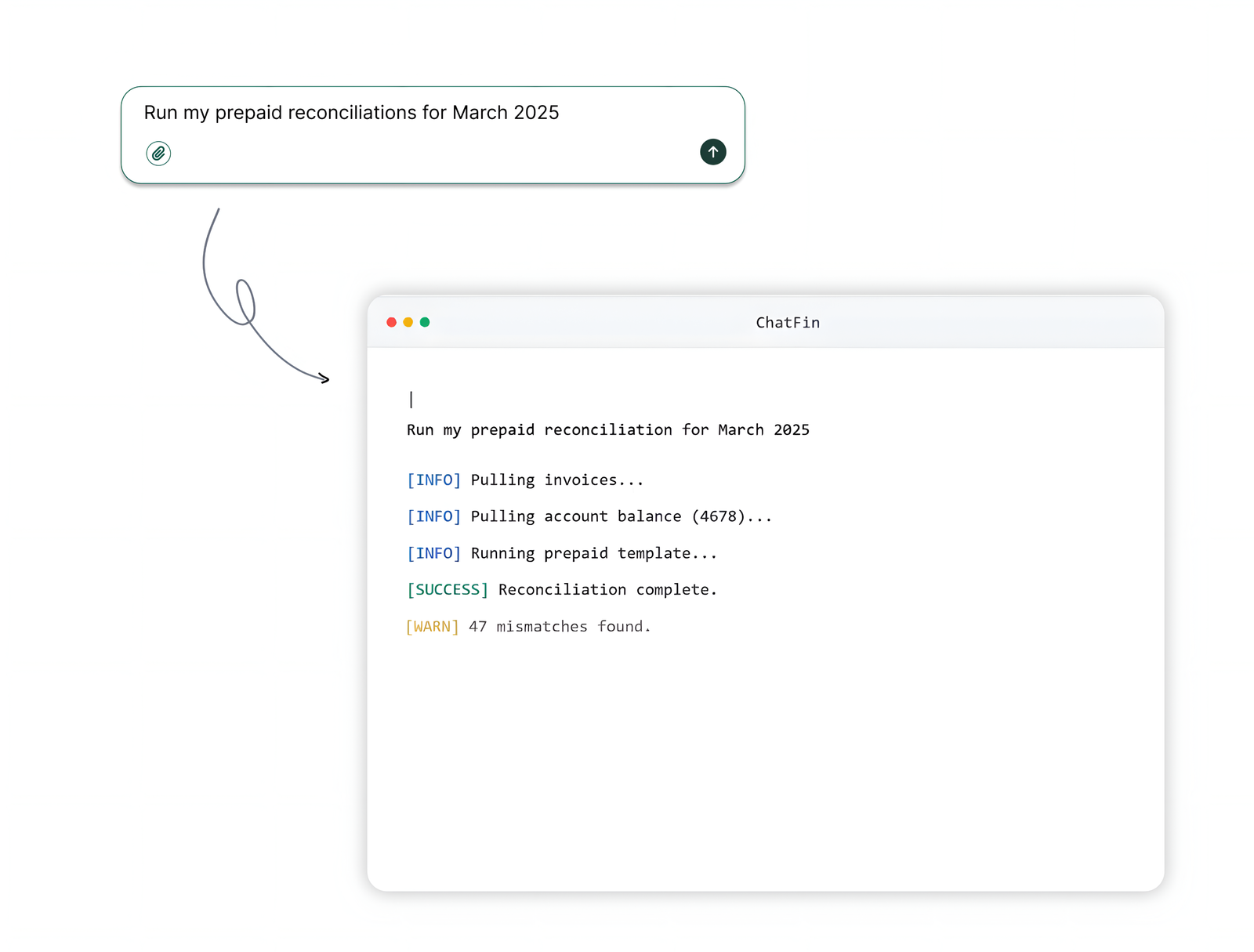
ChatFin pulls transactions from NetSuite through SuiteQL, RESTlets, and SuiteAnalytics Connect, alongside bank feeds and subledgers, into one matching workspace. It normalizes and matches on rules and historical patterns, then flags each exception with a plain explanation of why it broke.
Where NetSuite's generative matching raises the auto-match rate inside the bank reconciliation, the agent layer takes the remainder and the cross-account picture, resolving the breaks that span the bank, the subledger, and the GL. Finance reviews only the exceptions, and the status rolls up into a live close view.
Enabling NetSuite's close AI is the first win. Carrying the close across modules is the second, and it is a different job.
Ashok ManthenaA close that coordinates itself
How it runs
GL activity, subledger data, and operational metrics are read continuously. The agent tracks checklists and dependencies, monitors readiness, flags missing entries, and predicts where the close will stall, sitting on top of the Intelligent Close Manager rather than replacing it.
Accountants get guided tasks in order and leadership gets a live progress view. The variance narrative draws on NetSuite's Intelligent Flux Analysis where it is available and extends it with cross-module drivers the native tool does not reach.
AP and accruals, checked before they post
How it runs
Invoices are ingested and digitized, then validated against purchase orders and contracts on pricing, quantity, and terms before payment. NetSuite's own Bill Capture handles extraction well, and the agent layer adds the three-way match and the exception routing across the payables and receiving records.
For accruals, historical spend, contracts, and operational signals feed a suggested accrual with a rationale and a confidence range. Finance reviews and approves, and the variance between accrued and actual feeds back so the next estimate improves.
Ask a question, get a sourced answer
How it runs
Ask Oracle already answers plain-language questions inside NetSuite. The agent layer extends that to questions that cross the ERP boundary, joining NetSuite data with bank, subledger, and contract sources to answer the question a controller actually asked, with every figure sourced back to the record.
The output reads like a senior analyst wrote it: the number and the reason arrive together, with a link back to the transaction behind each figure.
Governance, write-back, and the person who signs
Every agent action is bounded the same way. ChatFin reads through the interfaces the ERP already supports, applies your policy, and prepares the write-back as a payload a person approves before it posts. Nothing moves money or touches the ledger on its own authority.
The trail is the point. Each step keeps the prompt, the response, and the prepared payload, so an auditor can see not just what changed but why the agent proposed it. The ERP stays the system of record, and a named controller still signs.
Native AI first, agent layer second, NetSuite as the record throughout.
The pattern is deliberate. Turn on NetSuite's Intelligent Close Manager, generative bank matching, and Intelligent Flux Analysis, because they are real and included. Then add an agent layer that carries the cross-module close the native tools only monitor, reading and writing through supported interfaces with the trail intact.
NetSuite stays the system of record. The agents draft the work and a named controller signs, which is what keeps the whole thing defensible during an audit.
What a close day looks like with native AI switched on
On the first day of close, the controller opens the Intelligent Close Manager and sees which tasks are late. Bank items match where they can and the exceptions wait in a queue. By midday the flux explanations are drafted, and the question becomes which of them a person needs to confirm before they go into a package.
What the native AI does not do is carry the work between its own modules. The cash entry, the subledger tie out and the board commentary still need someone to move them along. That handoff is where days pile up, and it is the place to look when the native features are on and the close is still slow.
Teddy Collins, EVP of Finance at SeatGeek, talks about generating accruals at scale.
“We've partnered with our engineering team to build a finance specific data warehouse where we can run scripts to generate accruals and revenue entries on a much bigger scale. Hit F9, go to lunch, come back, and the monthly revenue accrual is ready to go.”
Five handoffs that decide how long the close takes
Each is a moment where work passes from one person or system to the next.
- From the bank feed to the cash entry. Matched items are cleared, then someone still has to explain the rest before the cash entry is final. A queue ordered by size shows which exceptions matter first.
- From flux draft to owner comment. The generated explanation is a starting point. The budget owner confirms or corrects it, and the controller needs to see which ones are still open.
- From accrual proposal to posted entry. The agent proposes the entry with source documents attached. The accountant checks them and posts, and the reviewer later reads the same trail.
- From subledger to balance sheet. AP and AR close at different times. Someone checks that the subledger totals agree with the ledger before reconciliations are called done.
- From finished close to board commentary. Once the numbers are final, the commentary has to be written quickly, with each statement traceable to an account.
Ashok Manthena, host of the AgentCFO podcast, talks with Caitlin Haberberger about automating the close and keeping it visible.
“I think the close process is something that can be automated a lot, probably I would say 80 to 90 percent. It should be automated, but there should be enough transparency for the team involved to look at where the process is.”
Quick Answers on AI for the NetSuite Close
what is the NetSuite Intelligent Close Manager?
The page describes it as a command center that tracks close readiness and ranks tasks by estimated impact. It monitors and assists inside NetSuite and is worth switching on first.
does NetSuite have AI bank reconciliation?
NetSuite added generative bank matching, which the page says lifts the auto match rate. Items without a confident match still need a person, so measure what is left over, not only what clears.
how does NetSuite Intelligent Flux Analysis work?
It drafts variance explanations for review. A budget owner should still confirm each one, since a fluent explanation that is wrong costs more than a missing one.
can an AI agent work alongside NetSuite native AI?
Yes. The page recommends turning the native features on first and adding an agent layer for cross module work, reading through SuiteQL, RESTlets and SuiteAnalytics Connect and writing back as approved payloads.
do NetSuite EPM agents need a separate license?
The page says much of the EPM agent functionality needs a separate license, so check what your tier includes before planning the close around it.
See agents carry a NetSuite close across modules.
Turn on the native AI, then bring one close. We will show cross-module reconciliation, the flux narrative, and governed write-back through SuiteQL and REST, with NetSuite as the system of record.