
Best AI Agents for JD Edwards EnterpriseOne
JD Edwards has strong integration tooling and no embedded finance copilot, so agents connect through the AIS server and Orchestrator.

- JD Edwards EnterpriseOne has strong integration tooling, the AIS REST server, Orchestrator, and Logic Extensions, but no embedded finance copilot.
- That absence is the opportunity: JDE is agent-ready by architecture, and an external agent layer supplies the finance AI the ERP does not.
- ChatFin reads and writes through the AIS REST server and Orchestrator, carrying reconciliation, close, and AP on top of JDE.
- JD Edwards stays the system of record. Every agent action keeps its trail, and a named controller signs.
JD Edwards EnterpriseOne is a capable, deeply deployed ERP, and it is honest to say it does not ship an embedded finance copilot the way NetSuite, Sage Intacct, or Oracle Fusion now do. There is no native agent to enable first.
That absence is not a dead end, it is the opportunity. JDE has excellent integration tooling, the AIS REST server, the Orchestrator, and Logic Extensions, which makes it agent-ready by architecture. An external agent layer supplies the finance AI the ERP does not, and it does so through JDE's own supported interfaces.
The honest starting point: no native finance copilot
Unlike several modern cloud ERPs, JD Edwards EnterpriseOne does not include an embedded generative finance assistant. Oracle has invested in JDE's integration and extensibility rather than in a native copilot, so there is no in-product finance AI to switch on.
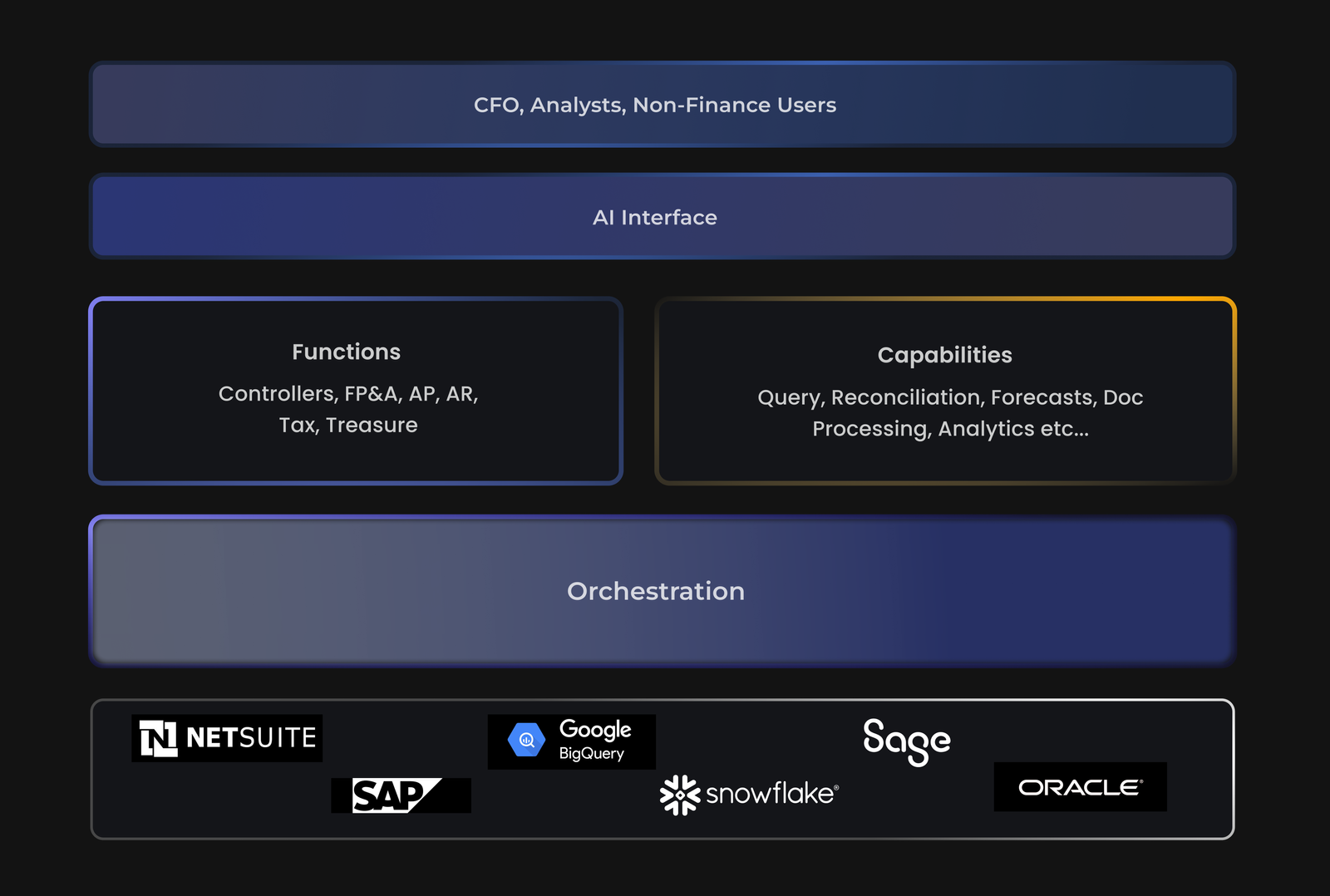
What JDE does have is strong connective tissue: the Application Interface Services REST server exposes JDE functions to outside systems, the Orchestrator automates multi-step processes and integrations, and Logic Extensions let teams add logic without customizing the core.
So the honest first move for a JDE finance team is not enabling a native agent, because there is not one. It is recognizing that the platform is already built to be driven by an external agent layer through these interfaces.
Where the native AI stops
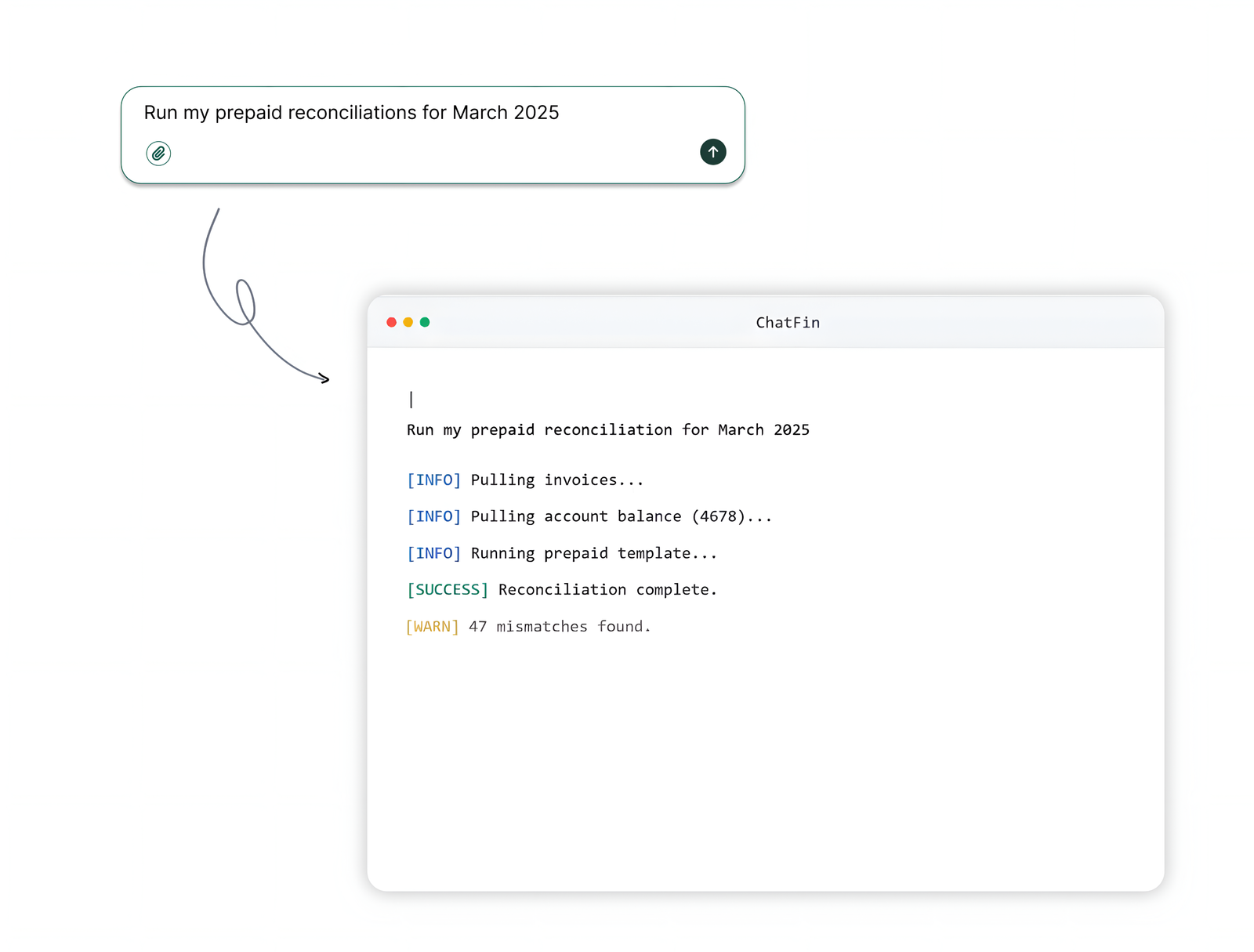
The gap here is plain: the reconciliation, the close coordination, the variance narrative, the AP validation, none of it has a native AI in JDE to do it. Today that work is manual or scripted.
Because JDE exposes its functions cleanly through AIS and the Orchestrator, that gap is unusually well-suited to an external agent layer. There is no native tool to work around or duplicate, only a well-defined interface to build on.
That is the whole pitch for JDE specifically: the missing native copilot is the reason an agent layer delivers more here than on ERPs that already ship one.
Reconciliation the agent layer carries end to end
How it runs
ChatFin reads transactions from JD Edwards through the AIS REST server, orchestrated where needed, alongside bank feeds and subledgers, into one matching workspace. It normalizes and matches on rules and history, then flags each exception with a plain explanation.
Because there is no native matching to layer on, the agent carries the reconciliation end to end, resolving breaks across the bank, the subledger, and the GL, and rolling status into a live close view.
On JD Edwards there is no native copilot to enable. That missing piece is what the agent layer supplies.
Ashok ManthenaA close that coordinates itself
How it runs
GL activity, subledger data, and operational metrics are read continuously through AIS. The agent tracks checklists and dependencies, flags missing entries, and predicts where the close will stall.
Accountants get guided tasks in order and leadership gets a live progress view, with the variance narrative naming drivers across modules, the analysis JDE has no native tool to produce.
AP and accruals, checked before they post
How it runs
Invoices are ingested and digitized, then validated against purchase orders and contracts before payment. The agent adds the three-way match and routes only the exceptions, with clean invoices flowing to payment via orchestrated write-back and a full validation history.
For accruals, historical spend and contracts feed a suggested accrual with a rationale and a confidence range. Finance reviews and approves, and the accrued-to-actual variance improves the next estimate.
Ask a question, get a sourced answer
How it runs
JDE has no native plain-language finance assistant, so this capability is entirely additive. The agent layer answers questions against JDE data pulled through AIS, joined with bank, subledger, and contract sources, and returns an answer with every figure sourced.
The number and the reason arrive together, linked back to the transaction behind each figure, giving JDE users a query experience the ERP does not provide on its own.
Governance, write-back, and the person who signs
Every agent action is bounded the same way. ChatFin reads through the AIS REST server and writes back through orchestrated, supported interfaces, preparing each change as a payload a person approves before it posts. Nothing moves money or touches the ledger on its own authority.
The trail is the point. Each step keeps the prompt, the response, and the prepared payload, so an auditor can see not just what changed but why the agent proposed it. JD Edwards stays the system of record, and a named controller still signs.
No native copilot, an agent-ready core, JDE as the record throughout.
JD Edwards does not ship a finance copilot, so the pattern is different here. There is no native tool to enable first, only an unusually clean set of interfaces, AIS, the Orchestrator, and Logic Extensions, that make JDE ready to be driven by an agent layer.
That agent layer supplies the reconciliation, close, and AP intelligence JDE lacks natively, reading and writing through supported interfaces with the trail intact. JD Edwards stays the system of record, and a named controller signs.
See agents carry a JD Edwards close through the AIS server.
JDE has no native copilot to turn on, so bring one close and we will show reconciliation, the variance narrative, and governed write-back through the AIS REST server and Orchestrator, with JDE as the system of record.