
AI on SAP Business One Without Replacing the ERP
SAP Business One is rarely the thing that is broken. The work it takes to get anything out of it is.

- SAP Business One is the quiet workhorse of the mid-market and the standard subsidiary ERP in two-tier setups under a larger SAP headquarters. Mature, trusted, and almost never the actual problem.
- The pain sits around the ledger, not in it. Crystal Reports and the Query Generator for anything non-standard, a Windows client that takes too many clicks, and a stack of paid add-ons holding the process together.
- Every change routes through your SAP partner. A new field, a tweaked approval, a fresh report: small asks become billable requests and a queue you wait in.
- Mainstream maintenance for Release 10.0 ends December 31, 2026, with no extended maintenance offered and Version 11 to follow. That clock forces the upgrade question earlier than most finance teams want to answer it.
- An AI layer reads B1 through its supported interfaces, applies your policy, and runs approved work across reconciliation, AP, AR, and close without new add-ons or core changes.
- Some version moves still have to happen. AI changes the timing and the pressure behind the decision, not whether you eventually land on a supported release.
If you run SAP Business One, you have probably been told the same thing more than once: the way to get modern finance capability is to move up to a bigger cloud ERP, and only there. Sometimes that advice is right. Just as often it is a reflex, aimed at a system that is doing its core job perfectly well.
Replacing a B1 estate is one of the most disruptive projects a lean finance team can take on, and many of these projects trade a set of familiar limits for a set of unfamiliar ones. AI has opened a third option that did not exist a few years ago: modernize the experience and automate the work while the ERP itself stays exactly where it is.
Mature does not mean obsolete
There is a habit of treating older software as outdated software. SAP Business One shows why that shortcut is wrong. It is the platform SAP built for companies that are too small for S/4HANA and too complex for accounting software, and it is the default subsidiary system in two-tier deployments where a larger SAP or Oracle estate sits at headquarters.
Under the dated screens is logic that holds up. Perpetual inventory and landed cost, multi-currency and multi-branch, the banking and payment engine, production and MRP, and a chart of accounts that has been shaped to the business over years. These are solved problems in B1, tested across a very large installed base. Companies do not stay on it because they are stuck. They stay because the ledger is trustworthy and the switching cost is real.
The weakness is almost never the transaction engine. It is the surface and the effort. The client takes more clicks than anyone would design today, the reporting path runs through Crystal Reports and the Query Generator before it usually ends in an Excel export, and much of what the business actually needs lives in add-ons bolted on over time. None of that is a reason to replace the record. It is a reason to change how people reach it.
The ledger is not the problem. Getting a straight answer out of it is.
Replacement restarts the learning
A working B1 install carries years of local configuration, and replacing it means relearning all of it during a live year.
The AgentCFO podcast treated the ERP as the system of record, with most of the useful work happening in the layer around it.
Write down what your current setup handles well before comparing it against a replacement, and weigh that against the quoted benefit.
What a typical SAP B1 shop actually looks like
Before deciding whether to rip and replace, it helps to be honest about how these environments run day to day, because the pattern is remarkably consistent from one B1 company to the next.
None of this is a knock on the platform. It is simply the shape of the thing. And it is exactly the shape an AI layer is built to change, because every item on that list is about the work around the ledger rather than the ledger itself.
The hidden cost of replacement
Anyone who has finished a major migration knows that swapping enterprise software is never only a technology project. Moving off SAP Business One, whether up to a larger cloud ERP or across to another mid-market platform, means redesigning processes, migrating history, rebuilding integrations, retraining users, and testing at length before real transactions ever flow.
The published benchmarks are sobering. Panorama Consulting research puts the average mid-size implementation around 17.4 months, about 3.6 months beyond plan, with roughly 55 percent of projects exceeding budget and 68 percent running long. Data migration is the most commonly cited challenge, and median time to return sits near two and a half years.
For a B1 shop the lift is worse than the averages suggest, because so much of how the business runs is not in the core product at all. It is in the add-ons, the SDK customizations, the partner-built reports, and the user-defined fields. Every one of those has to be reproduced, replaced, or retired somewhere new.
Those decisions consume attention for a year or more before anyone sees a benefit. A useful reference point on the AI side is our view on how long it actually takes to connect AI to an ERP, which is measured in weeks rather than fiscal years.

AI introduces a new layer
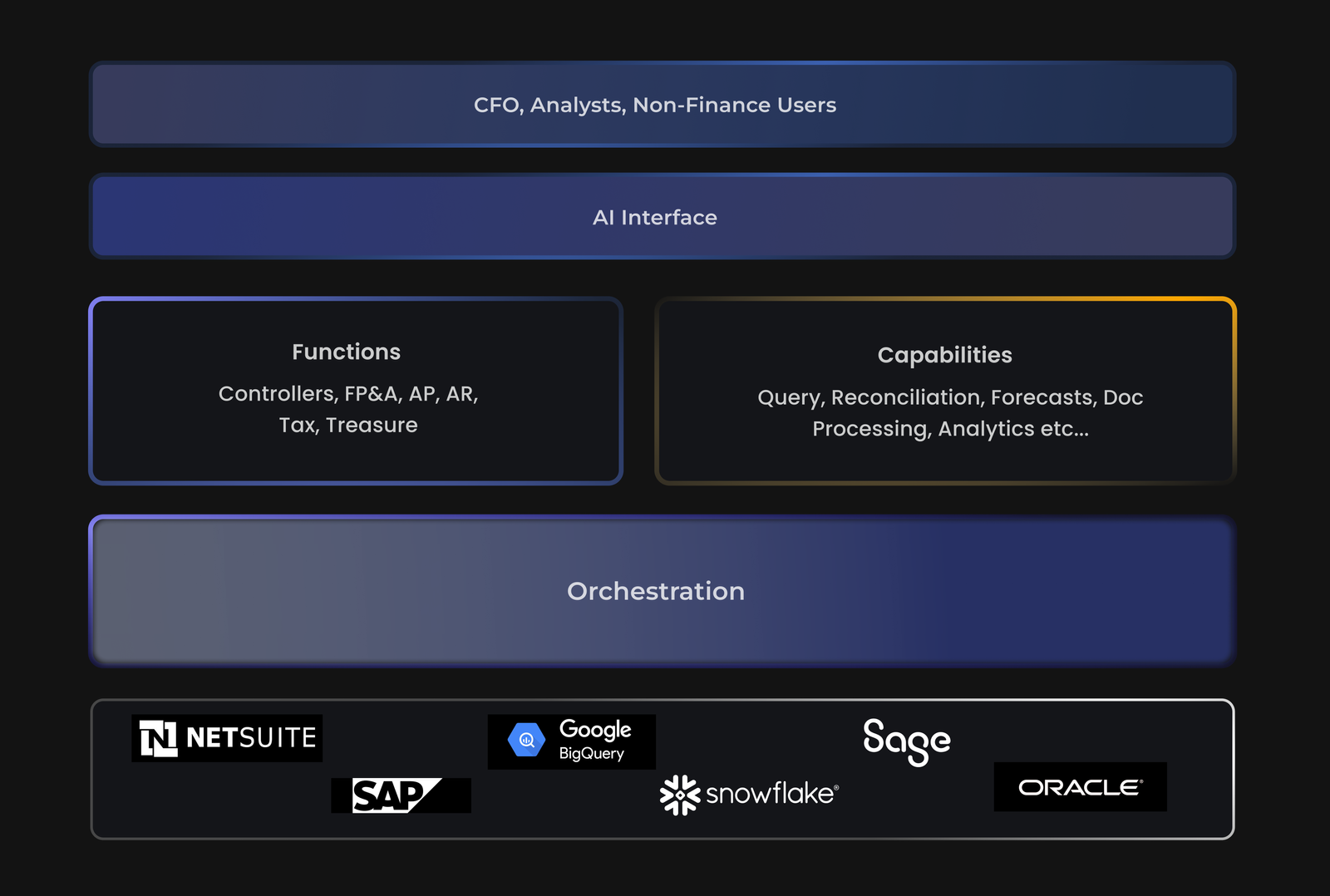
Artificial intelligence changes the conversation because it adds an architectural option that did not exist before. Instead of building every new capability inside B1, or paying a partner to, teams can place an intelligence layer above the system they already run.
SAP Business One exposes its data through supported interfaces, the Service Layer on HANA and the DI API on SQL. Rather than editing core objects or adding another add-on, the AI layer reads through those interfaces, interprets a request, executes an approved process, and returns the result through a conversational interface. B1 keeps doing what it does best: holding the transactions, protecting data integrity, and enforcing the rules.
Consider what this replaces. Today, a controller who wants to know which AR invoices are overdue and why opens a query, exports it, and pivots it. With an AI layer connected to B1, the question is asked directly and the answer comes back assembled from the underlying documents, with the drivers named. The same pattern covers purchase orders slipping past their delivery date, bank lines that have not matched against the statement, GL exceptions before the books close, and customers whose ordering behaviour has shifted. None of it requires a new add-on or a change request. It requires clean access, clear policy, and a system that knows the difference between reading a ledger and changing one. Our ERP AI integration checklist covers what to settle before the first connection is made.
Business knowledge moves outside the ERP
The more significant shift is about where new business logic lives. In a typical B1 estate, that logic is scattered: some in add-ons, some in formatted searches and user-defined fields, some in SDK code, and a good deal of it in the partner's head. Changing any of it is a change request with a cost and a wait.
An AI layer holds that logic as editable context instead. Approval thresholds, coding rules, close procedures, and the odd exceptions your business lives by can be supplied to the system directly and owned by the people who set them. It uses that context to guide users, automate repetitive work, generate recommendations, and coordinate across more than one system.
The practical effect is flexibility that B1 alone cannot offer. A policy changes without a partner ticket. The record stays stable while the interface adapts. This is the same argument behind platform agnostic AI: the intelligence should not be hostage to one vendor's release cycle, or to one partner's availability.
Most SAP Business One teams do not need a new system of record. They need to stop paying their partner for every question.
, Ashok ManthenaProtecting years of enterprise investment
Most B1 companies have put real money and years of effort into the estate they have. That investment is in the tuned chart of accounts, the industry workflows, the add-ons that make the platform fit, the report library, the master data, and the training that lets a small team run the whole thing. Replacing the platform usually means rebuilding most of that from a blank page.
An AI layer preserves it. The add-ons keep running, the Crystal Reports stay where they are, and the modernization shows up in how people reach the system rather than in a rebuild. That distinction matters most for teams whose migration plans are already underway, because the same layer can smooth a move to Version 11 or a two-tier consolidation rather than compete with it.
Support timelines belong in this conversation, because they are the honest reason many replacements get scheduled at all. Mainstream maintenance for SAP Business One 10.0 ends December 31, 2026, and SAP has not offered extended maintenance for it, with Version 11 set to follow. Worth being precise here: that date is version-specific, not an end of life for the product, so it is a prompt to plan a version move, not a signal to abandon B1. What the AI layer buys you is room to make that move on your own schedule, on top of a system that keeps earning its keep in the meantime, instead of under the pressure of a support cliff.

A practical modernization strategy
None of this makes modernization unnecessary. Some B1 companies genuinely have to move, because of the support timeline, a HANA decision that is already made, a regulatory requirement, or growth the current release cannot express. What AI changes is the timing and the urgency behind that decision.
Rather than launching a replacement mostly to gain usability, automation, or better reporting, evaluate first whether an AI layer delivers those gains on top of the B1 you run today. In most environments it can supply faster access to information, a conversational interface, intelligent recommendations, workflow automation, document processing, and cross system insight without a multi year program. That path lets a company modernize in increments while carrying far less risk.
The choice is no longer legacy versus modern. It is an architecture where a proven B1 estate stays the trusted record and AI provides the intelligence, flexibility, and experience people now expect. For where to point the first effort, the high impact AI use cases for the CFO office map the bottlenecks worth taking on early, and the controller's role shifts along with them.
One caution worth repeating: a general purpose assistant rarely survives contact with finance. The distance between summarizing a number and standing behind it is the same distance between a generalist copilot and a specialist finance system, and it is where most layered approaches on B1 come apart.
Keep SAP Business One. Change how the work gets done.
ChatFin runs as the AI layer above the SAP Business One you already use, on SQL or on HANA. It reads from B1 through its supported interfaces, applies your policy, and executes approved workflow across reconciliation, AP, AR, reporting, and month-end close, with final sign off left to a controller.
No core object changes, no new add-on in the critical path, no multi year cutover. Because autonomous finance only holds up when it lands cleanly in the system of record, every action is written back with its trail intact, which is what makes it defensible during an audit. See the full integration coverage if you want to check your stack.
The goal is not to retire a platform that still works. It is to stop making your team pay the interface tax, and the partner tax, on a system that already holds the truth.
Book a demoNot another add-on. One finance layer over B1.
Reconciliation, close, AP, AR, reporting, and document processing run in one workspace above SAP Business One, with 100+ pre-built agents and a shared audit trail. Tell us which B1 workflow hurts most and we will walk through it live.
Where SAP Business One reporting runs out
SAP Business One handles transactions well. These five gaps are documented, and every one of them ends in a spreadsheet.
No native consolidation. Multi company consolidation means exporting each company's reports and combining them in Excel, which is why close week reruns the same pack repeatedly.
No transaction currency reporting. Native reports cannot produce statements in transaction currencies, which makes reconciliation harder and slows period end.
One accounting standard per company. B1 assumes a single reporting standard per managed company, so running US GAAP and IFRS in parallel means manual adjustment at consolidation.
Rigid report formats. A chart of accounts change forces manual restructuring of income statement rows rather than the report adapting.
Weak statutory mapping. You can hold an external code per GL account, but there is no mapping to multiple alternate charts and no way to run statements on them.
An agent connected over the Service Layer reads across companies and answers the consolidated question directly, which is the step that currently happens in Excel.