
AI Without Replacing Your ERP
The old assumption was that a mature ERP eventually has to go. AI changes that math. It sits above the system of record, modernizes how people work with it, and leaves the transaction engine alone.

- Mature is not the same as obsolete. Most legacy ERP platforms are still trusted because their business logic has been proven across millions of transactions.
- Replacement is the expensive option. Panorama Consulting benchmarks put a mid-size implementation near 17 months, with roughly 55 percent of projects over budget and 68 percent past schedule.
- AI introduces a third path: a layer above the ERP that reads data, applies policy, and executes approved work through APIs rather than core code changes.
- Business knowledge moves out of the ERP. Policies, approval rules, and procedures live in the AI layer, so processes can change without touching the transaction engine.
- The support clock still matters. SAP ECC mainstream maintenance ends December 31, 2027, while Oracle has committed Premier Support for JD Edwards EnterpriseOne 9.2 into the late 2030s.
- Some migrations remain necessary. AI changes the timing and the pressure behind the decision, not the decision itself.
For years, enterprise software conversations ran on a single assumption: a legacy ERP eventually needs to be replaced. Teams running JD Edwards, SAP ECC, Oracle E-Business Suite, Dynamics NAV, SAP Business One, or a mature Sage estate were told that modern capability lives in the next cloud platform, and only there.
Cloud ERP earns that recommendation in plenty of cases. What it does not earn is a default. Replacements are among the most expensive and disruptive programs a company can take on, and many finish with new problems in place of the old ones. AI has quietly opened a third option, which is to modernize the experience and automate the work while the ERP itself stays where it is.
Mature does not mean obsolete
There is a habit of treating older software as outdated software. In practice, many established ERP platforms remain effective because they were built around the operational realities of their industries.
Manufacturers stay on JD Edwards for its production, inventory, and supply chain depth. Large enterprises still run SAP ECC environments shaped over decades of global complexity. Oracle E-Business Suite continues to carry finance, procurement, and asset management. SAP Business One and the Sage family still fit a wide band of mid-market operations.
These systems survived because they solve hard problems reliably. Over years, they accumulated mature workflows, proven security models, robust integration paths, and business logic refined across thousands of real implementations. Their weakness is usually presentation rather than function. The screens look dated, navigation takes more clicks, and the design language belongs to another decade. Underneath sits logic that has been tested against millions of transactions.
The interface aged. The business logic did not. Replacing a system because it looks old writes off the part that still works.
The hidden cost of replacement
Anyone who has finished a major migration knows that swapping enterprise software is never only a technology project. Moving from JD Edwards to another ERP, from SAP ECC to S/4HANA, or from E-Business Suite to Oracle Fusion means redesigning processes, migrating history, rebuilding integrations, retraining users, and testing at length before production traffic ever arrives.
The published benchmarks are sobering. Panorama Consulting research puts the average mid-size implementation around 17.4 months, about 3.6 months beyond plan, with roughly 55 percent of projects exceeding budget and 68 percent running long. Data migration is the most commonly cited challenge, and median time to return sits near two and a half years.
The technical lift is only half of it. Most mature environments carry custom reports, workflows, approval chains, integrations, and industry modifications that describe how the business actually runs. Every one of them raises the same set of questions during a migration.
Those decisions consume executive attention for years. Even well run programs often pass their second anniversary before the promised benefits show up in the numbers. A useful reference point on the AI side is our view on how long it actually takes to connect AI to an ERP, which is measured in weeks rather than fiscal years.
AI introduces a new layer
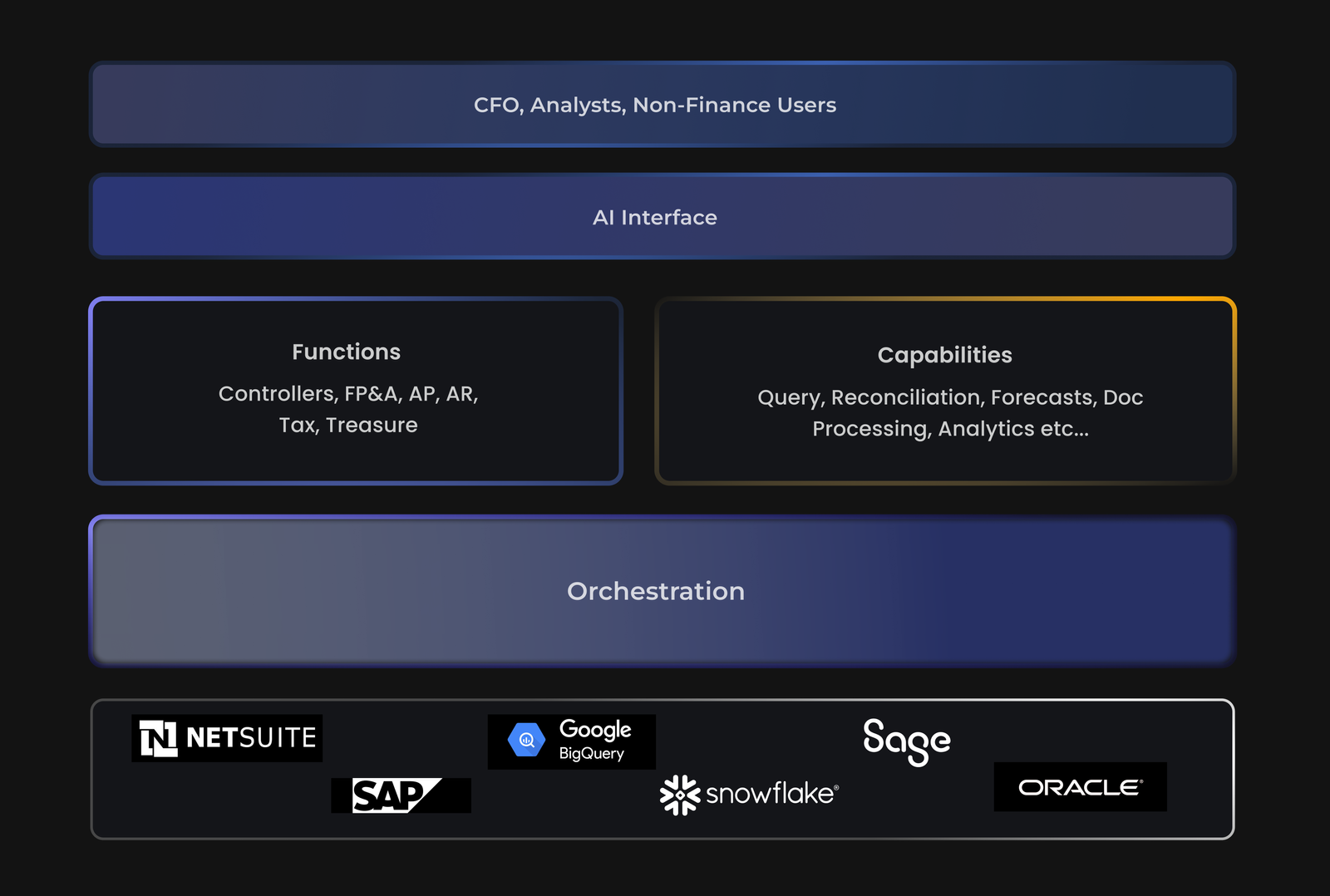
Artificial intelligence changes the conversation because it adds an architectural option that did not exist before. Instead of building every new capability inside the ERP, teams can place an intelligence layer above the systems they already run.
Modern platforms reach the ERP through APIs, integration services, and existing business workflows. Rather than editing core code or altering database structures, the AI layer consumes business data, interprets a request, executes an approved process, and returns the result through a conversational interface. The ERP keeps doing what it does best: managing transactions, protecting data integrity, enforcing rules, and holding the record.
Consider what this looks like in practice. A finance manager wants to understand unusual spend across business units. The traditional path means a report request, a dashboard change, or a custom query. With an AI layer connected to the ERP, the question can be asked directly, and the answer comes back assembled from the underlying transactions with the drivers identified. The same pattern covers purchase orders at risk of missing delivery, production orders waiting on inventory, customers with unusual ordering behavior, and approvals holding up the month-end close.
None of that requires new ERP development. It requires clean access, clear policy, and a system that knows the difference between reading a ledger and changing one. Our ERP AI integration checklist covers what to settle before the first connection is made.
Business knowledge moves outside the ERP
The more significant shift is about where new business logic lives. Adding functionality used to mean extending ERP workflows through configuration or custom code. Both routes add long term complexity, complicate upgrades, and build technical debt that compounds quietly.
Now a large share of that logic can sit in the AI layer instead. Process documentation, operating policies, approval thresholds, standard procedures, and domain knowledge can be supplied to the system directly. It uses that context to guide users, automate repetitive activity, generate recommendations, and coordinate work across more than one system.
The practical effect is flexibility. Processes keep evolving without a change request against the ERP. The record stays stable while the interface adapts. This is the same argument behind platform agnostic AI: the intelligence should not be hostage to one vendor's release cycle.

Most companies do not need a new system of record. They need a better way to work with the one they already trust.
— Ashok ManthenaProtecting years of enterprise investment
Most enterprises have poured budget and years of effort into configuring their ERP environment. That investment covers process design, industry specific workflows, security models, master data governance, financial controls, regulatory compliance, integration architecture, and training. Replacing the platform usually means rebuilding much of that institutional knowledge from a blank page.
An AI layer preserves it. The workflows that were tuned over a decade keep running, and the modernization shows up in how people reach them. That distinction matters most for teams whose migration plans are already underway, because the same layer can smooth the transition rather than compete with it.
Support timelines belong in this conversation as well, since they are the honest reason many replacements get scheduled. SAP has set mainstream maintenance for ECC 6.0 to end on December 31, 2027, with paid extended maintenance available through 2030 for the final enhancement packages and a narrower window beyond that under RISE. Oracle has moved the other way, keeping Premier Support for JD Edwards EnterpriseOne 9.2 and E-Business Suite 12.2 available well into the 2030s under its continuous innovation model. Two very different clocks, and each one changes what an AI layer is buying you: breathing room in one case, durable extension in the other.

A practical modernization strategy
None of this makes ERP modernization unnecessary. Some organizations genuinely have to move because of vendor support timelines, infrastructure constraints, regulatory requirements, or a business model the current platform cannot express. What AI changes is the timing and the urgency behind the decision.
Rather than pursuing a replacement primarily to gain usability or incremental capability, evaluate first whether an AI layer delivers those improvements on top of what you run today. In many environments it can supply faster access to information, a conversational interface, intelligent recommendations, workflow automation, document processing, and cross system insight without a multi year transformation. That path lets a company modernize in increments while carrying far less implementation risk.
The choice is no longer legacy versus modern. It is an architecture where proven ERP platforms stay the trusted record and AI provides the intelligence, flexibility, and experience people now expect. For where to point the first effort, the high impact AI use cases for the CFO office map the bottlenecks worth taking on early, and the controller's role shifts along with them.
One caution worth repeating: a general purpose assistant rarely survives contact with finance. The distance between summarizing a number and standing behind it is the same distance between a generalist copilot and a specialist finance system, and it is where most layered approaches fail.
Keep the ERP. Change how the work gets done.
ChatFin runs as the AI layer above the system you already use, including NetSuite, Sage Intacct, Dynamics 365, Acumatica, SAP Business One, and JD Edwards. It reads from the ERP through supported interfaces, applies your policy, executes approved workflow across reconciliations, AP, AR, reporting, and month-end close, and leaves final sign off with a controller.
No core code changes, no database restructuring, no multi year cutover. Because autonomous finance only holds up when it lands cleanly in the system of record, every action is written back with its trail intact, which is what makes it defensible during an audit. See the full integration coverage if you want to check your stack.
The goal is not to retire a platform that still works. It is to stop making your team pay the interface tax on a system that already holds the truth.
Book a demoNot six tools. One finance system.
Reconciliation, close, AP, AR, reporting, and document processing run in one workspace, with 100+ pre-built agents and a shared audit trail. Tell us which workflow hurts most and we will walk through it live.