
AI Should Eliminate Repetitive Finance Work, Not Just Improve It: The Capacity Recapture Imperative
20% faster reconciliation is the wrong goal. Finance teams that eliminate repetitive tasks entirely recapture 40 to 60% of capacity for analysis and strategy. Leading CFOs are reframing AI success: not productivity improvement, but task elimination.
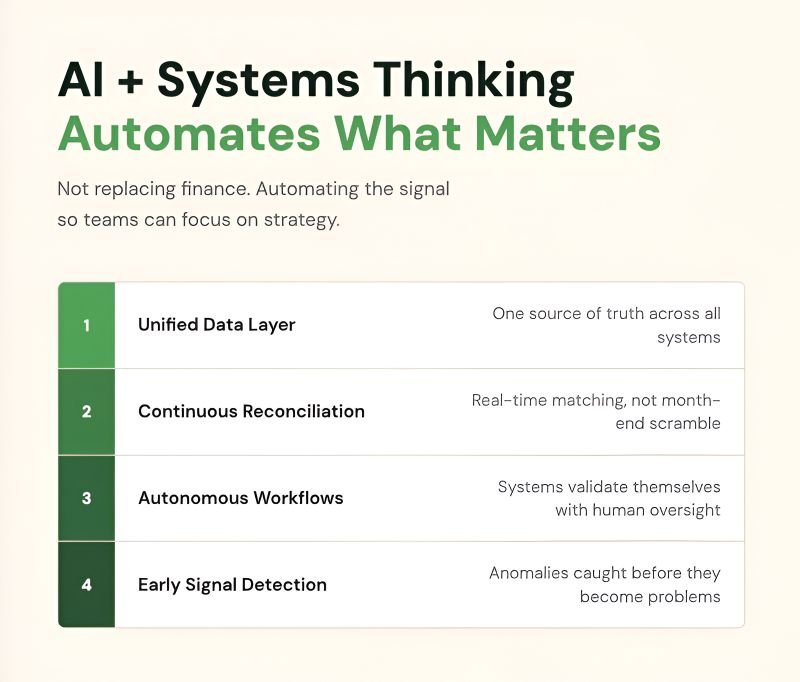
- Finance Time Allocation Finance teams spend 60 to 70% of their time on data gathering, formatting, and low-value reporting. This work should be eliminated, not accelerated.
- Task Elimination Potential McKinsey research shows automation can eliminate 42% of finance tasks entirely. Not improve them. Eliminate them completely.
- Capacity Recapture When repetitive tasks are eliminated, teams recapture 40 to 60% of capacity for analysis, forecasting, and strategic partnership with the business.
- ROI and Satisfaction CFOs targeting task elimination report 2x higher team satisfaction and automation ROI compared to those pursuing productivity improvements alone.
- Strategic Elevation Elimination-focused AI strategies shift finance teams from tactical execution to strategic partnership. The profession elevates.
Finance teams measure AI success wrong. They celebrate 20% faster reconciliation. A CFO reports "we close the books in 8 days instead of 10." That is not a transformation. That is optimization of waste.
The right measure: eliminate the task entirely. Stop reconciling manually. Stop gathering data in spreadsheets. Stop formatting reports. AI should delete those workflows from the operating model, not accelerate them.
The Productivity Trap in Finance AI
Finance leaders fall into a trap: they look for ways to speed up existing work. Faster close. Quicker reconciliation. More efficient reporting. Finance teams spend 60 to 70% of their time on data gathering, formatting, and low-value reporting. The wrong question is how to do those things faster.
The right question is whether the team should do them at all. A 20% improvement in a low-value task is still a low-value task. The team is still constrained to tactical work instead of strategic partnership.
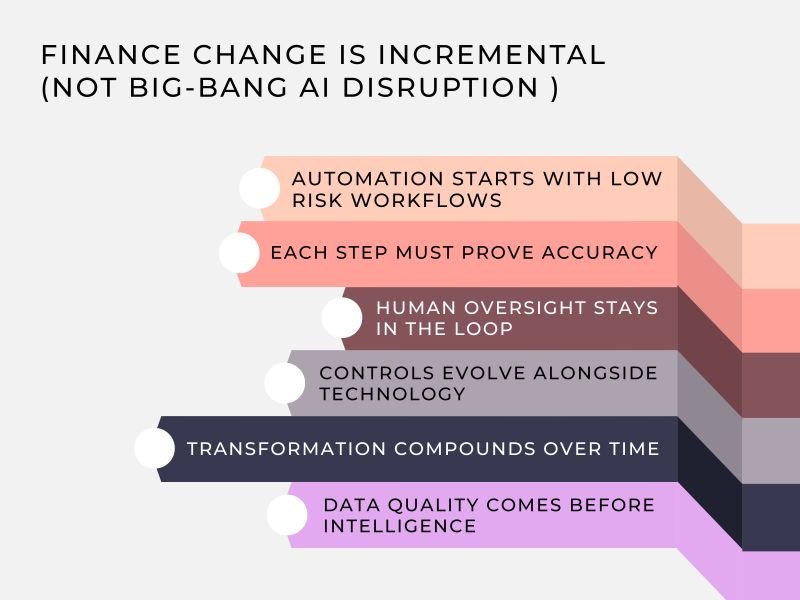
What Elimination vs. Improvement Looks Like in Practice
Automation can eliminate 42% of finance tasks entirely, not just reduce their time. That distinction changes everything. Consider reconciliation: an improvement approach speeds up the manual work. An elimination approach removes it entirely.
Improvement: "We reconcile in 2 days instead of 3." Elimination: "The GL auto-reconciles. We spend zero days on reconciliation and redirect those resources to variance analysis and forecasting." One is optimization. The other is transformation.
Tasks That Should Be Fully Automated by 2026
Finance organizations should eliminate these categories of work entirely by the end of 2026. CFOs who target task elimination report 2x higher team satisfaction and automation ROI. The ROI is not just financial. It is retention and morale.
How Finance Teams Recapture Capacity
The power of elimination is capacity recapture. When reconciliation disappears, where does that time go? Strategic work. Teams that eliminate repetitive tasks report recapturing 40 to 60% of capacity for high-value analysis. That recapture is transformational.
A 5-person accounting team spends 3 people-months per quarter on reconciliation and reporting. Eliminate those tasks, and you recapture 3 people-months. That is capacity for forecasting, planning analysis, cash flow modeling, and strategic partnership with the business.
Optimization of a low-value task is still low-value work. Elimination of repetitive work is transformation.
The Finance Profession Elevates When Work Is Eliminated
Organizations eliminating repetitive tasks see a side benefit: finance professionals want to stay. Accounting for data entry is soul-crushing. Variance analysis and strategic forecasting is intellectually engaging. When AI eliminates the grunt work, the profession becomes attractive again.
Finance teams at companies eliminating repetitive work report higher satisfaction, lower turnover, and stronger business partnership. The elimination strategy attracts talent. The improvement strategy burns them out faster.
Stop Optimizing Low-Value Work. Start Eliminating It.
Finance leaders should measure AI success not by speed but by elimination. How many reconciliation processes vanished? How many variance reports became fully automated? How much capacity did teams recapture?
The finance teams winning in 2026 are not 20% faster at the same work. They eliminated the work entirely and redirected their people to strategy, analysis, and partnership. That is the transformation CFOs should pursue.
Research & Sources
The ChatFin Advantage
ChatFin is built on elimination, not improvement. The platform automates entire task categories, not just accelerates existing workflows. Reconciliation agents eliminate manual GL matching. Coding agents eliminate data entry. Variance agents eliminate low-value reporting. The finance team recaptures 40 to 60% of capacity for strategic work.
Learn more: AP Automation Guide