
AI Cut Manual Invoice Work From 100% to 7%: What Finance Teams Can Learn From the Latest Data
New data from Meta, Billtrust, and Gartner confirm what leading finance teams already know: AI is compressing close cycles, cutting collections backlog, and shifting finance from manual processing to strategic decision-making. Here is what the numbers actually say.
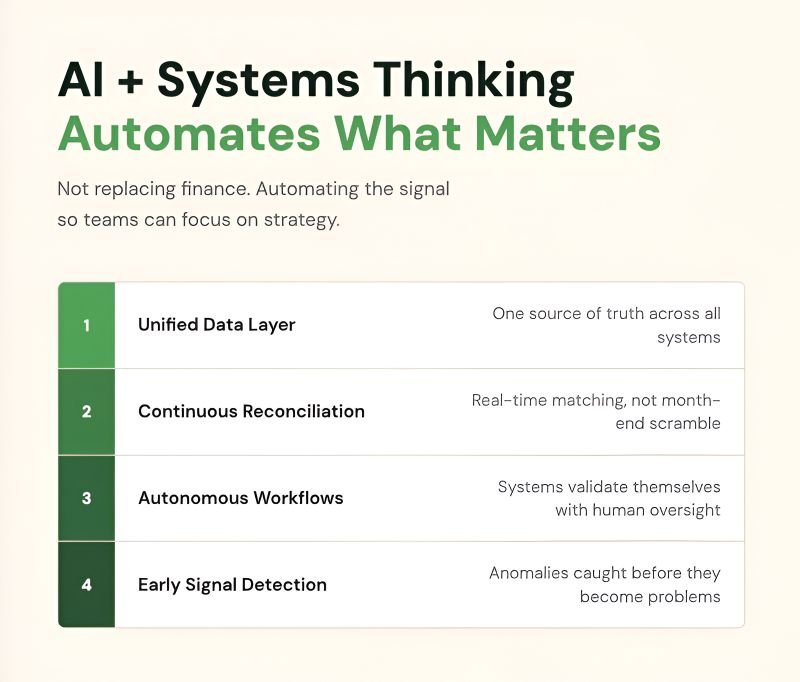
- The Meta Benchmark Agentic AI dropped manual invoice intervention from 100% to 7% within 7 days, compressing a 10-day procurement cycle toward a single day.
- AR Transformation 99% of companies using AI in accounts receivable reduced Days Sales Outstanding, with 75% seeing drops of 6 or more days.
- ERP First 56% of CFOs want AI embedded directly in existing ERP platforms, not layered on as standalone tools.
- The Execution Gap Only 7% of CFOs report strong AI impact. The gap is not the technology. It is process redesign and change management.
- Gartner's Close Prediction Embedded AI in cloud ERP will drive a 30% faster financial close by 2028.
- Competitive Urgency AI spend in finance technology is expected to reach $22.6 billion. Finance teams that delay risk compounding disadvantage.
The financial close is changing faster than most finance teams realize. What used to take 10 days is now done in 3. What used to require constant manual intervention is running at 7% human touchpoints. The benchmark has been set. The risk is whether your finance team is moving toward it or watching it happen at competitors.
What 7% Manual Intervention Actually Means
Meta processes 600,000 invoices monthly. Before deploying agentic AI, 100% required manual field editing. Within 7 days of deployment, that dropped to just 7%. The fields needing human correction collapsed from 30 down to 3 or 4. Their stated goal is a single-day procurement cycle, compressed from 10 days.
The insight most teams miss: Meta spent 18 months redesigning processes before deploying a single AI tool. The AI did not create the efficiency. Disciplined process design made the AI effective. Automation applied to broken workflows just produces broken results faster.
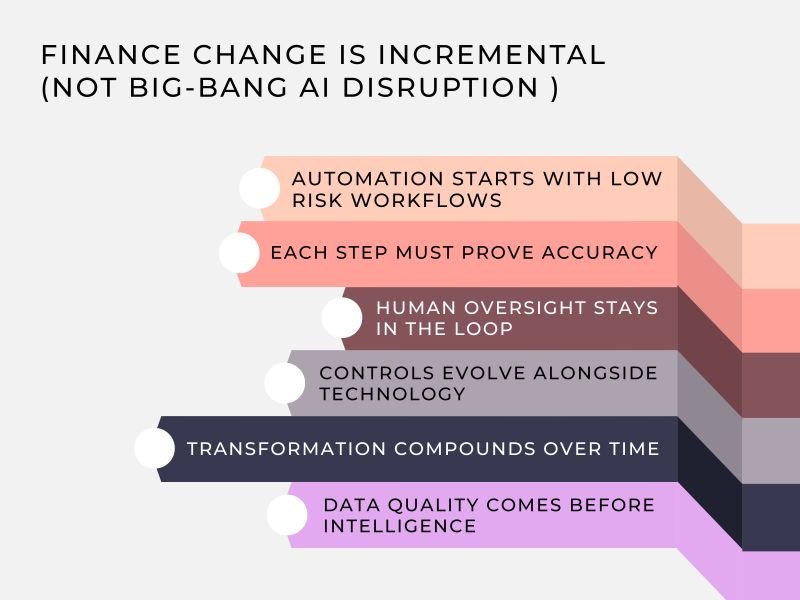
Fix the process, then count the return
The return on this work comes from the process being repaired, which is a different question from what the software costs.
My accounting process is a colossal mess. So I do an ROI on the process fix.
Vin Messina, on the AgentCFO podcast
Measure your current cost per invoice and the exception rate. Without those two numbers the business case stays vague.
Collections and AR: The Data Is In
99% of companies using AI in accounts receivable reduced Days Sales Outstanding. 75% saw DSO drop by 6 or more days. 82% improved productivity and scalability without adding headcount. These are not projections from a vendor whitepaper. They are reported outcomes from real deployed systems, documented in Billtrust's 2025 State of AI in Accounts Receivable study.
ERP Integration: Where Finance Leaders Actually Want AI
There is a consistent disconnect between how AI tools are marketed and where CFOs actually want them deployed. The 2025 L.E.K. Consulting Office of the CFO survey found that 56% of CFOs want AI embedded directly in existing ERP systems, not bolted on as a separate layer of tools. That preference is not about convenience. It is about data integrity, governance, and the reality that standalone tools create more integration work, not less.
Gartner's 2026 research confirms this direction: embedded AI in cloud ERP will drive a 30% faster financial close by 2028. The organizations reaching that benchmark will be the ones that integrated AI into existing workflows rather than layering new tools on top of old processes and hoping adoption follows on its own.
"A task that used to take three hours now takes 15 minutes." - CFO, L.E.K. 2025 Office of the CFO Survey
The Execution Gap: Why Most Teams Are Still Waiting
Here is the uncomfortable number: only 7% of CFOs report strong impact from their AI investments, even though nearly 60% are actively piloting or deploying AI tools. The technology is not the problem. Execution is what separates teams that see results from teams that run another pilot that quietly gets deprioritized.
Finance teams that achieve strong results share a consistent pattern: they redesign the process first, define what strong impact looks like before signing any contract, and treat AI adoption as a change management challenge as much as a technology one. The organizations closing books in 3 days did not start with software. They started with absolute clarity on what they needed to change and why.
The Close Cycle Is Compressing
Gartner predicts it. Meta demonstrates it. Billtrust quantifies it. AI is compressing financial close cycles, reducing manual AR work, and shifting finance teams toward the strategic work that actually moves the business forward.
Finance teams that move now are setting the benchmarks their competitors will spend 2027 trying to match. The gap between the leaders and everyone else is already wider than most finance leaders realize.
The ChatFin Advantage: Enterprise Finance Automation Platform
ChatFin is a finance AI super-agent platform that runs directly inside your ERP - NetSuite, SAP, Oracle, or Acumatica. Unlike disconnected point solutions that create more integration work, ChatFin connects AP, AR, reconciliation, forecasting, and compliance in a single autonomous system. With 100+ pre-built finance agents, ChatFin teams deploy agentic automation in weeks, not months. The platform learns your workflows, handles exceptions intelligently, and surfaces only true anomalies for human review.
Organizations deploying ChatFin report measurable results: 40-60% reduction in close cycle time, 80%+ automation rates on exception handling, and finance teams freed from tactical work to focus on strategic priorities. ChatFin does not replace finance judgment. It eliminates the mechanical work that masks it.
Learn more: Financial Close Automation: Transform Your Month-End Process in 2026
Additional resource: The Finance AI Stack 2026: Every Tool CFOs Are Using Across Close, AP, AR, FP&A and Reporting