
AI Agents as Digital Coworkers: How Companies Built 20,000 Virtual Employees in 2026
McKinsey now operates with 20,000 AI agents alongside 40,000 human employees. By 2026, 80% of enterprise applications will embed AI agents as digital coworkers. Here's how this shift is reshaping how teams work.
- Virtual Workforce Scale McKinsey reached 20,000 AI agents, planning to reach parity with 40,000 human employees by end of 2026.
- Enterprise Adoption 80% of enterprise applications expected to embed AI agents as digital coworkers by 2026.
- Collaborative Model AI agents are enablers and multipliers, not replacements. Small teams now punch above their weight.
- Autonomous Capability AI agents can plan, execute, analyze, and produce outputs without step-by-step human instruction.
- Speed to Impact A three-person team can now launch a global campaign in days using AI agent support.
The definition of a workforce is changing. It is no longer just the people you employ. In 2026, the workforce includes the AI agents that work alongside your team. McKinsey CEO Bob Sternfels revealed the firm now operates with a hybrid workforce: 40,000 humans and 20,000 agents. The goal is to reach parity—40,000 humans, 40,000 agents—before the end of 2026.
From Tool to Coworker
AI agents are no longer just tools that analyze data or answer questions. They are digital coworkers that plan, execute, analyze, and produce outputs autonomously, without step-by-step human instruction. This shift from AI-as-tool to AI-as-coworker is the defining trend of 2026.
Traditional AI required humans to frame questions, interpret results, and take action. AI agents operate differently. They understand context, make decisions within defined bounds, execute workflows across systems, handle exceptions intelligently, and report outcomes. They are collaborative partners, not passive responders.
The McKinsey Model: Scale Without Proportional Headcount Growth
McKinsey is not planning to hire 20,000 more people. Instead, 20,000 AI agents are handling work that previously required human labor. But this is not a story about job elimination. It is a story about capacity multiplication.
The firm's strategy shows a new operating model: deploy agents for high-volume, repetitive cognitive work, and redeploy human consultants to higher-value client work. The humans focus on strategy, creativity, and judgment. The agents handle execution, analysis, and reporting.
Enterprise Applications: 80% Will Embed Agents by 2026
This is not McKinsey-specific. By 2026, an estimated 80% of enterprise applications will embed AI agents as digital coworkers. This means agents will be native to the software you already use—not bolted on.
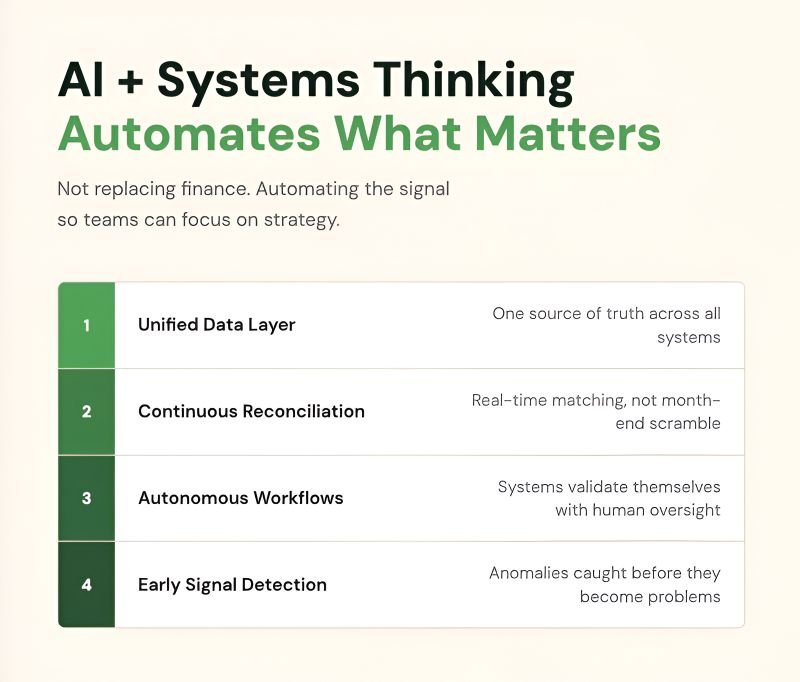
When agents are embedded in your enterprise resource planning (ERP), customer relationship management (CRM), or finance systems, they become part of the operating model. Finance teams will have agents handling reconciliation, variance analysis, and forecasting. Sales teams will have agents managing pipeline, forecasting, and customer outreach. Operations teams will have agents optimizing supply chain and logistics.
"A three-person team armed with AI agents can now launch a global campaign, manage vendor relationships, and scale operations in ways that used to require fifty people." - McKinsey Insights 2026
The Skills for Teams Working With AI Agents
If agents are now coworkers, the skills needed to lead teams change. Managers are no longer just directing human output. They are designing agent workflows, monitoring agent performance, handling agent exceptions, and making judgment calls on agent recommendations.
The Finance Team Advantage
Finance teams have an immediate advantage with agent adoption. Finance work is highly structured, rule-based, and repetitive. Agents excel at exactly this type of work. A finance team with AI agents can:
Close monthly in hours, not days. Agents reconcile accounts, detect variances, post journal entries, and generate disclosures in parallel. Human finance professionals validate and interpret.
Forecast continuously. Instead of one forecast per quarter, agents run rolling forecasts that update as actuals come in, providing real-time visibility.
Detect anomalies instantly. Agents monitor every transaction in real-time, flagging fraud, duplicate payments, or policy violations before they become problems.
The Digital Coworker Era Is Here
The question is no longer "Will AI agents impact my team?" The answer is yes, and 2026 is the inflection point. The question now is "How will we design our work so AI agents multiply our impact?"
Organizations that view AI agents as coworkers—and redesign workflows accordingly—will outpace those still treating AI as a tool. The competitive advantage goes to teams that learn to work alongside their digital coworkers.
ChatFin: Your AI Agent Partner for Finance Operations
ChatFin is built on the principle that AI agents are coworkers, not tools. ChatFin's agentic AI runs inside your NetSuite, SAP, Oracle, or Acumatica ERP as a true digital employee that handles close cycles, reconciliation, forecasting, and compliance without step-by-step prompting. Unlike traditional AI that requires constant human direction, ChatFin agents autonomously execute finance workflows, make decisions within policy bounds, handle exceptions intelligently, and continuously improve.
Finance teams deploying ChatFin report they are operating at McKinsey-like efficiency gains: 40-60% reduction in close cycle time, 80%+ automation on routine tasks, and finance teams freed from execution work to focus on strategy and business partnership. ChatFin does not replace finance judgment. It multiplies finance impact by eliminating the manual work that masks it.
Learn more: Agentic AI in Finance: Why Agents Are the Future of Finance Operations
Additional resource: Building High-Performance Finance Teams With AI Agent Collaboration