
Agentic AI in Finance: 82% Deploy, But Only 7% See Strong ROI. Here Is Why.
82% of midsize companies and 95% of PE firms have deployed agentic AI. Yet only 7% of CFOs report strong ROI. Gartner warns 40% of projects will be cancelled. Here is the reality gap between deployment and results.
- The Adoption Boom 82% of midsize companies have begun or plan agentic AI implementation in 2026.
- The ROI Gap Only 7% of CFOs report strong impact. Most deployments are narrowly scoped or pilot-stage.
- Project Attrition Gartner predicts 40% of agentic AI projects will be cancelled by end of 2027 due to cost and unclear ROI.
- Close Cycle Compression Leading companies compress close from 6.2 days to 1.8 days with multi-agent workflows.
- Compliance Gains Fraud detection platforms report 93% fewer false positives and $10M+ analyst time savings per deployment.
The numbers sound impressive: 82% of midsize companies deploying agentic AI, 95% of PE firms jumping in, 90% of finance functions expected to deploy AI by 2026. But there is a hidden truth in those numbers. Most of those deployments are pilots or narrowly scoped. Most are not delivering ROI. This is the reality gap between "deployed" and "working."
Deployed Does Not Mean Delivering ROI
While 82% of midsize companies have begun or plan agentic AI implementation, only 7% of CFOs report strong ROI from their investment. The gap is not between early adopters and laggards. It is between companies that deployed a solution and companies that designed a system.
What does "deployment" mean? For many companies, it means:
A vendor implementation of a single agent handling one process (AP automation, for example). The agent works. It reduces manual data entry. But it is not integrated into the finance workflow. It is not orchestrated with other agents. It does not drive close cycle compression or strategic insights.
This is not failure. It is the first step. But it is also why only 7% report strong ROI while 82% have "deployed."
Deployment without a defined problem
Projects get funded on the technology and stall because nobody stated which process was supposed to change.
But the problem I see is everybody's jumping into AI without contemplating that one basic concept.
Vin Messina, on the AgentCFO podcast
Write the problem statement before the pilot, in one sentence, with the number it is meant to move.
The Reality: 40% of Projects Will Be Cancelled
Gartner issued a stark warning in 2026: over 40% of agentic AI projects will be cancelled by end of 2027. The reasons are telling:
What the Winners Are Doing Differently
So what separates the 7% that are seeing strong ROI from the 82% that deployed but did not? Here are four things:
1. Multi-Agent Orchestration, Not Single Agents
Companies seeing real close cycle compression (6.2 days down to 1.8 days) are using 4-8 specialized agents working together. A reconciliation agent, a variance agent, a journal entry agent, a disclosure agent, and an orchestrating agent that coordinates them. Single agents are useful. Multi-agent systems are transformational.
2. Business Process Redesign, Not Process Automation
Companies that automated existing processes kept existing overhead. Companies that redesigned processes around what agents do eliminated overhead. Example: Instead of "accounts payable team enters invoice data, system flags duplicates, team investigates," the redesign is "agents extract invoice data, detect duplicates, flag only exceptions, team approves batch." The process changed. The overhead dropped 70%.
3. Governance as Architecture, Not Afterthought
Winning deployments embed governance into agent design from day one. What policies should agents follow? What exceptions need escalation? What audit trail is required? These are design questions, not implementation problems. Governance designed in is scalable. Governance bolted on is brittle.
4. Continuous Measurement Against Business Outcomes, Not Task Metrics
Failed deployments measure "hours saved" or "transactions processed." Winning deployments measure "close cycle compressed," "forecast accuracy improved," "anomalies detected earlier," "capital deployed faster." The difference is profound. One measures activity. The other measures impact.
"Most companies deploy agentic AI to do faster what they already do. The winners deploy it to do differently what they always did. That mindset difference is why 7% see ROI while 82% deployed." - Gartner Agentic AI Research 2026
Where Real Impact Is Emerging: Fraud and Compliance
One area where agentic AI is delivering unambiguous ROI: fraud detection and compliance automation. Here, the wins are measurable and significant:
Why does compliance automation deliver ROI while process automation struggles? Because compliance has clear metrics: false positives, false negatives, throughput. When agents reduce false positives by 93%, the ROI is obvious. When agents "reduce data entry," the ROI is ambiguous.
The Question Every CFO Should Ask
If your company is in the 82% that deployed, ask this question: "Are we automating existing processes, or redesigning processes around what agents do?" The answer determines whether you are in the 7% seeing ROI or the 93% paying for pilots.
Deployment Is Not the Same as Transformation
The agentic AI moment is real. But the moment lives in the gap between "we deployed a tool" and "we redesigned how we work." Most companies are on the deployment side of that gap. The 7% who see ROI have crossed it.
The question for 2026 is not whether to deploy agentic AI. The question is whether you will redesign your finance operations around what agents can do—or just automate what you already do faster. One drives ROI. The other drives cost.
ChatFin: Multi-Agent Architecture Built for Real Impact
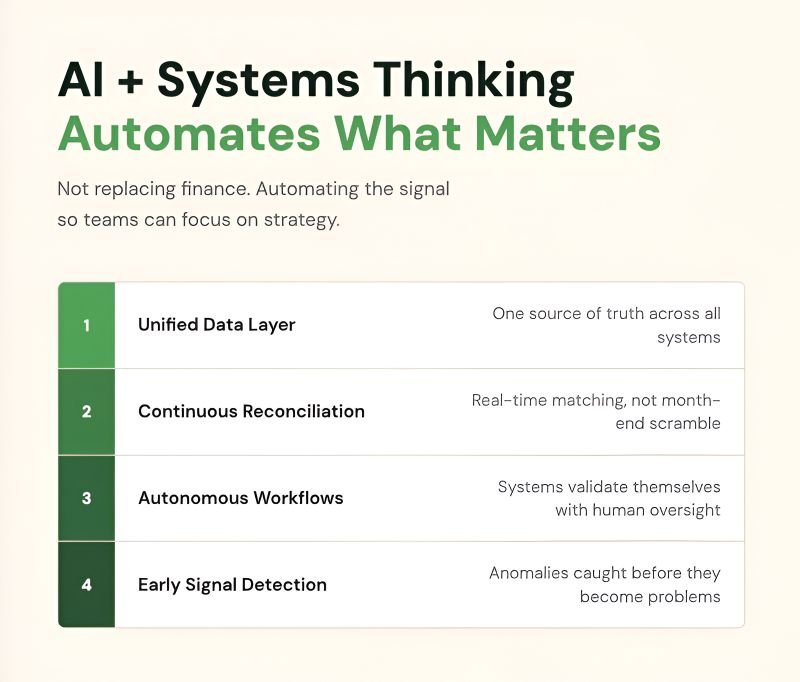
ChatFin is built on multi-agent orchestration, not single-process automation. Rather than replacing one spreadsheet with an agent, ChatFin coordinates 100+ specialized agents working together to compress your entire close cycle, detect anomalies in real-time, and surface strategic insights. The difference is immediate: 40-60% close cycle reduction, 80%+ automation on exception handling, and finance teams free to focus on what matters.
Unlike pilots that automate one process, ChatFin agents redesign how finance operates end-to-end. Reconciliation, variance analysis, journal entries, disclosures, compliance reporting—all orchestrated as one autonomous system, measured against business outcomes, with governance built in from the start.
Learn more: Multi-Agent Orchestration: How to Compress Your Close Cycle from 6 Days to 1.8 Days
Additional resource: Why 40% of Agentic AI Projects Fail (and How to Join the 7% That Succeed)